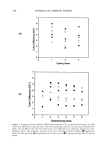
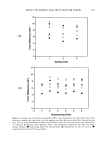
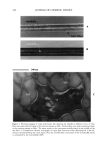
504 JOURNAL OF COSMETIC SCIENCE THE ROLE OF VERNIX CASEOSA IN NEONATAL ADAPTION Marty O. Visscher The Skin Sciences Institute, Cincinnati Children • Hospital Medical Center Vernix caseosa is a complex proteolipid material, unique to humans, which is synthesized in part by fetal sebaceous glands during the last trimester of pregnancy. Prenatally, vernix provides a thin, hydrophobic, surface film surrounding the fetus that protects the developing skin from maceration and the deleterious effects of water and urine. Vernix is believed to play a pivotal role in epidermal barrier development, nutrition and intestinal maturation prior to birth. Premature infants lack vernix and struggle to form an adequate epidermal barrier after birth and are susceptible to nosocomial and community acquired infections. Investigations of the composition and functional parameters of vernix demonstrate that it is important for innate immunity and neonatal adaptation at birth. The goal of our research goal was to provide the scientific basis for leaving vernix in place at birth and to establish the basis for evaluating 'vernix equivalents' on premature infants. The older literature contains sporadic reports of vernix as a potential wound healing ointment. The regulation of transepidermal water gradient is known to be important for epidermal barrier formation and regeneration following wounding. Data generated using human skin culture systems demonstrates a direct effect of vernix overlying cultured skin substitutes to increase glucose consumption and lactate production. These findings are consistent with a role of vernix to stimulate epidermal metabolism with potential effects on wound healing. At birth, vernix on the fetal skin surface is presumably transferred to the perineum of the mother during the birth process. Moreover, the formation of the epidermal barrier in utero has strong analogies to healing of an open wound. Newborn infants are known to undergo desquamation after birth with formation of a dry skin surface. Whether this desquamatory process is secondary to removal of vernix with resultant abnormal generation of natural moisturizing factor (NMF) is as yet unknown. It has also been shown that vernix when applied to adult volar skin increases transepidermal water loss and has an increased ability to bind exogenous water. Given, the high water content of vernix, and the above mentioned properties we hypothesized that vernix plays a significant role in neonatal skin adaptation as the baby enters the terrestrial world. We used non-invasive biophysical and optical techniques to evaluate neonatal skin condition objectively, by enrolling near term infants in a randomized clinical trial. We report the results of investigations of five aspects of vernix caseosa: the role in innate immunity, antioxidant properties, skin surface distribution at birth, thermal regulation, and skin surface adaptation dunng the immediate post birth period. The data indicate that vernix contains anti-infective materials, including surfactant proteins, SP-A and SP-D, and lysozyme. The anti-oxidant properties were attributed to the presence of a-tocopherol. A quantitative determination among a group of 430 newborns indicated that vernix skin surface coverage was generally higher for the lower gestational age infants, higher for the c-section infants, higher for females, higher for white infants, and lower in infants exposed to meconium. Preservation of vernix on the skin surface at birth had no effect on thermal stability of the infants, compared to a

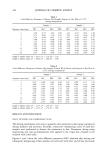
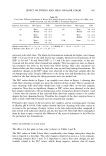
2004 ANNUAL SCIENTIFIC SEMINAR 505 group of controls for whom vernix was removed. Retention of vernix on the infant skin surface following birth resulted in significantly different biophysical properties when compared to those of infants for whom vernix was removed at birth. The rate of stratum corneum (SC) moisture accumulation was significantly higher for the vernix treated skin (back site) at birth and 24 hours later. The baseline SC hydration was significantly higher at birth (chest and back sites) for the vernix treated group than for the vernix removed group. The skin surface pH was significantly lower with vernix treatment both initially and at 24 hours for the back. The observed effects of vernix on SC pH are potentially attributable to components within vernix and/or to their breakdown products. The implications of the pH changes on SC barrier characteristics are discussed. The findings suggest that it is appropriate to leave vernix in place at birth, to minimize its removal during bathing, and to evaluate "vernix equivalents" to facilitate epidermal barrier development and infection control in preterm infants.
Purchased for the exclusive use of nofirst nolast (unknown)
From: SCC Media Library & Resource Center (library.scconline.org)