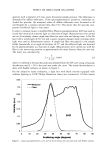
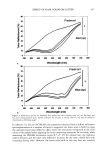
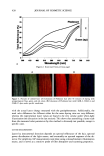
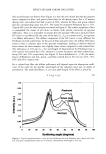
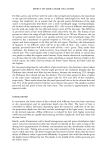
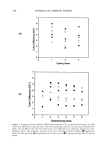
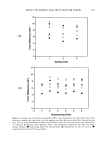
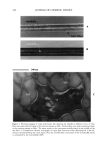
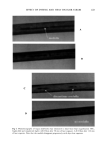
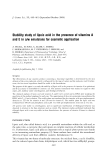
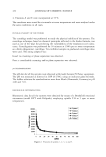
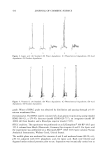
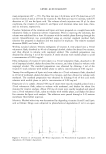
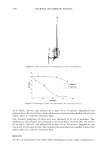
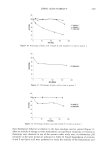
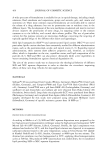
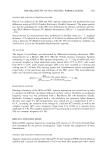
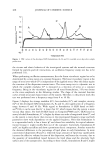
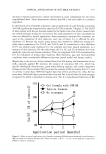
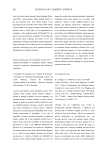
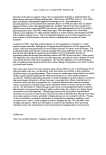
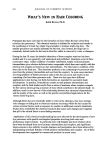
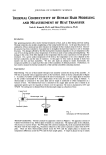
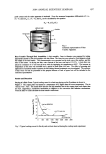
EFFECT OF HAIR COLOR ON LUSTER 427 8O 7O • 60 r- 50 m 4O o 2o lO 0 i 350 400 8O Piedmont i i i i i i l 450 500 550 600 650 700 750 Red (sp) Wavelength (nm) 80O 7O • 60 r- 50 m 4O 0 2O 10 Piedmont Blue (sp) 0 • i i i i [ i l 350 400 450 500 550 600 650 700 750 800 Wavelength (nm) B Figure 2. Reflectance spectra for Piedmont hair before and after coloring with (A) red, (B) blue, and (C) green semipermanent dyes. Arrows indicates the increase in dyeing time (5, 20, and 45 minutes). (Continued on following page) In reference (7), the use of CIELAB color parameters obtained from a diffuse reflectance spectrophotometer as a measure of luster is suggested: the luster scale is built by using the calculated total color difference (AE), where the zero-luster corresponds to the color values of the sample before applying the luster-improving treatment. In our study, when measuring the CIELAB tristimulus values (L*, a*, b*) for colored hair, the lightness indeed decreases and the total color difference increases for the same colored hair with increasing dyeing time. However, the luster scale built in this way does not correlate

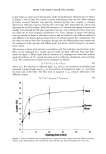
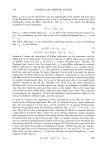
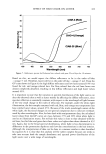
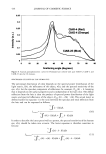
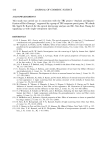
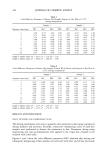
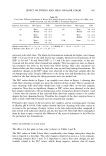
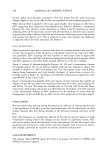
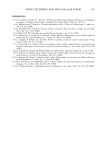
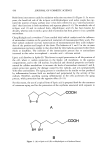
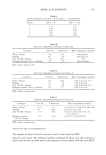
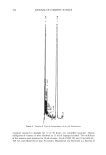
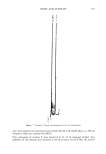
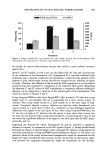
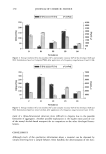
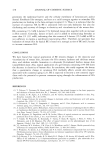
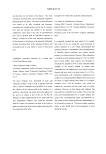
428 JOURNAL OF COSMETIC SCIENCE 80 ._.70 Piedmont •6o t • 30 Green (sp) 2o lO o , 360 C 410 460 510 560 610 660 710 760 810 Wavelength (rim) Figure 2. (Continued from previous page) A B Figure 3. Pictures of colored hair: (A) Coloration of Piedmont hair after 45 minutes of dyeing with semipermanent blue, green, and red colors. (B) Coloration of Piedmont hair with CIAR-4, CIAO-4, and CIAB-25 dyes under specific conditions. with the actual luster change measured with the goniophotometer. Additionally, the total color differences for different colors for the same dyeing time are very different, whereas the experimental luster values are found to be very similar under white-light illumination (see discussion in the last section). This shows that assembling a luster scale from the measured color parameters by this method is obviously not possible, except in specific cases. LUSTER MEASUREMENTS Luster by instrumental detection depends on spectral reflectance of the hair, spectral power distribution of the light source, and eventually on spectral response of the de- tector. For simplicity, GP measurements were done using a monochromatic illumination source, and it serves as a sensitive probe of fiber absorptive and scattering properties.
Purchased for the exclusive use of nofirst nolast (unknown)
From: SCC Media Library & Resource Center (library.scconline.org)