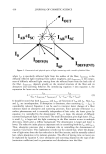
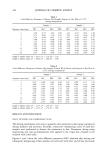
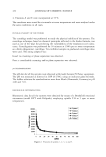
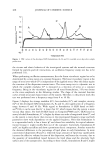
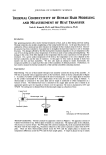
498 JOURNAL OF COSMETIC SCIENCE Thermal Conductivity Measurements: The literature gives the thermal conductivity of haft as 0.37 Wm4K 4. However, the values determined for different samples of hair in the dry (50%RH) condition were in the range of 0.06-0.08 Wm4K 4. This clearly shows that the heat transfer through hair assemblies is dominated by convection through air spaces between the fibers, rather than conduction through the keratin material. More data will be presented to support this conclusion. Modeling of Heat Transfer: This was accomplished by solving the heat conduo, on equation as applied to a cylinder in the case of single hair and to a bundle of cylinders in the case of a hair assembly. Using the proper boundary conditions, temperature profiles within the hair fiber or the fiber assembly were generated. In the case of a haft assembly the outcome of the model calculations was checked by experiment, at least at the surface and the center of the assembly. These profiles will be included in the conference presentation.

2004 ANNUAL SCIENTIFIC SEMINAR 499 ETHNIC HAIR: SOCIAL CONTEXT AND SCIENTIFIC REALITIES Victoria Holloway, M.D. L'Oreal Institute for Ethnic Hair and 3'kin Research Hair styling is an important means of self-expression, particularly for women of African descent. Hair care practices reflect both the needs of the consumer based on her specific hair type and styling desires as well as the trends of the moment. Specific hair care practices will be reviewed, as well as the scientific specificities of the hair of people of different ethnicities. This lecture will review some of the Institute's recent research on the physical and morphological properties of the hair.
Purchased for the exclusive use of nofirst nolast (unknown)
From: SCC Media Library & Resource Center (library.scconline.org)