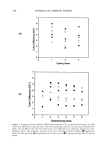
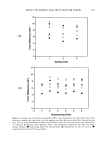
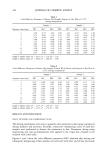
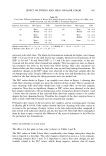
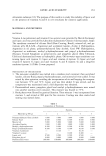
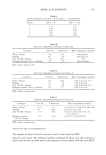
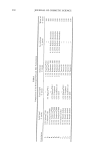
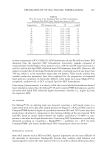
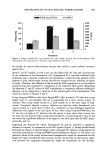
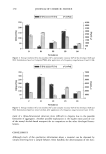
EFFECT OF DYEING AND HEAT ON HAIR COLOR 443 Table III Total Color Difference Parameter of Brown Hair Sample Exposed to Dryer in Steps of 10 Min, with 20-Min Intervals, and After 60 Min of Continuous Exposure Exposure time (min) Hair region DE* Exposure time (min) Hair region DE* 10 Root 0.9 + 0.2 40 Root 1.0 + 0.4 Middle 0.7 + 0.3 Middle 0.9 + 0.3 20 Root 0.9 + 0.3 50 Root 1.1 + 0.4 Middle 0.6 + 0.2 Middle 1.1 + 0.4 30 Root 1.2 + 04 110# Root 1.3 + 0.2 Middle 1.0 + 0.2 Reference values: Root: L* = 21.3, a* = 3.2, b* = 3.2, Middle: L* = 1.8, a* = 3.6, b* = 3.4. # Rej•rence values: Root: L* = 21.0, a* = 3.5, b* = 3.7. extracted with ethyl ether. The black dye formulations rendered the higher color change (DE* = 6.0 and 10.0) in the dark brown hair samples, followed by formulations of red (DE* • 4.0 and 7.0) and blond (DE* • 1.5 and 4.0) dyes, respectively, to the not- cleansed and the earlier ether-cleansed hair samples. This was expected, since no bleach- ing treatment was done on the brown hair before dyeing. Hair color saturation was observed after the first dyeing for both the tone-up and long-lasting formulations. No significant changes in the DE* values were observed in the dyed hair samples after the six shampooing cycles. Despite differences in the dying time and formulations, the dyes sorbed in the hair during the dying processes were not washed out. The DE* values shown in Figure 2 are roughly twice those in Figure 1, showing that ethyl ether cleansing strongly acts upon the sorption of dyes in hair. This is unexpected, since cleansing with ethyl ether should have only a small effect on the hair sorption properties. Note that no significant changes in DE* values were observed in the dyed hair samples submitted to the six shampooing cycles. Comparison between Figures 1 and 2 shows that the amount of dye removed from dyed hair samples seems to be similar despite the hair cleansing history. Therefore the strength of the dyes' sorption forces is alike in both ethyl-ether-cleansed and not-cleansed hair samples. Permanent dyes consist of dye precursors, dye couplers, and an oxidizing agent reacting at alkaline pH 8-10 (8). Early studies showed that hair cleansing with ether causes an increase in the percentage of empty cavities in the hair endocuticle when compared to hair treated with surfactant solution and also hot water (9). The ethyl ether consequence must be then to open a way for the diffusion of the reactive substances in hair fiber by the permanent dye formulations. EFFECT OF EXPOSURE TO A HOT PLATE The effect of a hot plate on hair color is shown in Tables I and II. The DE* values in Table I show that a considerable color change takes place when the hair is exposed to a hot plate. This color change is observed as soon as a 2-min exposure, remaining constant after 3 min. It is important to notice that color changes are par- ticularly related to the DL* values, which, being negative, indicate that all tresses

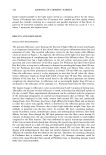
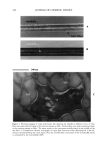
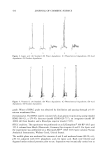
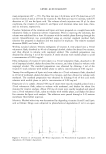
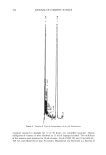
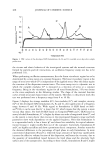
444 JOURNAL OF COSMETIC SCIENCE medulla.. •- i• bqir fiber A B 340 nm MF MF C .. Figure 3. Photomicrographs of virgin dark brown hair showing the medulla in different views. A: Hair fiber seen under reflected light in the stereomicroscope at 660x. B: Hair fiber seen under transmitted light in the stereomicroscope at 660x. The arrow points to the continuous medulla placed in the middle of the hair fiber. C: Transmission electron micrograph of virgin dark-brown hair fiber (Elmiskop101 at 80 kV, osmium-stained) showing the cortex region. Note the non-fibrillate constitution of the medulla (M), which is surrounded by the macrofibrills (MF).
Purchased for the exclusive use of nofirst nolast (unknown)
From: SCC Media Library & Resource Center (library.scconline.org)