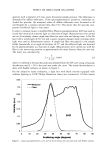
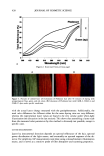
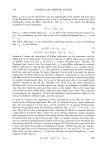
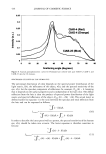
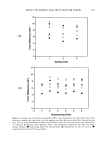
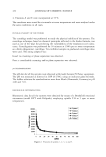
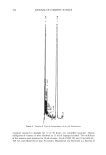
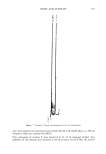
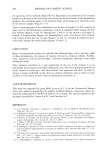
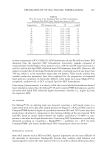
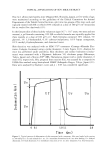
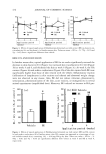
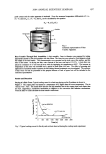
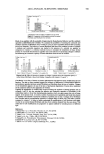
EFFECT OF HAIR COLOR ON LUSTER 425 aperture with a diameter of 6 mm, and a horizontal sample position. The reflectance is dominated by diffuse reflectance. If the spectrophotometer's geometric conditions ex- cluded the specular, the measured values of diffuse reflectance were decreased at all wavelengths by a constant amount (less than 1%). This shows that the specular com- ponent of reflected light is very small. In order to measure luster, a modified Brice-Phoenix goniophotometer (GP) was used to record the intensity of scattered light as a function of angle. Measurements were carried out on 30 randomly chosen single hair fibers for each color and dyeing time. A He-Ne laser with a wavelength of 632 nm and a quartz tungsten halogen lamp emitting white light were used as illumination sources. A single hair fiber was placed in the sample holder horizontally at an angle of incidence of 45 ø and the reflected light was detected by the photomultiplier as a function of angle. Measurements were carried out with the fiber in the root-to-tip position at approximately the same distance from the root end. The luster was calculated by: S -- L=S+D 100% (1) where S is defined as the specular peak area obtained from the GP curve using a Gaussian distribution and (S + D) is the total area under the curve. The actual deconvolution is done with Peakfit software, as shown in Figure 1. For the subjective luster evaluation, a light box with black interior equipped with uniform lighting (a 20-W Philips fluorescent lamp) was constructed. A black (matte 0.35 0.3 0.25 0.1 0.05 - - - Fitted S+D i i 0 10 40 50 60 70 80 90 Scattering angle (degrees) Figure 1. Typical goniophotometric curve and its deconvolution into specular peak with Peakfit software.

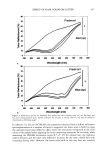
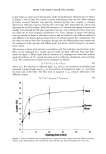
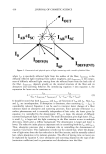
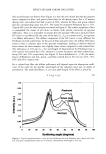
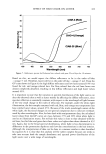
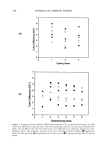
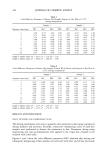
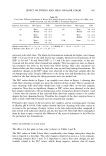
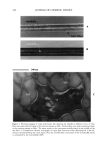
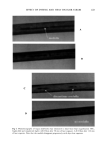
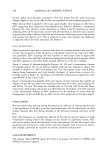
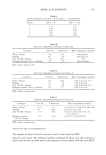
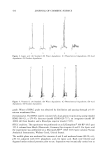
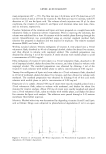
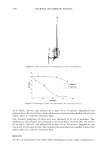
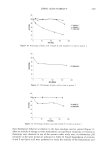
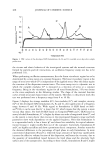
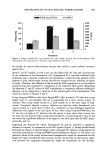
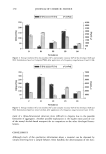
426 JOURNAL OF COSMETIC SCIENCE finish) cylinder parallel to the light source served as a mounting device for the tresses. Tresses of Piedmont hair colored for 45 minutes were combed and then tightly wound around the cylinder, resulting in a consistent and parallel alignment of hair fibers. A panel of 20 untrained evaluators was asked to evaluate the tresses on a scale of 1 to 5, where 5 represents the highest luster. RESULTS AND DISCUSSION REFLECTANCE MEASUREMENTS The spectral reflectance curve showing the fraction of light reflected at each wavelength is an important characteristic of the colored object and gives information about hue and saturation of color. The recorded reflectance curves for the hair tresses with different colors are shown in Figure 2. As expected, the reflection of the light of at least their own hue and absorption of complementary hues are observed for different colors. The refer- ence Piedmont hair has a high reflectance in the red, yellow, and green parts of the spectrum and a low reflectance in the blue region. For Piedmont hair dyed with Clairol Hot Red color, a steep rise in reflectance is observed at wavelengths longer than 600 nm. For the Piedmont hair dyed with Clairol Green Weed and Denim Blue colors, the reflectance spectra show pronounced maxima at around 530 and 480 nm, respectively. From the reflectance curves it is also important to note that for all colors the charac- teristic reflectance bands are broad (half width of more than 50 nm). This indicates the dullness of the hair hue. A weak second band in the reflectance spectrum can further complicate the observed hue. A reflectance tail at wavelengths higher than 650 nm is attributed to the reflectance of the substrate (i.e., Piedmont hair) from the fiber interior. The largest change in reflectance curves occurs between 0 and 5 minutes of dyeing time. Thereafter, the decrease in total reflectance is small, indicating that additional uptake of the dye is small. These experimental observations can be correlated with the properties of the individual components in commercial semipermanent dyes as follows: The com- mercial dyes employed in this study contain both neutral HC dyes and cationically charged basic dyes. The basic dyes have a high affinity for keratin fibers and are known to color the cuticle very rapidly, which is observed in the reflection spectra after five minutes of dyeing time. However, due to their high molecular weight, basic dyes are unlikely to penetrate into the hair cortex. In contrast, HC dyes, consisting predomi- nantly of aromatic amine, nitroaromatic amine, and anthraquinone derivates, have little affinity for hair. Even though the HC dyes penetrate into the fiber cortex during 45 minutes of dyeing time, the dye concentration in the cuticular sheath is much higher compared to the fiber interior. This was confirmed by optical microscope examination of the cross sections of red-colored hair, showing the typical ring-dyed cross section with the cuticular sheath as a dark red ring, predominantly produced by the basic dye, and a weak pink-colored cortex, resulting from the neutral HC red dyes. We note that dyeing with semipermanent dyes does not involve chemical reaction, but depends on diffusion of colorants from the solution into the hair. Therefore, the resulting coloration of Piedmont hair is relatively weak (see Figure 3A). Stronger coloration could be achieved by using bleached hair instead of Piedmont hair, as bleaching damage would make hair easily penetrable.
Purchased for the exclusive use of nofirst nolast (unknown)
From: SCC Media Library & Resource Center (library.scconline.org)