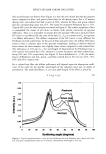
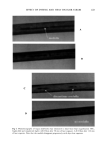
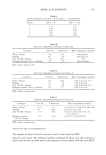
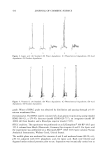
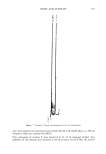
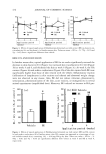
EFFECT OF DYEING AND HEAT ON HAIR COLOR 445 A c ß . discontinue medulla Fig 4. Photomicrographs of virgin dark-brown hair submitted to dryer heat (final magnification 480x, bright-field and transmitted light). A,B: Fibers after 50 min of heat exposure. C,D: Fibers after 110 min of heat exposure. Note that the medulla disappears progressively with dryer heat exposure.

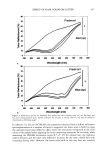
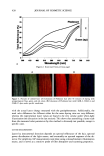
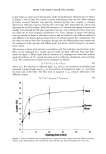
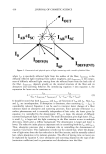
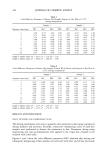
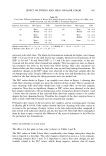
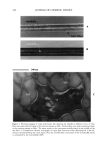
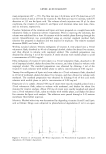
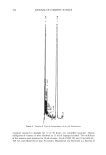
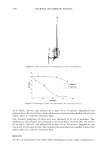
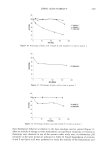
446 JOURNAL OF COSMETIC SCIENCE became darker after hot-plate treatments. This also means that the main structural changes happen in the cuticle cells, as they are responsible for hair lightness properties (9). When silicone fluid is applied to the tresses, quite smaller color changes are observed in DE*, suggesting that it preserves color properties (see Table II). However, a comparison between the color reference values (footnotes in Tables I and II) discloses an initial darkening effect of the hair tresses treated with silicone fluid, in much the same amount as the hot-plate effect. Silicone fluids are well known as conditioning agents that smooth and increase hair gloss (11,12). This is expected to cause color changes, but darkening is expected only if the fluid penetrates the fibers (9). EFFECT OF DRYER HEAT These experiments were done to observe if the heat of a common hairdryer had any effect on hair color properties. Table III shows no significant values for the total color differ- ence parameter, DE*, meaning that hair exposure to dryer heat causes no appreciable changes in hair color, although comparison among hair sample photomicrographs before and after exposure to the dryer shows marked differences in the hair medulla. Figure 3 consists of photomicrographs (Figures 3A, 3B) and a transmission electron micrograph (Figure 3C) of control hair samples with the hair medulla in detail. The medulla is observed in 50% (root region) and 75% (tip region) of the control fibers, despite being fragmented and with variable thickness. A cross-section overview of a medulla is seen in Figure 3C, revealing its non-fibrillar constitution in opposition to the macrofibrills of the cortical cells. Figure 4 shows photomicrographs of the root regions of dryer-exposed, hair samples. In Figures 4A and 4B, hair fibers were exposed to dryer heat for 50 min, and in Figures 4C and 4D for 110 min. We found the medulla only in 33% and 20% of the hair fibers, respectively. Surprisingly, this points to a labile behavior of medullar cells when exposed to the intermediate heating of 60øC produced by the hairdryer. It seems that the disappearance of the medulla has no effect on the color properties in this hair sample. CONCLUSIONS We have shown that tone-up dyeing formulations are effective in color production and in dye persistence in the hair, as are the long-lasting ones. On the other hand, the color change obtained after hair dyeing depends on the previous cleansing treatment of the hair. Hair color properties are significantly affected by hair history and by exposure to high temperature (curling irons). Color changes are due mainly to a lightness increase, DL*, and can be masked using silicone fluids in hair pretreatment. On the other hand, color parameters are insensitive to some drastic structural changes, such as loss of an observ- able medulla, promoted by exposure to ordinary hairdryer temperatures. ACKNOWLEDGMENTS The authors thank FAPESP (grant 01/14161-9 and grant 02/12541-1), CAPES, and CNPq for financial support.
Purchased for the exclusive use of nofirst nolast (unknown)
From: SCC Media Library & Resource Center (library.scconline.org)