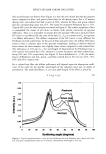
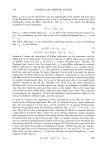
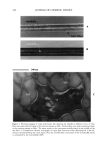
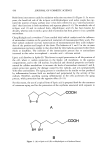
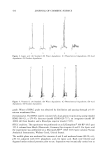
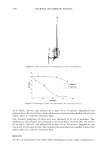
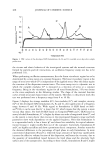
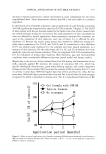
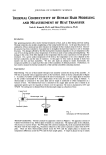
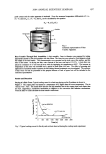
496 JOURNAL OF COSMETIC SCIENCE THERMAL CONDUCTIVITY OF HUMAN HAIR MODELING AND MEASUREMENT OF HEAT TRANSFER Yash K. Kamath, Ph.D. and Elena Petrovichova, Ph.D. TRl/Princeton, Princeton, NJ 08542 Introduction Hair grooming practices often involve thermal treatments of hair, such as blow-drying and heat curling. Thermal treatments also include straightening of hair using heated flat irons. In the past this practice was confined to African American hair after relaxation to eliminate the fine residual crimp in the hair. But now this practice has been extended to Caucasian hair to straighten the hair from long-wave curl or eliminate frizziness. The damage suffered by the fiber during these treatments depends on the air temperature in the case of blow-drying and the surface temperature of the devices used in heat curling and straightening. The damage to the cortex of the fiber depends on the temperature that the cortex experiences over the period of treatment. For a given surface temperature of the device, the temperature in the cortex depends on the thermal conductivity and the time of treatment. In this paper we have made an attempt to study heat transfer into hair and hair assemblies. We have also made an attempt to model, theoretically, the temperature profiles in a single hair fiber and in fiber assemblies of defined geometry. Furthermore, we have tried to measure the thermal conductivity of hair and hair assemblies containing moisture. Experimental Hair Drying: The rate of heat transfer through a hair assembly controls the dxying of the assembly. At TRI this is measured with an apparatus known as the Gyrotherm, which is shown schematically in Figure 1. It consists of a hollow cylinder mounted at the end of a rotating arm. A 1 cm 2 copper plate is mounted on the cylinder surrounded by 8 more copper plates of the same area and mass acting as ballasts. A thermocouple is connected to the center plate and its output is monitored to obtain temperature as a function of time. The flattened hair tress is mounted on the copper plate and the arm is rotated at an appropriate speed to give the required air velocity over the specimen. The room is maintained at 24øC and 50%RH. The cooling rate is obtained from the thermocouple output as a function of time. Copper Insert Insulated Cylinder Themnocouple Lead Counterweight / Motor Fig. 1 Schematics ofTRI Gyrotherm©. Thermal Conductivity: Thermal conductivity apparatus is shown in Figure 2. The apparatus consists of 4 plates from bottom to top. Bottom plate is heated at a constant rate. The topmost plate is the cold plate, which acts as a receiver of heat. The PVC plate with a known resistance (1•) is the second from the bottom The plate with the hair sample (R•, Resistance unknown) at the center is placed in contact with the PVC plate. There are three thermocouples placed across the PVC and the sample plates to measure the temperature differences across the PVC and the hair sample plates. A weight is placed on top to ensure

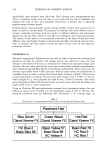
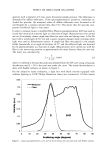
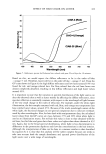
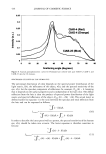
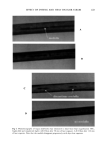
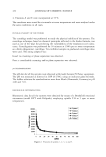
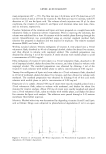
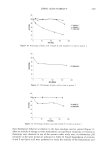
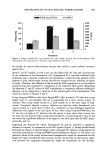
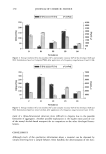
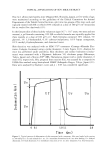
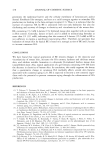
2004 ANNUAL SCIENTIFIC SEMINAR 497 good contact and the entire apparatus is insulated. From the measured temperature differentials ATs i.e., (T2 -T0 and AT• i.e., (T3 -T2), the P• can be calculated by the equation R• = R• (AT•/ATs) Fig. 2 Schematic representation of Heat Transfer Apparatus. Heat Transfer Through Hair Assemblies: A hair assembly, 5mm in diameter was prepared by taking appropriate amount of hair tied together with hair fibers. The cross ties were placed at lcm distances along the length of the hair bundle. Two thermocouples were mounted on the tress, one at the surface, and the other at the center. In drying wet hair, water content of the tress was kept at 12-13%. A hair drier was placed at a distance of 15 cm from the tress with the impinging air temperature at 80øC. The increase in temperature of the tress was recorded over a period of time from 6-40 min. The effect of perming and application of products meant to protect the hair during thermal treatments was investigated. The outcome of this work will not be presented in this preprint because of lack of space but will be included in the conference presentatior[ Results and Discussion Drying of a Hair Tress: Typical cooling curve for a hair tress drying on the Gyrotherm is shown in Figure 3. The copper plate was heated to a temperature 20øC higher than the room temperature. The air velocity was 1.7m/s. The results show that the wet hair transfers heat to the copper plate much faster than dry hair, suggesting a conduction mechanism in addition to the convection and radiation mechanisms. From the data we could calculate the heat transfer coefficients. 25 20 • lO n,,.. E o -5 -10 dry hair (50% RH) •wat hair ......... • up to 78 % water loss upt 2o *8• waterlosg'"'•.. / 80 % water loss 0 400 800 1200 1600 2000 2400 2800 Time (s) Fig. 3 Typical cooling curves for the dry and wet hair observed during the cooling mode experiment.
Purchased for the exclusive use of nofirst nolast (unknown)
From: SCC Media Library & Resource Center (library.scconline.org)