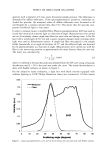
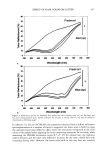
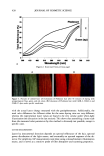
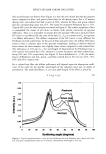
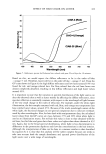
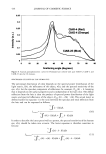
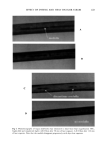
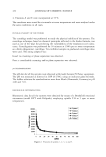
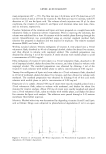
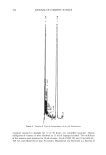
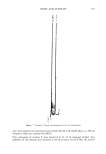
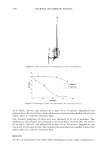
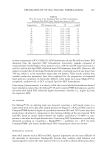
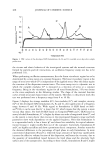
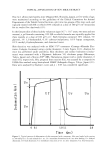
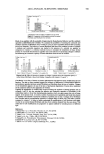
EFFECT OF HAIR COLOR ON LUSTER 433 80 70 • 60 • 5o 3o 20 10 C I.a.q,-4 (Red) CIAO-4 (Orange) CIAB-25 (Blue)/ 400 450 500 550 600 650 700 750 Wavelength (nm) Figure 7. Reflectance spectra for Piedmont hair colored with pure CI acid dyes for 30 minutes. Based on this, we would expect the diffuse reflectance to be in the order of blue orange -- red. Therefore, luster will be in the order of blue orange -- red. From the GP scans shown in Figure 8, the high diffuse reflectance and low luster around 19% was found for red- and orange-colored hair. For blue-colored hair the red laser beam was almost completely absorbed, resulting in low diffuse reflectance and high luster values around 45%. It is important to note that the variation in spectral distribution of the light source can alter the observed color as well as luster mainly by affecting the diffuse reflectance, since specular reflection is essentially constant with respect to the wavelength of light because of the very small change in the index of refraction. For example, under the white-light illumination, the hair samples saturated with red, blue, and orange one-component dyes have similar luster values, around 47%. Because of the multi-wavelength nature of the white light, the fractional changes in one spectral component due to color are overshad- owed by other wavelengths. Also, for hair dyed with semipermanent dyes, the calculated luster values from the GP curves are close, between 27% and 29% when white light is used as an illumination source. For red hair this value is close to that obtained with the red laser, but for blue and green hair these values are higher than those obtained at 632 nm. Again, due to the broad spectral distribution, white light is less discriminative to differences in dye penetration depths at such low dye concentrations in the hair interior. Although the interpretation of data can be done in a manner similar to that described by equation 8, it is clear that this analysis will be rather complex because one needs to take into account both the sample absorbance and spectral power distribution of the light source over a wide range of wavelengths.

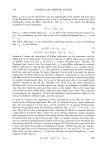
434 JOURNAL OF COSMETIC SCIENCE 0.36 0.3 0.26 ß :::l 0.2 '• 0.16 "• 0.1 0.06 i i i 0 10 20 30 CIAR-4 (Red) ClAO-4 (OranGe) CIAB-2$ (Blue) 40 50 60 70 80 9O Scattering angle (degrees) Figure 8. Typical goniophotometric curves for Piedmont hair colored with pure CIAO-4, CIAR-4, and CIAB-25 dyes for 30 minutes. PERCEPTION OF LUSTER BY THE HUMAN EYE The perceptual description of color depends on the spectral power distribution of the light source,/0•), the reflectance of the object, r0•), and the spectral sensitivity of the eye, s0•). Let the specular component of reflectance be constant, Rspec0•) = k, knowing that it depends on the surface properties and is independent of the hair color. The diffuse reflection from the hair is then the product of spectral power distribution of the light source and spectral reflectance of the object, Rdif/0•) = /0•) ' r0•). The actual luster as defined earlier by equation 1 is the ratio between the specular and total reflection from the hair and can be expressed as follows: • •'/(X)• L•t•/= (10) In order to describe the luster perceived by a person, the spectral sensitivity of the human eye, s0•), should be taken into account. The luster equation is therefore rewritten to become 4x). Lp .... ired x2foo f-•oo (11)
Purchased for the exclusive use of nofirst nolast (unknown)
From: SCC Media Library & Resource Center (library.scconline.org)