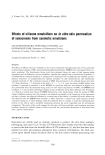
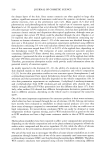
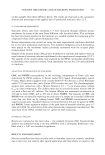
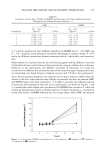
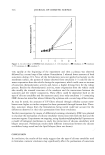
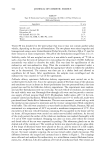
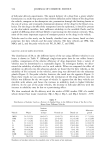
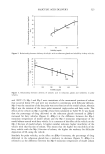
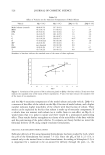
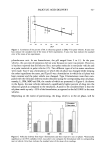
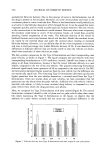
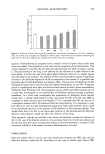
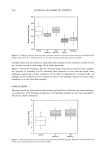
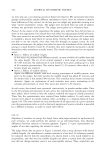
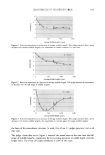
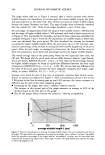
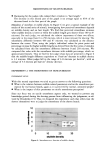
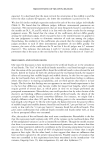
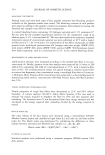
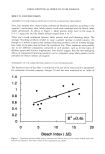
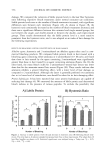
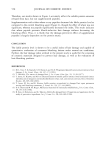
SALICYLIC ACID DELIVERY 525 35 3O 25 20 15 10 5 0 30 O•••O IPM L , , 35 40 45 50 Solubility (mg/ml) Figure 2. Relationship between delivery of salicylic acid to sebaceous glands and solubility in fatty vehicles. • 20 • •8 • 16 E 14 • 12 lO • 6 .• 2 m 0 G MP DMI 0 1 O0 200 300 400 500 Solubility (mg/ml) Figure 3. Relationship between delivery of salicylic acid to sebaceous glands and solubility in polar vehicles. and 100øC (2). Mp-1 and Mp-2 were transitions of the unsaturated portions of sebum that occurred below 0øC and were not involved in correlations with follicular delivery. Mp-3 was the transition of the less polar wax ester fraction of the model sebum, whereas Mp-4 was the mixture of the more polar saturated triglycerides and fatty acids. The effects of the vehicle on Mp-3 and Mp-4 have been tabulated in Table VI. It was found that the percentage of drug delivered to the sebaceous glands increased as AMp-3 increased for fatty vehicles (Figure 4). AMp-3 is the difference between the Mp-3 transition temperature of model sebum and the Mp-3 transition temperature of the model sebum treated with fatty vehicle. It is a measure of the effect of the vehicle on the Mp-3 fraction of model sebum. A higher number indicates higher miscibility of the vehicle with that fraction of sebum. This means that the higher the miscibility of the fatty vehicle with the Mp-3 fraction of sebum, the higher the tendency for follicular deposition of SA using the vehicle. Similarly for polar vehicles, as the effect on AMp-4 increases, the percentage of drug delivered in the sebaceous glands has a tendency to decrease (Figure 5). AMp-4 is referred to as the difference between the Mp-4 transition temperature of model sebum

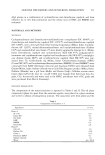
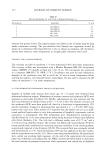
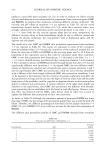
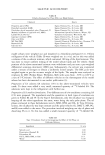
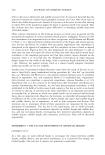
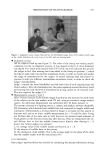
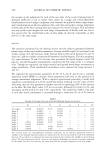
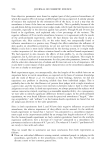
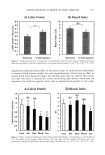
526 JOURNAL OF COSMETIC SCIENCE Table VI Effect of Vehicles on the Transition Temperatures of Model Sebum Vehicle Mp-4 (øC) Mp-3 (øC) AMp-3 (øC) AMp-4 (øC) Model sebum (control) 48.8 (0.22) 39.7 (0.43) -- -- MSO 45.3 (0.73) 37.4 (0.42) 2.3 3.5 IPM 45.9 (0.31) 36.5 (0.62) 3.2 2.9 OA 46.2 (0.27) 38.1 (0.55) 1.6 2.6 L 46.4 (0.27) 38.4 (0.07) 1.4 2.5 G 49.1 (0.29) 39.8 (0.17) -0.07 -0.3 B 47.0 (0.022) 40.4 (0.18) -0.7 1.8 MP 46.6 (0.45) 39.5 (0.43) 0.3 2.2 PG not observed 39.0 (0.18) 0.8 -- DMI 42.0 (0.45) 37.7 (0.27) 2.1 6.7 T 43.7 (0.22) 39.0 (0.12) 0.8 5.0 Numbers in brackets indicate the standard error of the mean of three replicates. g 35 .• 30 • 25 •. 2o • •o • 5 0 MSO •• L IPM i 0 0.5 I 1.5 2 2.5 3 3.5 4 4 5 •XMp-3 Figure 4. Correlation of the percent of SA in sebaceous glands to AMp-3 for fatty vehicles. X-axis error bars indicate the standard error of the mean of three experiments. Y-axis error bars indicate the standard error of the mean of six experiments. and the Mp-4 transition temperature of the model sebum and polar vehicle. AMp-4 is a measure of the effect of the vehicle on the Mp-4 fraction of model sebum, and a higher number indicates higher miscibility of the vehicle with that fraction of sebum. These results can be explained by the fact that sebum is made up of non-polar components. If a vehicle does not interact with sebum (as is visible from its non-effect on Mp-4), it would mean that it is polar in nature and there would be a pronounced partitioning effect. These results further strengthen our theory of the miscibility of the fatty vehicles and the partitioning of the polar vehicles. To evaluate our theory further we tested the follicular delivery of SA using simple emulsion formulations. SALICYLIC ACID EMULSION FORMULATIONS Follicular delivery of SA using liposomal formulations has been studied by Lieb, where the pH of the formulations was around 7.4 (12). Since the pK• of SA is 2.3 (13), it existed only in the ionized form in these formulations. According to Scheuplein (14), it is important for a molecule to be un-ionized for delivery through the pore, i.e., the
Purchased for the exclusive use of nofirst nolast (unknown)
From: SCC Media Library & Resource Center (library.scconline.org)