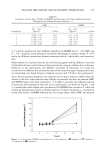
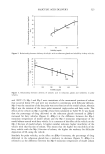
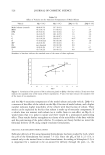
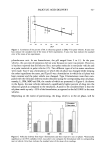
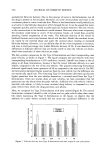
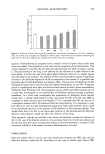
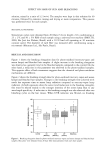
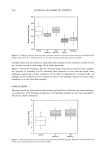
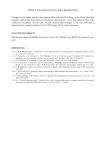
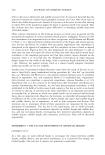
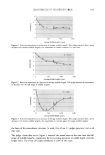
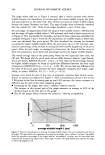
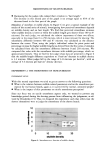
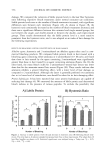
SMOOTHNESS OF SHAVEN BEARDS 545 ß Decreasing for the judges who related their criterion to "hair length." The decrease in this second part of the graph is on average equal to 85% of the decrease found in the first part of the graph. Dependence of smoothness on stubble density. In Figure 6 we give a typical example of the results of the second series of stimuli, investigating how perceived smoothness depends on stubble density and on hair length. We find that perceived smoothness increases when stubble density is lower or when the stubble length gets shorter (from 489 to 87 microns). For each judge, we calculated the relative importance of these two effects, especially in the range from 0 to 250 microns, which is most relevant for shaving: The smoothness difference between 489 and 87 microns was calculated as the distance between the curves. Then, using the judge's individual values for pivot point and percentage increase for higher stubble lengths (as derived from the first series of stimuli), we calculated from this the smoothness difference between 0 and 250 microns. We compared this value with the smoothness decrease with stubble percentage, which we approximated linearly. Thus we find for the judge whose data are presented in Figure 6 that the stubble length difference equivalent to 1 hair/cm 2 decrease in stubble density is 3.4 microns. Other judges fall in the range of 3-8 microns per hair/cm 2, with an average of 5.4 microns per hair/cm 2 density decrease. EXPERIMENT 2: THE SMOOTHNESS OF HUMAN BEARDS EXPERIMENT SETUP With this second experiment we tried to get an answer to the following questions: ß What is the relation between stubble-related parameters and tactile smoothness per- ception for real human beards, again as it is perceived by normal, untrained people? ß What is the impact of skin parameters on tactile smoothness perception? Since our focus was on tactile smoothness aspects only, we wanted to prevent any knowledge gained during the shaving process from influencing the judgments, as ad- vised by Drozdenko (15). Thus we designed the experiment such that others (not the shavers themselves) were to judge the smoothness of the shaven beards. 10 0 10 20 30 stubble density Figure 6. Smoothness as a function of stubble density.

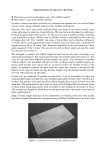
546 JOURNAL OF COSMETIC SCIENCE Participants: Subjects and judges. Six participants, called subjects in this paper, were se- lected with the criteria that they have experience with both wet and dry shaving. In the experiment, they shaved twice a week. All subjects participated on a voluntary basis. Nine other participants in the experiment, the judges, were also volunteers. Eight of them had also participated in the artificial beards experiment. Since we had not given them any training in experiment 1, nor given any feedback on the judgments, we could still consider all nine judges untrained. Twice a week they were asked to give their personal opinion on the different smoothness levels of the subjects' cheeks. Materials. There were six different shaving devices available: two off-the-shelf devices, namely a Philips CoolSkin with super retract (CS) and a Gillette Mach 3 Turbo (M3). In addition, we deployed four purpose-made devices, namely three Philips Sensotecs with their retract shaving knifes removed and with shaving head lainella thicknesses of 80, 100, and 150 t•m, respectively, and a Philips Quaalta-action, also without retract knifes and with a shaving head lainella thickness of 200 t•m. These four additional devices were intended to deliver various levels of stubble length after shaving. Procedure. The full experiment consisted of six judgment sessions. In each judgment session all judges judged all subjects for the smoothness of both their cheeks. Shortly before each judgment session, each subject had shaven both cheeks, each with a different shaving device. Before and after each judgment session several measurement sessions took place in which the skin and stubble parameters of the subjects were characterized. In more detail and in chronological order, we implemented the following procedure, which was repeated six times in its entirety: ß Shaving and measurement session 1: The subjects shaved both cheeks (max. two minutes per cheek) with a different device. We made sure that during all six shaving sessions each subject had used each shaving device once on each cheek, and that within one shaving session all six shaving devices were used twice. When the subjects were done shaving, we performed various in- strumental skin and stubble measurements: (a) Skin roughness (S.0 was measured with the GMF optical 3D Primos system. S•, a well-known surface roughness measure in skin research (see, e.g., ref. 14), is calculated from the measured skin topography. It averages the height distance to the average skin level (the area between the profile height and its mean level), as measured over 16 lines crossing radially in the point of measurement. Measurement took place just above the beard growth near the eyes. Unfortunately, most of the S.• measurements were lost, and only one measurement per subject and per cheek was retained. (b) Skin scaliness (D) was measured with D-Squame stickers (17). These transparent stickers were placed on the cheeks just above the beard, and when removed, a certain amount of skin adhered to them, which was greater in the case of very dry and scaly skin. Four observers compared the amounts of peeled-off skin, according to the corresponding scale (1-5), and their average score was retained. (c) Friction (F) was measured with a ring-shaped, rotating tailor-made friction mea- surement device. It was pressed against the skin with a force of 1.1 N, and via the motor current, the torque needed to rotate the ring was measured. Measurements took place on a bearded spot on the cheek, which was marked with UV-visible ink. (d) Sebum (S, skin greasiness) was measured with a Courage & Khazaka SM810 Sebumeter. It was measured next to the location where friction was measured.
Purchased for the exclusive use of nofirst nolast (unknown)
From: SCC Media Library & Resource Center (library.scconline.org)