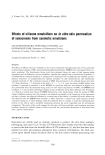
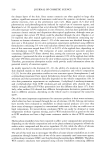
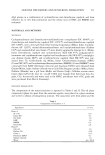
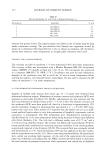
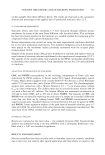
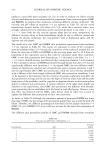
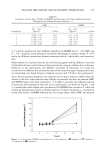
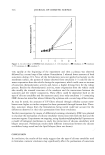
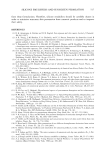
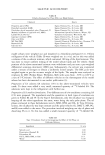
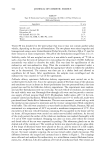
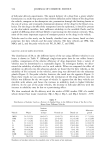
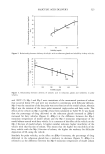
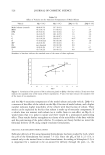
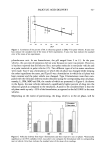
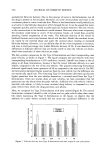
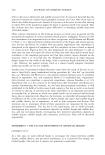
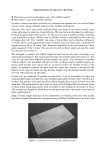
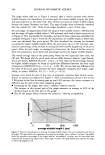
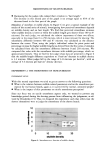
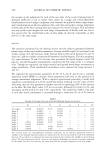
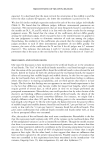
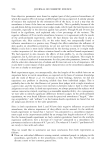
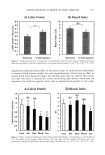
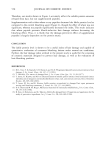
SILICONE EMULSIFIERS AND SUNSCREEN PERMEATION 515 Table IV Cumulative Amount (Q22) of OMC and BMBM and Percentage of the Dose Applied Permeated Through Excised Human Skin from Emulsion 1-5 OMC BMBM Q22 ñ S.D. Q22 ñ S.D. Formulation (pg/cm 2) % Dose (pg/cm 2) % Dose 1 22.94 ñ 1.08 0.23 3.37 ñ 1.20 0.34 2 24.68 _+ 6.14 0.25 2.69 ñ 0.24 0.27 3 13.59 ñ 2.60 0.14 2.10 ñ 0.37 0.21 4 13.09 ñ 4.31 0.13 1.49 ñ 0.65 0.15 5 17.19 ñ 5.88 0.17 2.34 ñ 0.77 0.23 1-5 could be explained by their different lipophilicity (BMBM Log P -- 4.8 OMC Log P -- 5.6, calculated using Advanced Chemistry Development software Solaris V 4.67) and/or by different interactions between sunscreen/vehicle, vehicle/skin, and sunscreen/ skin. Other authors (31) reported that the use of thickening agents and the different viscosities of formulations may retard sunscreen skin penetration, using an infinite dose technique. However, in our experiments, the different viscosities of emulsions 1-5 could not account for the different skin permeation data of the sunscreen agents being tested since no relationship was found between emulsion viscosity and UV-filter skin permeation. Since the percutaneous absorption rate depends on the drug's ability to diffuse from the vehicle to the skin, other than the drug's ability to penetrate the skin, we assessed OMC and BMBM release rates from emulsions 1-5 in order to elucidate the different patterns of sunscreen skin permeation observed in our experiments. As shown in Figures 1 and 2, a pseudo-first-order release rate was observed for BMBM from emulsion 4, while the remaining formulations showed a different pattern of release. Emulsions 1-3 showed an initial slow release of BMBM followed by a fast release phase, while OMC was released 120 lOO m 60 .• ,•o ,• 20 0 10 15 20 25 Time (h) Figure 1. In vitro release of OMC from emulsions 1-5. (¸) emulsion 1' (0) emulsion 2 (•') emulsion 3 (V) emulsion 4 (I) emulsion 5.

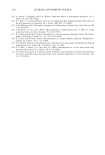
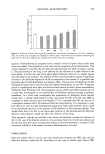
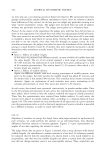
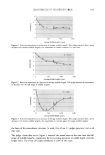
516 JOURNAL OF COSMETIC SCIENCE E i i i i i 0 5 10 1• 20 25 Figure 2. In vitro release of BMBM from emulsions 1-5. (¸) emulsion 1 (0) emulsion 2 (•') emulsion 3 (V) emulsion 4 (I) emulsion 5. very rapidly at the beginning of the experiment and then a plateau was observed followed by a second step of fast release. Formulation 5 released lower amounts of both sunscreens during 22 h. Since all the formulations were not applied occlusively on the membrane surface, the pattern of release observed from emulsions 1-3 could be due to water evaporation from the vehicle during the experiment, which could cause an increase of sunscreen thermodynamic activity and, hence, a higher driving force for the release process. Besides the thermodynamic activity, water evaporation from the vehicle could also modify the internal structure of the emulsion and the interactions between the sunscreen and the vehicle components. These effects could be dependent both on the type of silicone emulsifier and the sunscreen used, since only emulsions 1-3 containing OMC showed an initial fast release followed by a plateau and a second step of fast release. As may be noted, the amounts of UV filters released through cellulose acetate mem- branes were higher or similar compared to those permeated through human skin. There- fore, sunscreen release from the formulations being tested could not account for the differences observed in their skin permeation from these emulsions. Further investigations by means of differential scanning calorimetry (DSC) are planned to elucidate the mechanism of silicone emulsifier interactions with both the skin and the sunscreen agents. Experiments are ongoing, using dipalmitoylphosphatidyl liposomes as a model of biological membranes to study the interactions of silicone emulsifiers with bilayer structures. Preliminary results show different interactions between the silicone emulsifiers being tested and the lipid bilayers (data not shown). ß / CONCLUSION In conclusion, the results of this study suggest that the type of silicone emulsifier used to formulate cosmetic emulsions may significantly affect the permeation of sunscreens
Purchased for the exclusive use of nofirst nolast (unknown)
From: SCC Media Library & Resource Center (library.scconline.org)