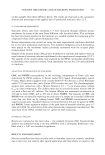
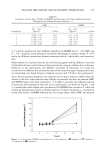
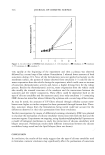
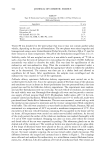
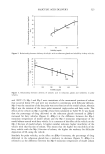
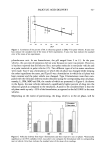
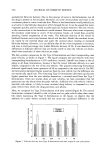
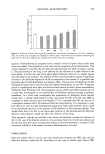
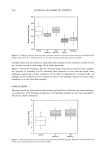
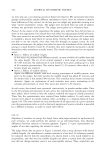
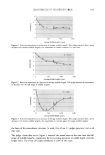
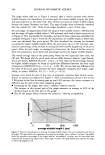
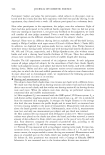
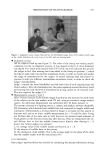
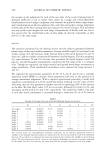
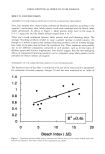
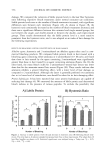
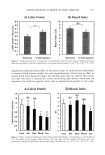
SMOOTHNESS OF SHAVEN BEARDS 543 10 8 7 6 4 0 o 50O lOOO average stubble leng• L (pm) Figure 2. Perceived smoothness as a function of average stubble length. This judge assessed, after a steep decrease with shorter stubble lengths, the smoothness to remain constant at a low level 2 o 500 lO00 1500 average stubble length L (pm) Figure 3. Perceived smoothness as a function of average stubble length. This judge assessed the smoothness to decrease over the full range of stubble lengths. ß o 5oo lOOO 1500 average stubble leng!• L (pm) Figure 4. Perceived smoothness as a function of average stubble length. This judge assessed, after a steep decrease with shorter stubble lengths, the smoothness to increase again for longer stubble lengths. the basis of his smoothness criterion. In total, five of our 20 judges produced curves of this type. The judge whose data are in Figure 3 assessed the smoothness to decrease over the full range of stubble lengths. Apparently he kept paying attention to stubble le,gth, even for longer hairs. Six of our 20 judges produced a curve of this type.

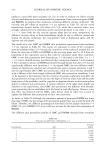
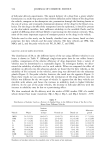
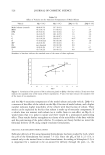
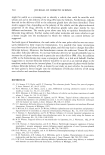
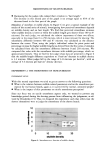
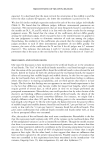
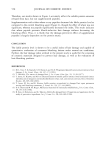
544 JOURNAL OF COSMETIC SCIENCE The judge whose data are in Figure 4 assessed, after a similar decrease with shorter stubble lengths, the smoothness to increase again for longer stubble lengths. He prob- ably paid attention to the soj9ness felt. This softness increased for longer stubble lengths because the longer filaments can bend. This type of judge often voluntarily remarked that the stimuli felt "soft." Nine of our judges produced a curve of this type. For each judge, we approximated both the range of lower stubble values (300 microns) and the range of higher stubble values (500 microns), each with a linear regression (as in Figure 2). This was feasible for all judges, and also for those whose data resembled the examples in Figures 3 and 4. From the two regressions, the stubble length at which they cross was calculated (the pivot point). We also calculated the increase (or decrease) occurring for higher stubble lengths (from the pivot point up to 1365 microns), mea- sured as a percentage of the decrease occurring for lower stubble lengths (up to the pivot point). Thus, for each judge, we managed to characterize the form of his/her curve by these two parameters: pivot point and percentage increase for higher stubble lengths. The overall average value of the pivot point, where the two regression lines cross, was 305 pro. We found that the pivot point did not differ between observer types (female, dry or wet shaver ANOVA, F(2,16) = 2.36, p = 0.126). Also, for the percentage increase for higher stubble lengths we found no significant differences between the three types of observers (ANOVA F(2,16) = 1.337, p -- 0.26). We did not find any differences for the value of the pivot point between the three judgment categories (hair length, accept- ability, or sojgness ANOVA, F(2,17) = 1.655, p = 0.22). Average curve forms for each of the types of judgment categories (hair length, accept- ability, or softness) are depicted in Figure 5. After a normalization of each curve to lose 5 PO points in the first decreasing part up until 305 microns, the curves continue in a different way for each of the three judgment groups: © Increasing for the judges who used a "softness"-related criterion. The increase in this second part of the graph amounts on average to 42% of the decrease found in the first part of the graph. © Flat for the judges whose criterion was related to "shaving acceptability." 10 o5 E 0 500 1000 1500 average stubble length L {pm) Figure 5. Perceived smoothness as a function of average stubble length. This plot summarizes the data of all judges. The upper black curve represents the average of the judges with a "softness" criterion. The middle black line represents the average of the judges with an "acceptability" criterion, and the lower black line represents the average of the judges with a "hair length" criterion. The gray dashed lines represent the range in which all judgments fall.
Purchased for the exclusive use of nofirst nolast (unknown)
From: SCC Media Library & Resource Center (library.scconline.org)