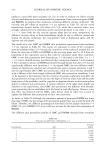
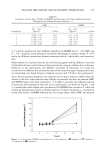
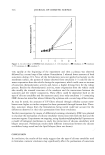
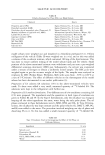
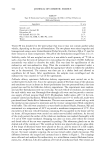
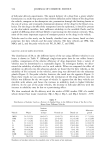
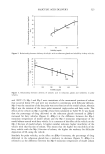
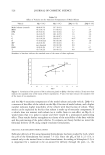
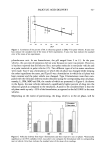
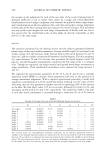
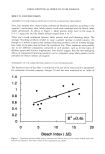
SMOOTHNESS OF SHAVEN BEARDS 549 expected. It is also found that the more vertical the orientation of the stubble is and the lower the skin scaliness (D-squame), the lower the smoothness is perceived to be. We also did similar multiple regression analyses for each of the nine judges individually (Table I). We found that for different judges, different instrumental parameters are important. The instrumental parameters that are most frequently found to contribute in the models are N, L, O, and D, which is in line with the above results for the average judgment scores. We found that the values of the coefficients did not differ greatly among the individual judges, which was partly due to the transformation we applied to the raw judgments in order to eliminate variation of scale use among the judges. Nevertheless, the similarity of the coefficients also entails that the relative weights the judges attribute to each of these instrumental parameters do not differ greatly. For instance, the ratio of the coefficients for N and for L for all judges was 6.7 microns/ (hair/cm2). This indicates that reducing L with 6.7 microns yields a smoothness im- provement that is the same as the one reached by a hair density reduction of 1 hair/cm 2. DISCUSSION AND CONCLUSIONS One topic for discussion is how representative the artificial beards are in the simulation of real beards. The "feel" of the artificial beards resembles a real beard enough to expect that the nature of the perceptual effects found for artificial beards is also relevant for real beards. Indeed we found, for both the artificial and the real human beards, the negative effects of increasing hair stubble length and stubble density. In this line we expect that also for real beards there will be people who relate the smoothness feeling to softness, others that relate it to shaving acceptability, and yet third parties that relate it to hair length. The fact that this finding was not apparent in our real beards experiment is due to the fact that differences only become visible for longer hair lengths, which would require growth of several days, at which point in time we no longer performed any perceptual measurements. Nevertheless, one could speculate that by other choices of the elasticity and bending stiffness parameters of the artificial beards, the details of the perceptive results might become somewhat different. For instance, we might find a slightly different value than 305 pm for the bending point in the smoothness-versus- hair-length curve (Figure 5). On the other hand, the balance between the positive effects of stubble length and stubble absence found for real beards (6.7 pm per hair/cm 2) is very nicely in line with the 5.4 lnm per hair/cm 2 measure found for artificial beards. This gives some confirmation that artificial beards resemble real beards rather well, at least as far as perceptual effects are concerned. Also, the results of the real-beards data need some consideration. Remarkable is the fact that the regression model explains only 49% of the variance in the real-beards data. Part of the unexplained variances can be accounted for as follows: Though the model assumes that there is no measurement error in the instrumental parameters, the variance that does exist in these parameters indirectly contributes to the remaining unexplained variance in the data set. Therefore, the result of 49% of explained variance is better than it might appear at first sight. On the other hand, it does suggest that there are influences that have not been captured in the present measurements. Possible sources of variation that were not controlled in this experiment have been mentioned in the introduction--for instance, fingertip force (5), skin temperature (6), and skin hydration (7).

550 JOURNAL OF COSMETIC SCIENCE Four objective parameters were found to explain (part of the) perceived smoothness, of which the negative effect of average stubble length (L) was as expected. A similar amount of variance was explained by the orientation (O) of the hairs, in such a way that the smoothness is lower if the hairs are oriented vertically. This is probably because of the up-and-down-feeling movements most judges made, which made the hairs become more noticeable, especially in the direction against hair growth. Though N and D were also found to be significant, each explained only a low percentage of the variance. The negative influence of N on tactile smoothness, however, is in agreement with the results of the artificial-beards experiment, where the hair density was also found to play a significant role. Skin scaliness (D), on the other hand, was unexpectedly found to influence smoothness in a positive way. Though this effect underlines the influence of skin quality on smoothness perception, we are not sure how to interpret this finding. Maybe a scaly skin is more easily influenced by the shaving system, or it might make a softer impression (cf. the softness criterion found in the artificial-beards experiment). We had expected to also measure the effects of skin profile, Sa, on the smoothness judgment, but S a did turn out not to be of importance in the judgment. This might be due to a reduced number of measurements for this particular parameter, however. Nor did the other skin characteristics of sebum and friction turn out to be of importance. All in all, there is some impact of skin quality characteristics on the smoothness judgments, but not as clearly as anticipated. Both experiments agree, not unexpectedly, that the lengths of the stubble hairs are an important factor in tactile smoothness, as expected on the basis of common knowledge and the work of Breuer eta/. (1). Contrary to their findings, however, we did not experience any problem in obtaining reliable data from individual judges. This is probably due to the fact that Breuer eta/. present their judges with a single stimulus at a given time, and the two-hour time intervals in-between make it hard to relate these judgments to each other. In both our experiments, we always presented the subjects with various consecutive stimuli, resulting in a reasonable reproducibility. As a consequence, we were able to identify significant differences between judges: In the artificial-beards experiment, we even found different criteria for perceived smoothness ("length," "shav- ing acceptability," and "softness") in the human-beards experiment we found that not all judges pay attention to the same parameters. Since in both experiments both L and N have their negative influences on perceived smoothness, the relative importance of their effects can be assessed. In the artificial- beards experiment we found that 1 hair/cm 2 less amounted to a smoothness improve- ment equal to the improvement yielded by an average hair length reduction of 5.4 pro. For the human-beards experiment we had a similar equivalence based on the multiple regression coefficients: here a decrease of 1 hair/cm 2 amounted to a smoothness im- provement similar to a decrease of 6.7 pm in L. The values of 5.4 and 6.7 pm/(hairs/cm 2) are nicely in line with each other. Thus we would like to summarize our main conclusions from both experiments as Follows: © There are individual differences among normal, untrained people in judging tactile smoothness, specifically in the smoothness criteria they use. Nevertheless, we can discern a more or less common general line.
Purchased for the exclusive use of nofirst nolast (unknown)
From: SCC Media Library & Resource Center (library.scconline.org)