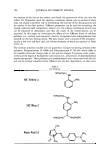
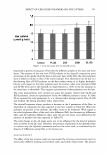
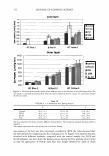
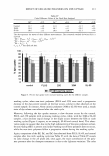
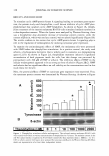
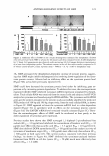
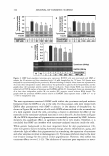
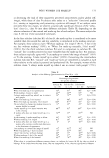
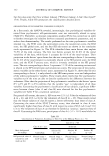
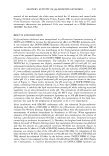
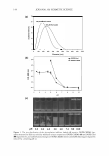
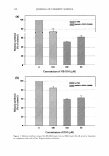
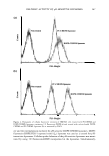
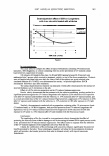
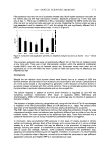
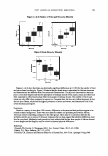
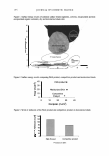
110 JOURNAL OF COSMETIC SCIENCE Colorimetric analysis on yak hair was conducted using a Lambda 35 UV-Vis-Nir Perkin Elmer instrument integrated with a Labsphere RSA-PE-20 reflectance and transmittance integrative sphere and a software color method (CIELAB scale L*, a*, b*, using CIED65/ 10° illuminant/observer condition). Yak hairs were assembled in the apposite Teflon support in such a way that the fibers were aligned and maximum overall smoothness was ensured. Three measurements of the same sample were registered, each time changing the fiber disposition to ensure that any change in the reflectance of the samples was not simply due to a non-uniformity of the yak hair sample preparation assembly the data reported represent the average of these measurements (14). From the L, a, and b values measured, the il.L a'nd il.C were calculated and were reported as lightness and color charge, respectively. The a value represents the green-to-red shift, the b value the blue-to-yellow shift. The total color difference (il.E), il.L, and il.C definitions are given below (15): il.C = [(at - aY -(bt -bY] 112 il.E = [(Lt -LJ2 + (at - aY + (bt -bY] 112 il.L = Lt - L0 The at b tJ L t data describe the final value obtained after the dyeing process or the different washing cycles a0, b0, L0 describe the non-colored yak hair, or alternatively, the initial dyed values (first washing cycle included). RESULTS AND DISCUSSION HAIR DYE UPTAKE The sorption of the dye mixture on yak hair was determined using an extraction procedure for the solution containing 0.1 % concentration of a different polymer. For comparison, the data obtained in the same experimental condition using a base dye solution (control) are reported. Each amount is the average value of three replicate adsorption experiments. Figure 1 shows the amount of the adsorbed dye mixture (ex- pressed as µmoles of uptake versus gram of hair) still present on the hair (inner and outer layer) after the dyestuff process. It can be seen that in the presence of a cationic polymer there is an increment of about 30% of the dye amount in the hair fiber, whereas no variation in the dye mixture was observed when a non-ionic polymer was employed (compared with the control). Cationic polymers are well known in the literature for their high degree of substantivity to hair (1). The driving force for this appreciable uptake could be ascribed to electrostatic interaction between the positively charged groups (cationic) of the polymers and the negative sites of the hair surface present at any pH above its isoelectric point (pH ca. 3.7). Moreover, cationic polymers have been shown to form both association complexes and/or hydrophobic interactions with dye (6). On the other hand, when neutral polymers are used, as the nature of the main binding with the hair fiber is of the polar and Van der Waals kind, they can be easily removed by shampoo, a good hydrogen-bond break- ing agent, with the consequent loss of anti-fading power (1). To monitor the effect of the different polymers on the dyes composing the mixture, an analysis of the extracted dyes relative to the outer and inner layers of the fiber was made. In Figure 2 are reported histograms relative to the amount ofHC Blue 2, Basic Red 51, and HC Yellow 2 uptake

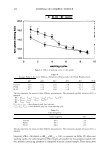
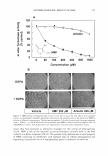
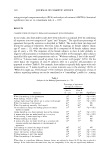
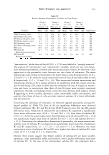
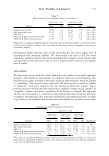
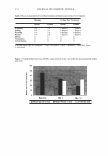
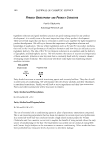
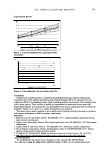
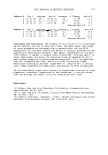
EFFECT OF CELLULOSE POLYMERS ON DYE UPTAKE 111 15 dye uptake (µmoll g hair) 10 5 Colour PLUS 250 30M SL-60 Fi gu re 1. Total dye uptake after the dyestuff process. (expressed as µmoles versus gram of hair) for the different samples in the outer and inner layers. The presence of the non-ionic PLUS polymer in the dyestuff composition gives an increase in the uptake of all the dyes in the outer layer of the fiber the other polymers show a behavior similar to that of the control sample. This observation can be due to a fast-forming film of PLUS polymer on the hair surface owing to its higher hydropho- bilicity with respect to the other polymer used. In contrast, when ionic polymers (30M and SL-60) were used in the dyestuff, an improvement (ca. 30%) in the dye amounts in the inner layer is observable. This suggests a penetration of these polymers into the hair. The color measurements were carried out using the samples treated with SL-60 and PLUS polymers, chosen as representative of the two different polymeric classes. In Table III are reported the color parameters: L} a} b} obtained after dyeing (control, Plus, SL-60) and without the dyeing procedure (yak), respectively. The dyestuff treatment always produces a decrease in the L parameters of the fiber, as observable in comparing the data reported in the first column of Table III. When the polymers are present in the dyebath, this effect seems to be weakened. With regard to the color brightness effect, of the total color difference (dE), the chromaticity differences (dC), and the lightness differences (dL), only the last one seems to be affected by the presence of polymer (see data reported in Table IV). The color change in the alb plane seems not to be influenced by the kind of polymer used, as shown in the dC data. Therefore, the presence of polymers in the dyebath seems to concern only the lightness parameters and not the color itself, as confirmed by the absence of differences perceptible to the human eye. HAIR DYE WASH-OUT The effect of the dye mixture wash-out was studied by carrying out extraction tests on tresses after different washing cycles (third, sixth, and ninth, respectively). The percent
Purchased for the exclusive use of nofirst nolast (unknown)
From: SCC Media Library & Resource Center (library.scconline.org)