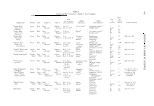
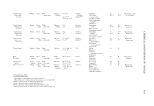
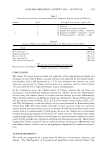
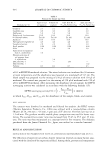
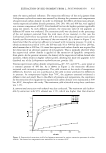
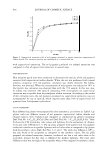
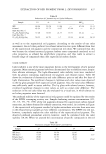
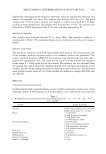
CHEMICAL COMPOSITION OF "KOHLS" 401 chemical compositions. However, for a variety of reasons (to check on the consistency of composition with location of purchase, as close inspection of the information on some containers/enclosed leaflets revealed small variations from that seen before, and to ac commodate both samples arriving over a period of time and the more immediate needs of a student's project), it was decided to analyze all (i.e., 38) of the obtained samples by scanning electron microscopy (SEM). The samples obtained in Doha with the same name, origin, and information on their containers/leaflets gave identical SEM results. Thus only the results for the 19 observably different kohl samples from Doha are given (Table I) and discussed later. Two of the Yemeni samples ("Hashmi® Kajal"-see Table II), purchased in one of the souks of Saana, appeared to be almost identical to each other. However, the seller insisted that one (the more expensive, and the one with an "emblem of authenticity" on its packaging) was the "real version" and that the other (less expensive, and without the "emblem of authenticity" on its packaging) was a "fake version." Thus these two samples were regarded as being observably different from each other, as were the six other purchased samples with no labels. All ten Yemeni samples were analyzed by the SEM technique (Table II). The second analytical technique, X-ray powder diffraction (XRPD), was applied to a total of 26 kohl samples, that is, to 16 of the 19 observably different samples from Doha and all ten of the Yemeni samples. While some of the (overall) 29 samples had been seen in previous studies, it was felt (for the reasons given previously) that most (i.e., all except three) should be redone by this technique for this study. Any previous data (SEM and XRPD, as well as availability of data on contents/medical effects) are given with our results in Tables I and II and are also mentioned in the later Discussion section. SCANNING ELECTRON MICROSCOPY (SEM) The initial SEM work, on some of the Doha samples and on all of the Yemeni samples, was done on an Hitachi S3200N variable vacuum scanning electron microscope with an attached EDS (energy dispersive spectrometer). Later, more detailed, work, on all the samples, was started on a JEOL JSM 5 300 L V (low-vacuum) SEM with an attached Rontec EDX (energy dispersive X-ray) microanalyzer. However, technical breakdown of this machine meant that the SEM work was finished on an FEI XL 30 ESEM FEG machine with a Rontec EDX analyzer attached. For all the SEM work, each sample was mounted on an (aluminum) stub using an adhesive carbon tab/disc. Also, each machine was designed so that either a graduated vacuum was employed or that the specimen chamber was differentially evacuated to low vacuum. Thus any electric charge on the specimen was neutralized, thereby allowing specimens to be studied without coating. Elements lighter than carbon (i.e., Z 5) cannot be detected using any of these machines. Elemental detection was qualitative, and the element peaks that were only just above the background are given in brackets in Tables I and II. X-RAY POWDER DIFFRACTION (XRPD) For XRPD, the kohl samples were, where necessary, ground to a uniform powder and then mounted in an aluminum holder on a glass slide. Diffraction data were collected

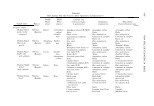
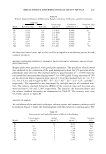
Sample name Texture Color Bought in "Hashmi Kaja!" Greasy Black Doha (pink circular (old souk) container) "Hashmi Kaja!" Greasy Black Doha (gold circular (old souk) container) "Hashmi Kaja!" Greasy Black Doha (blue stick/ (old souk) pencil) "Hashmi® Kaja!" Greasy Black Doha (B&W tube (old souk) with emblem) "Hashmi® Kohl Aswad" Powder Black Doha (with emblem) (matte) (old souk) "Hashmi Surma Sunef' Powder Grey- Doha (matte) Black (old souk) "Hind Ka Noor Powder Black Doha Eye Liner" (old souk) "Khojati® Mumtaz® Greasy Black Doha Cold Kaja!" (main souk) "Khojati® Surma Powder (Grey-) Doha No. 13® Black Black (old and [Export Quality}" main souks) "Khojati® Surma Powder (Grey-) Doha Sada" (matte) Black (old and main souks) "Kho! Noori" Powder Black Doha (shiny) (old souk) Table I Traditional Eye Cosmetics ("Kohls") Used in Qatar SEM (in decreasing Made in order of peak ht.) Pakistan Zn, C, 0 (Karachi) Zn,0,C (Si)N Pakistan C,Zn,O (Karachi) Zn, 0, cN Pakistan C,O (Karachi) C, Zn, 0, Pb, sz Pakistan Zn, C, 0 (S) (Karachi) C,O(S)2 Zn, 0, cN Pakistan Pb, S, C, 0 (Karachi) (Na/Zn) Pb, S, C, 0 (Zn)2 Pakistan Pb, S, C, 0 (Karachi) Pb, S, C, 0 (Zn)2 India C, Si, Mg, S, (Mumbai) 0 (Al, Zn/Na, Ca, Fe) C, Si, 0, S, Mg (Caf India C(O) (Satara) India Zn, 0, C, Si, Al, (Nashik) Ca, Fe Zn, 0, C, Fe (Si, s)2 India Pb, S, 0, C (Nashik) Pb, S, C, OQ France Pb, S, 0, C Pb, S (Si, 0, Na, Ca)N XRPD Main phase Zincite (ZnO)N ZinciteN Amorphous carbon Zincitez Zincite Amorphous carbonz ZinciteN Galena Galenaz Galena Galenaz Amorphous carbon Amorphous carbonz Amorphous carbon Zincite Zincitez Galena GalenaQ Galena GalenaN XRPD Minor phase(s)+ (Amorphous carbon)N (Paraffin wax)N (Amorphous carbon)N (Paraffin wax)N Paraffin wax Galena (PbS)2 (Amorphous carbon? (Paraffin wax) (Amorphous carbon) (Paraffin wax)N, z (Amorphous carbon)N None (Cerussite (PbC03))z (Anglesite (PbS04))z None (Anglesitef (Zincite)z (Cerussitef Talc (Mg3Si4010(0H)2) (Talc)2 (Quartz (Si02))2 Wax (Paraffin or Bees) Camphor (C10H160) (Amorphous carbon/graphite) (Camphor? (Amorphous carbon)2 (Quartz? (Cerussite) (Anglesite) (Anglesite)Q (Cerussite)Q (Cerussite) (Anglesite) (Cerussite)N (Anglesite)N t'0 Data++ Data++ on on medical contents' effects? Vendor comments y N (qual.) NZ NZ N N NZ NZ 0 y N Said to be 'cold' c (qua!.) � NZ NZ z y YIN Said to be 'cold' (qual.) 0 yz NZ NN NN 'Tj Y* Y* Said to be 'cold' n (qual.) 0 NZ NZ C/'J Y** N Said to be 'cold' � (qua!.) trJ Y**z NZ """"' n y Y* Said to be 'cold' C/'J (quant.) n NZ Y*z """"' trJ z n y y Described as "cold" & trJ (quant.) "OK for children" y y Described as "hot" (quant.) (both souks) & NZ NZ "for adults" y y Described as "cold" (quant.) (both souks) & yQ NQ "for children" N N Said to be 'cold' NN NN
Purchased for the exclusive use of nofirst nolast (unknown)
From: SCC Media Library & Resource Center (library.scconline.org)