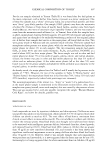
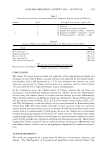
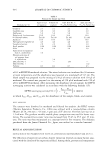
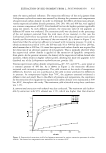
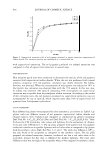
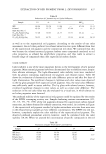
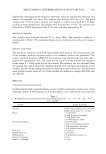
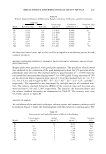
ANTI-INFLAMMATORY ACTIVITY OF C. ASIATICUM 429 Table I Clinical Evaluation Criteria of International Contact Dermatitis Research Group (ICDRG) (11) Symbol ± + ++ +++ Score 0 2 3 4 Table II Scoring of skin reaction: 5-point scale (1) Negative (2) Incomplete or irregular erythema (3) Regular well-defined erythema + induration (4) Significant erythema + induration + vesicle (5) Erythema purplish + induration + bullae Analysis of Results According to the Grade of the Mean Irritation Index (M.I.I.) Grade Non-irritating (1) Slightly irritating (2) Mean irritant (3) Very irritating ( 4) Very severely irritating (5) L quotation of the 8 readings (all volunteers) Mean irritation index (M.I.I.) = b f l ( . ) N um er o vo unteers X 8 readings CONCLUSIONS M.1.1. 0.00-0.24 0.25-0.99 1.00-1.99 2.00-2.99 3.00-4.00 The extract of Crinum asiaticum Linne var. japonicum! of the Amaryllidaceae family and designated as the 19th of Korea's natural treasures, was obtained by the ethanol extrac tion method, with a pH maintained at 3.5. It was confirmed that lycorine, an active molecule, was present in Crinum asiaticum Linne var. japonicum! and its content (about 1 % ) was identified by a high-performance liquid chromatogram. In the cytotoxicity assay, the ethanol extract of Crinum asiaticum did not show any cytotoxicity, instead showing slightly increased cell viability. In the anti-inflammatory activity assay, the ethanol extract of Crinum asiaticum showed good anti-inflammatory effects through inhibition of iNOS gene expression, followed by reduced NO production and the reduced release of PGE2 , IL-6, and IL-8 by various stimuli such as H202 , UV, and SDS. Furthermore, in the anti-allergic activity assay measured by �-hexosaminidase release from RBL-2H3 cells treated with IgE, Crinum asiaticum Linne var. japonicum extract showed good anti-allergic activity to decrease the �-hexosaminidase release to the control level at a concentration of 1000 µg/ml. In an in vivo clinical test to investigate the skin-sensitizing potentials of the extract of Crinum asiaticum, the repeated and single cutaneous applications of Crinum asiaticum Linne var. japonicum extract under an occlusive patch did not provoke any cumulative irritation and sensitization reaction. These results suggest that Crinum asiaticum Linne var. japonicum extract, having anti-inflammatory and anti-allergic effects, could be used as an appropriate ingredient for cosmeceutical prod ucts. ACKNOWLEDGMENTS This work was supported by a grant from the Ministry of Commerce, Industry, and Energy, "The Development of Cosmeceutical Ingredients from Natural Plants Like

430 JOURNAL OF COSMETIC SCIENCE Nymphaea tetragona of Jeju Plant" (Subject Number 2006-10027299), as the part of a regional specialization technique development project within a regional industry pro motional project of the Ministry of Commerce, Industry, and Energy. REFERENCES (1) A. M. Samud, M. Z. Asmawi, J. N. Sharma, and A. P. M. Yusof, Anti-inflammatory activity of Crinum asiaticum plant and its effect on bradykinin-induced contraction on isolated uterus, Immunopharmacol ogy, 43, 311-316 (1999). (2) S. 0. Okpo, F. Fatokun, and 0. 0. Adeyemi, Analgesic and anti-inflammatory activity of Crinum glaucum aqueous extract,]. Ethnopharmacol., 78, 207-211 (2001). (3) S. Yui, M. Mikami, M. Kitahara, and M. Yamazaki, The inhibitory effect of lycorine on tumor cell apoptosis induced by polymorphonuclear leukocyte-derived calprotectin, lmmunopharmacology, 40, 151-162 (1998). (4) S. Yui, M. Mikami, Y. Mimaki, Y. Sashida, and M. Yamazaki, Inhibition effect of Amaryllidaceae alkaloids, lycorine and lycoricidinol on macrophage TNF-production, Yakgaku Zasshi, 121(2), 167- 171 (2001). (5) F. Denizot and R. Lang, Rapid colorimetric assay for cell growth and survival: Modifications to the tetrazolium dye procedure giving improved sensitivity and reliability,]. lmmunol. Meth., 89, 271-277 (1986). (6) L. C. Green, D. A. Wagner, J. Glogowski, P. L. Skipper, J. S. Wishnok, and S. R. Tannenbaum, Analysis of nitrate, nitrite and [ 1 5 N}-nitrate in biological fluids, Anal. Biochem., 126, 131-138 (1982). (7) G. Dickneite, H-U. Schorlemmer, and H-H. Sedlacek, Use of lycorine as an immunosuppressor, US Patent 4,699,912 (1987). (8) R. G. Knowles and S. Moncada, Nitric oxide synthases in mammals, Biochem.J., 298, 249-258 (1994). (9) H. Cheong, E. J. Choi, G. S. Yoo, K-M Kim, and S. Y. Ryu, Desacetylmatricarin, an anti-allergic component from Taraxacum Platycarpum, Planta Med., 64, 577-578 (1998). (10) H. A. Shelanski and M. V. Shelanski, A New technique of human patch tests, Proc. Sci. Sect. Toilet Goods Assoc., 19, 46-49 (1953). (11) D.S. Wilkinson et al., Terminology of contact dermatitis, Acta Derm. Venereal., 50, 287-292 (1970). (12) H. T. Chung, H. 0. Pae, B. M. Choi, T. R. Billiar, and Y. M. Kim, Nitric oxide as a bioregulator of apoptosis, Biochem. Biophys. Res. Commun., 282, 1075-1079 (2001). (13) K. Xie, lnterleukin-8 and human cancer biology, Cytokine Growth Factor Rev., 12, 375-391 (2001). (14) M. Karin, Y. Cao, F. R. Greten, and Z. W. Li, NF-kappaB in cancer: From innocent bystander to major culprit. Nat. Rev. Cancer, 2, 301-310 (2002). (15) E. Loukinova, Z. Chen, C. Van Waes, and G. Dong, Expression of proangiogenic chemokine Gro 1 in low and high metastatic variants of Pam murine squamous cell carcinoma is differentially regulated by IL-1 alpha, EGF, and TGF-[31 through NF-KB dependent and independent mechanisms, Int.]. Cancer, 94, 637-644 (2001). (16) J. R. Vane and R. M. Botting, Anti-inflammatory drugs and their mechanism of action, Inflamm. Res., 47(Suppl 2), S78-S87 (1998). (17) L.B.Schwartz, R. A. Lewis, D. Seldin, and K. F. Austen, Acid hydrolases and tryptase from secretory granules of dispersed human lung mast cells, J. Immunol., 126(4), 1290-1294 (1981). (18) M. J. Fischer, J. J. Paulussen, D. A. Horbach, E. P. Roelofsen, J. C. van Miltenburg, N. J. de Mol, and L. H. Janssen, Inhibition of mediator release in RBL-2H3 cells by some H 1 -antagonist derived anti-allergic drugs: Relation to lipophilicity and membrane effects, Inflamm. Res., 44, 92-97 (1995).
Purchased for the exclusive use of nofirst nolast (unknown)
From: SCC Media Library & Resource Center (library.scconline.org)