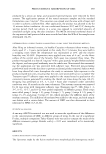
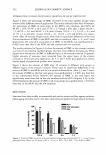
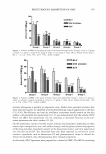
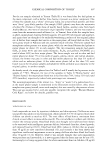
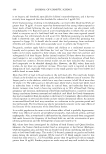
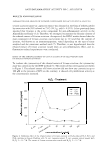
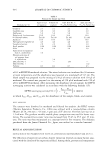
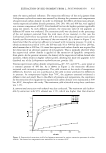
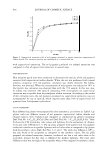
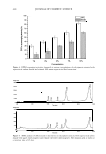
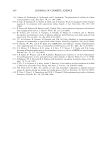
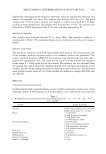
EXTRACTION OF RED PIGMENT FROM L. ERYTHRORHIZON 435 exert the most profound influence. The extraction efficiency of the red pigment from Lithospermum erythrorhizon roots was assessed by altering the pressures and temperatures of supercritical carbon dioxide. In order to determine the effects of extraction pressure, various supercritical carbon dioxide pressures, 100, 200, 300, and 400 bar, were applied at a constant temperature of 60°C. Four hundred bar was the highest pressure applicable using our system. At each different pressure, the extraction yield of red pigment at different S/F ratios was evaluated. The extraction yield was calculated as the percentage of the red pigment extracted from the total mass of raw material, in this case the Lithospermum erythrorhizon root powder. S/F is the ratio of the mass of supercritical carbon dioxide used for extraction to the mass of the raw material. As is shown in Figure 2, we determined that the extraction efficiency increased with increasing pressure. In order to obtain an extraction yield of 1.0%, the S/F was only SO at 400 bar and 130 at 200 bar, which meant that at 400 bar, 2.6 times less supercritical carbon dioxide was required for the extraction of an identical quantity of red pigment. This is normally observed when the supercritical carbon dioxide is applied to the extraction of lipophilic compounds from plants. As the pressure increases, the density of the supercritical carbon dioxide also increases, which results in higher solvent power, allowing for more red pigment to be dissolved out of the Lithospermum erythrorhizon root powder (16). Various supercritical carbon dioxide temperatures-40°, 50°, and 60°C-were tested at a constant pressure of 400 bar. As is shown in Figure 3, the extraction efficiency increased with increasing temperature. The yield increase as the result of temperature differences, however, was not as profound as the yield increase attributed to differences in pressure. At temperatures higher than 70°C, the pigment extracted evidenced a different color and smell. Due to the effects of pressure and temperature, the conditions for the extraction of red pigment via supercritical carbon dioxide were maintained at 400 bar, 60°C, throughout this study. The maximum yield achievable using these conditions was 1.2%. A conventional extraction with ethanol was also conducted. The maximum yield achiev able by extraction with 95% ethanol was 1.5%, which was higher than that observed 1.4 12 1.0 0.4 02 ■------ · 0 50 ---■-----■ -----■ ----- 100 bar -200bar --4-300 bar --.--400 bar ■--· -■--- 100 150 200 250 s/f ratio Figure 2. Supercritical extraction yield of red pigment measured at various extraction pressures of carbon dioxide. The extraction temperature was maintained at a constant 60 ° C.

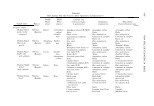
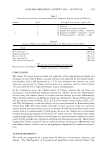
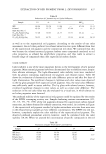
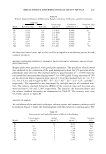
436 1.4 12 1.0 � 0.8 � w 5= 0.6 0.4 0.2 JOURNAL OF COSMETIC SCIENCE ----4o•c -----5o·c __,._60-c 0.0 +----r---r-----r-----r-�-----,-----,,---..----r-----1 50 100 150 200 250 s/f ratio Figure 3. Supercritical extraction yield of red pigment measured at various extraction temperatures of carbon dioxide. The extraction pressure was maintained at a constant 400 bar. with supercritical extraction. The red pigment produced via ethanol extraction was compared to that of supercritical extraction in several ways. SKIN IRRITATION Skin irritation patch tests were conducted to determine the toxicity of the red pigment extracted with supercritical carbon dioxide. When the test was performed with cosmol solution containing 17% red pigment, coloration was clearly observed. No edema, however, was detected. When the concentration of red pigment was reduced to 10% in the lipstick, less coloration was observed than with the 17% sample. In this test, also, no edema was observed. The lipstick containing 10% red pigment via supercritical extraction was acceptable from the standpoint of skin irritation. According to the results of skin irritation tests, the red pigment generated via supercritical extraction was not recommended for use in lipstick, which requires more than 10% of supercritical red pigment from Lithospermum erythrorhizon. COLOR ASSESSMENT Four different lip glosses were prepared for color assessment, as is shown in Table I. Lip glosses with two different sources of red pigment, supercritical carbon dioxide and ethanol extracts, were evaluated and compared to commercial lip glosses containing D&C Red No. 6 (C 18 H 1 4N2 06S·2Na) and D&C Red No. 7 (C 18 H 1 4N2 06S·Ca). Table II shows the CIE tristimulus color values and lightness for the evaluations of chroma ticity and color differences (17). The lip gloss prepared with supercritical red pigment evidenced a similar or acceptable lightness and red color value as compared to lip glosses with the synthetic colors, D&C Red Nos. 5, 6, and 7. The total color difference, dE*a6, was also found to be acceptable as compared to the synthetic colors. The lip gloss prepared via ethanol extraction, however, evidenced too low a red color value to be acceptable, despite the fact that it exhibited the highest lightness. The total color difference value was too high to be acceptable when it was compared to synthetic colors,
Purchased for the exclusive use of nofirst nolast (unknown)
From: SCC Media Library & Resource Center (library.scconline.org)