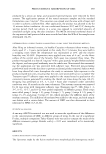
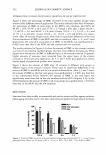
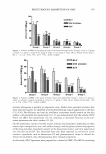
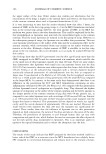
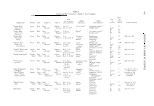
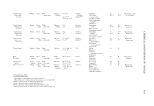
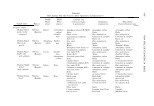
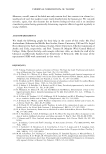
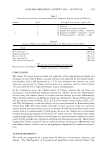
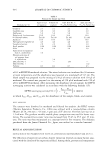
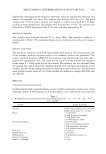
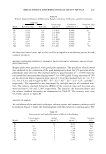
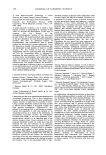
Table IV Other Analyses of Kohl Samples No. containing n Made in Purchased in lead (%) Non-lead elements/compounds 11 India and Pakistan Midlands (UK) 6 (55%) Zn, C/Menthol, herbs, pearls 13 Not given Kuwait 11 (85%) C/Fe20 3 'H20, herbs 17 Nigeria Nigeria 17 (100%) C/herbs 21 Saudi Arabia and India Saudi Arabia 14 (67%) C, 0, S, Si, Ca, Fe, Al, Ti, Sb, Na, Zn, Cl, K 47 Mostly India, Mostly Oman (39) 15 (32%) Mostly compounds based on Fe, Ca, Zn, Pakistan and Oman and B. Also, various C compounds. 23 Mostly India and United Arab Emirates (UAE) 11 (48%) Various largely as above Pakistan (Mostly Abu Dhabi, 18) 18 Egypt (11), India (4), Cairo 6 (33%) Various largely as above China, Sudan, and Saudi Arabia 27 Egypt (20), India (4), Cairo (18), Luxor (5), 6 (22%) Various largely as above China, Sudan, and and Aswan (4) Saudi Arabia 53 Pakistan, India, Iran, Dubai, Sharjah, Ajman, 23 (43%) Various largely as above Saudi Arabia, Dubai, Umm Al-Quwain, Ras France, Morocco, Al-Khaimah, and and Syria Fujairah Kohl analyses using only AA (atomic absorption) and/or CRM (confocal Raman microscopy): 22 Mostly India, Pakistan, World-wide6 13a (59%) Not given and Morocco 21 Mostly India, Pakistan, Bahrain r (33%) Not given and Saudi Arabia 6 Mostly India and Saudi Arabia 4a (67%) Sb (at less than 10%) in 5 samples Saudi Arabia 10 Pakistan Pakistan (Karachi) 8 (80%) Zn (in the 2 non-lead samples), SiOiall) 8 Mostly Saudi Arabia Saudi Arabia 6a (75%) Sb, As, Cd, and Pt (all at less than 1 %) 28 Egypt (18), imported (10) Egypt (Greater Cairo) W (50%) Not given 10 Morocco ( 6), Morocco (Marrakesh) 10 (100%) Not given imported (4) 107 Saudi Arabia, India, Saudi Arabia 62 (58%) Al, Sb (each at less than 1 % ) and camphor/ Pakistan, and Iran menthol found in a few samples 3 India (2) and Pakistan (1) United Arab Emirates (UAE) 2 (67%) Graphite/amorphous carbon a For above 1 % lead. 6 America, UK, Morocco, and Mauritania. Year and Method(s) used reference AA,XRPD (1979) (29) AA, XRPD, SEM (1981) (30) AA, XRPD, SEM (1984) (31) SEM (1995) (32) XRPD, SEM (1998) (6) n l: XRPD, SEM (2002) (8) � - XRPD, SEM (2004) (7) n r n XRPD, SEM (2006) (33) 0 � "iJ XRPD, SEM (2006) (2) 0 - 0 0 AA (1991) (34) 1-jj � AA (1992) (35) 0 AA (1993) (36) l: r AA (1994) (37) � AA (1995) (38) AA (1997) (39) AA (2001) (40) AA (2004) (41) CRM/AA (2005) (3) � ,.......

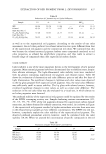
416 JOURNAL OF COSMETIC SCIENCE Over time there have been differences in the chemical compositions found for a few of the kohl samples studied here. Thus, in Tables I and II are listed the various major and minor phases found both here and in some of our prior publications for these samples. The "Hashmi Kajal" samples (in a B&W tube for both tables, and as a blue stick/pencil for Table I) are the only ones to have had variations-between amorphous carbon and zincite-in their major phases. For most of these variously analyzed samples, the minor phases have not changed significantly. One exception is in finding galena in both the "Hashmi Kajal" samples listed in Table II. We currently believe that this galena minor phase occurs as an occasional impurity with zincite ore from a particular location (galena often occurs as an impurity with the zinc ore sphalerite (ZnS), but only occasionally with the ore zincite). Also, over time there have been changes in the information provided, on both "contents data" and "medical effects," for some kohl samples. In the last two columns of Tables I and II are listed the varying "Y/N" symbols for samples studied here and in one or more of our prior publications. For "contents data" there have been changes for eight samples in Table I and for one sample in Table II. Most (i.e., six in Table I and one in Table II) of these changes are "positive"-that is, a change from providing no information on contents to providing at least some qualitative data. Regarding "Data on medical effects," six samples (in Table I) have changed from giving no such information to giving at least some such data. However, it should be stated that some of the information now given-for both contents and/or medicinal usage-is not always of the highest quality (see above). The non-lead elements or compounds found in our present study are broadly similar to those found in the previous studies in Table IV. However, several authors (32,36,38,41) did find antimony (usually in small/very small amounts) in some of their kohl samples, whereas in all our previous studies, as well as here, we found no antimony whatsoever. CONCLUSIONS In the 29 kohl samples analyzed overall in this study, 14 (48%) samples had galena (PbS) present to some degree. By country studied, this number and percentage change to: for Doha (Qatar), six (32%) out of 19 and eight (80%) of ten for Yemen. The other main phases found in our samples were amorphous carbon (three), iron oxides (one), quartz (one), sassolite (five), talc (one) and zincite (seven). In Yemen a large number of the samples for sale had no labeling whatsoever (and thus no written information on contents or possible medicinal usage) and were often locally made, whereas for Qatar all the samples found in the souks of Doha had been imported (mostly from India and Pakistan) and only one had no written labeling. This study thus shows that traditional eye cosmetics ("kohls") are readily available in the souks of Doha (Qatar) and Yemen. If a kohl sample was bought in a souk in Doha, there would be an approximately one-in-three probability that it would contain a lead com pound. For the souks of Saana, there would be a higher probability of a kohl sample bought there containing a lead compound (five of the seven samples, bought in two souks, contained galena, though in three samples only as a minor phase), and on the few (three) samples where labeling is present, there would be no information on lead's presence.
Purchased for the exclusive use of nofirst nolast (unknown)
From: SCC Media Library & Resource Center (library.scconline.org)