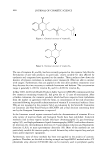
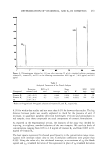
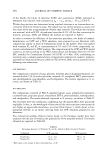
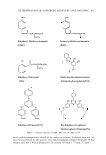
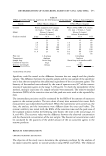
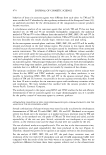
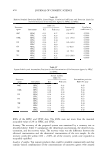
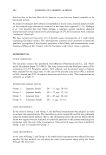
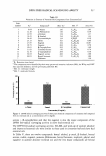
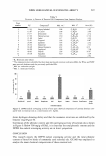
472 JOURNAL OF COSMETIC SCIENCE The UPLC used in the test was the Waters Acquity Ultra Performance Liquid Chro matographic system (Waters, Milford, MA). The system consisted of an Acquity 996 PDA detector, a binary pump, an autosampler, and a column oven. The data was collected and processed by Empower II. The column used was a Waters UPLC BHS Cl8 column (2.1 mm x 50 mm, 1.7 µm). REAGENTS Ethylhexyl methoxycinnamate (Parsol MCX, OMC) was purchased from TCI (Tokyo, Japan), isoamyl p-methoxycinnamate (Neoheliopan ElO00, IMC) was purchased from Symrise (Holzminden, Germany), ethylhexyl salicylate (Escalol 587, OS) was purchased from Sigma (St. Louis, MO), and ethylhexyl triazone (Uvinul Tl 50, OT) was purchased from BASF (New Jersey, USA). Methylene bis-benzotriazolyl tetramethyl butylphenol (Tinosorb M, TM) and bis-ethyl hexyloxy phenol methoxyphenyl triazine (Tinosorb S, TS) were purchased from Ciba (North Carolina, USA). Methanol, ethanol, acetonitrile, and dimethyl formamide of HPLC grade were purchased from Merck. All of the other chemicals were analytical grade (Sigma). SOLUTION PREPARATION Standard solutions. Stock standard solutions of the six sunscreen agents were prepared daily. Into a 100-ml volumetric flask were accurately weighed 19.5, 10.5, 14.2, 8.2, 16.4, and 7 .9 mg of OMC, IMC, OS, OT, TS, and TM, respectively. The solutions were dispersed with 100 ml of dimethyl formamide/methanol (50:50, v/v) by ultrasonication for 10 min. In order to build the corresponding calibration curves and evaluate the precision of the proposed method, working standard solutions of OMC, IMC, OS OT, TS, and TM were prepared as shown in Table I. Sample solution. Two hundred milligrams of the suncare product was accurately weighed into a 100-ml volumetric flask and dispersed with 100 ml of dimethyl formamide/ methanol (50:50, v/v) by ultrasonication for 10 min. The sample was filtered through 0.2-µm membrane filters (Whatman, NJ) and then analyzed by HPLC or UPLC. Method of analysis. The samples were analyzed through HPLC and UPLC. The operation conditions are summarized in Table II. Table I Preparation of Working Standard Solutions Cone. (g/ml) Flask size Flask ID Volume of Flask ID IMC OMC OS OT TM TS (ml) (source) source (ml) A 105 195 142 82 79 164 100 B 52.5 97.5 71 41 39.5 82 50 A 25 C 26.3 48.8 35.5 20.5 19.8 41 50 B 25 D 13.1 24.4 17.8 10.3 9.9 20.5 50 C 25 E 6.6 12.2 8.9 5.11 4.9 10.3 50 D 25

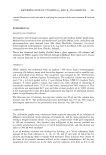
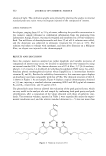
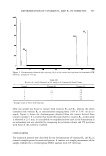
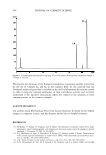
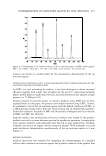
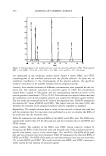
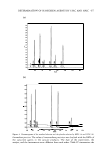
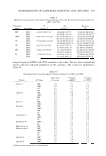
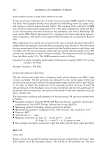
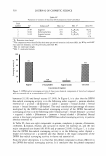
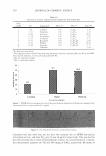
DETERMINATION OF SUNSCREEN AGENTS BY UPLC AND HPLC 473 Table II HPLC and UPLC Operation Conditions for Determination of Six Sunscreen Agents in Suncare Products System Column Eluent Gradient method Flow rate Temperature Sample loop Column of injection Detector wavelength VALIDATION STUDIES HPLC (Waters Alliance) Waters symmetry C 18column ( 4.6 mm x 75 mm, 3.5 µm) Solvent A (water) Solvent B (ethanol) Time % A % B 25 75 2.0 25 75 3.5 10' 90 5.5 00 100 10.5 00 100 11.0 25 75 1.0 ml/min Ambient Partial loop 10 µl 310 nm UPLC (Waters Acquity) Waters UPLC BHS C18 column (2.1 mm x 50 mm, 1.7 µm). Solvent A (water) Solvent B (methanol) Time % A % B 15 85 1.0 15 85 2.0 20 80 2.5 20 80 3.0 00 100 8.5 00 100 9.0 15 85 0.4 ml/min Ambient Partial loop with needle overfill 2 µl 310nm Specificity could be tested as the difference between the test sample and the placebo sample. The difference between the placebo sample and the test sample of the specificity test is that the test sample has the additional ingredients of the six sunscreen agents. The linearity of the method was evaluated by the sum of squares errors (R 2 ) of the concen trations of sunscreen agents in the range 5-200 µg/ml. To check the repeatability of the method, multiple injections of a sample solution were measured. The relative standard deviations (RSDs) of the retention time and the peak area were used as the repeatability data. The intermediate precision could be estimated by the RSDs of the amount of sunscreen agents in the suncare product. The test values of assay were measured two times. Each measurement was independently performed. When the experiments were carried out, the date, the analyst, and the instruments were different from the ones used before. The system's stability was tested with the RSDs of the retention time and the peak area of the standard solution within the following time frames: the time in the initial stage, 24 h, and 48 h. The recovery value was the difference between the observed concentration and the theoretical concentration of the test sample. The theoretical concentration could be calculated by the quantity of the added amount of the six sunscreen agents in the suncare products. RESULTS AND DISCUSSION CHROMATOGRAPHIC SEPARATION The objective of the study was to determine the optimum condition for the analysis of six major sunscreen agents in suncare product using HPLC and UPLC. The chemical
Purchased for the exclusive use of nofirst nolast (unknown)
From: SCC Media Library & Resource Center (library.scconline.org)