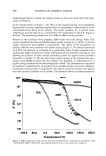
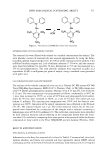
498 JOURNAL OF COSMETIC SCIENCE properties. As is the case for the industrial composites, the hair fibers provide the primary strength to the fixative composite. (With respect to fixative gel products, this sometimes goes against popular belief.) In both cases, it is important that the polymer adheres to the fibers. (2) The fixative gel glues multiple hair fibers together, creating a composite fiber with a larger effective diameter, and thus, higher stiffness. Good adhe sion between the polymer and the fibers allows stress transfer between the polymer and fiber and is necessary to achieve composite properties. Polymer cohesion, which is affected by molecular weight, architecture, crystallinity, polar interactions, hydrogen bonding, environmental conditions, and additives, contributes to the composite strength when there is sufficient polymer-hair adhesion. To demonstrate the connection of composite science and cosmetic formulation, the effect of the neutralizing base on the polymer film and hair fiber composite mechanical properties will be shown for polyacrylate-2 crosspolymer (Fixate™ Superhold polymer, Lubrizol Advanced Materials, Inc., Noveon® Consumer Specialties). Film testing will show how the neutralizer affects the cohesive properties of the polymer, and testing fixative-hair composites will measure the combined adhesive and cohesive properties. The results will be considered with respect to polymer composite principles, and the implications for fixative gel performance will be discussed. EXPERIMENTAL MATERIALS Gels were prepared using 3 wt% (solids) polyacrylate-2 crosspolymer (a (meth)acrylic acid-ester copolymer) and neutralizing to pH 7 with sodium hydroxide (NaOH), 2-amino-2-methyl-l-propanol (AMP), or triethanolamine (TEA). SAMPLE PREPARATION AND METHODS Polymer films were prepared on Mylar the dry film was approximately 0.25-mm thick. The films were allowed to d ry for a minimum of 48 hours at 23°C, 50% relative humidity (RH). Tensile testing of the films was done with an XT-Plus Texture Analyser (Texture Technologies). All testing was performed at 23°C, 50% RH using the sample geometry described in ASTM D 882-02 (3) and a rate of 5 cm/min. Young's modulus (4), calculated as the slope of the linear portion of the stress versus strain curve, and elongation at break were obtained for comparison. Dynamic mechanical analysis (DMA) was performed on a TA RSA3 Dynamic Mechani cal Analyzer (TA Instruments) using rectangular samples of polymer film. Samples were tested in extension from -100° to 200°C at a frequency of 1 Hz and a strain of 0.05%. The glass transition temperature (T ) was chosen as the onset of the decrease in the I g elastic modulus (E ). The stiffness of the fixative-hair composite samples was performed using an XT-Plus Texture Analyser in a three-point bend configuration. Composite samples for this test were prepared by applying 0.8 g of fixative gel to virgin Chinese hair tresses weighing 2. 5 g and measuring 16. 5 cm in length. The prepared tresses were sandwiched between

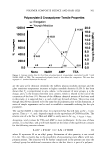
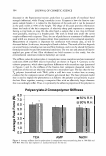
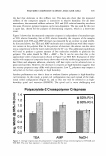
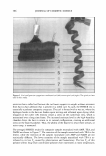
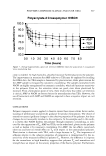
POLYMER COMPOSITE SCIENCE AND HAIR GELS 499 perforated, Teflon-coated plates and clamped using spacers to maintain a flat, rectan gular geometry while the samples were dried for 24 hours at 23 ° C, 50% RH. For high-humidity testing, the dried samples were conditioned for an additional 24 hours at 25°C, 90% RH. Testing was done using a support span of 2.54 cm and a flexure rate of 40 mm/s. The data were plotted as force versus time. Peak force was used as a measure of stiffness instead of Young's modulus (5 ), which is in the linear deformation region of the curve, because it is a better probe of adhesion (6). Five samples were prepared per gel, and the averages were reported. High-humidity spiral curl retention (HHSCR) testing was performed on fixative composite samples. Gel (0.1 g) was applied to a European brown hair tress weighing 0.5 g and measuring 16.5 cm in length. Application and distribution of the gel was done with the tress on a balance to ensure accurate loading. The treated tresses were wrapped onto curlers with a machined spiral groove, secured, and dried for 24 hours at 23 ° C, 50% RH. The dried tresses were carefully unwrapped and hung on a ruled peg board. The initial length of the curls was recorded, and the peg board assembly was placed into a humidity cabinet at 25°C, 90% RH. Readings were taken every 15 minutes for the first hour, then every half hour for hours two through four, and every hour for hours five through eight. The curl retention is calculated as: % Curl retention= (L - L r )/(L - L 0) X 100 (1) where L is the length of the uncurled tress, L r is the length of the curl at the time of the reading, and L0 is the length of the curl at the start of the experiment. The length of the tress is denoted as the lowest line number (on the peg board) that is below the entire tress. Ten tresses were prepared per gel, and the averages were reported. RESULTS AND DISCUSSION Traditionally, rigid polymers have been used in fixative applications to create stiff-hold hairstyles. It is generally believed that the fixative polymer stiffens the hair since the stiffness of treated hair is more rigid than that of the untreated hair fibers. However, it will be demonstrated that fixative-treated hair is a polymer-fiber composite. Thus, the hair fibers are the primary source of strength of the composite, and adhesion is of prime importance in achieving polymer composite properties. Nonetheless, this does not mean that the cohesive properties are unimportant. With adequate adhesion, the cohesive strength of the polymer affects the stiffness of the composite. Therefore, the cohesive properties of potential fixative polymers must also be considered. Cohesion of fixative polymers is probed by mechanical tests on thin films. FILM PROPERTIES Dynamic mechanical analysis (DMA) and tensile testing are conducted to give compli mentary information on polymer cohesion. DMA is used to measure the glass transition temperature (T g ), melting temperature(s), and crosslinking, all of which affect the stiffness of the polymer. Since most fixative polymers are amorphous, T g is the most important parameter for describing rigidity. T g is a measure of the cohesive energy of the polymer. It represents the thermal energy needed to overcome attractive forces and
Purchased for the exclusive use of nofirst nolast (unknown)
From: SCC Media Library & Resource Center (library.scconline.org)