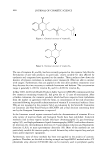
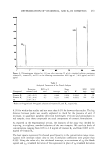
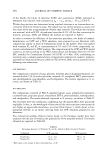
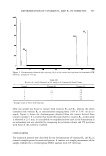
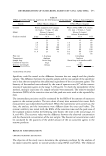
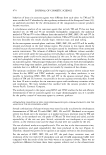
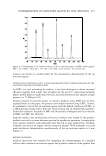
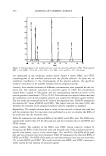
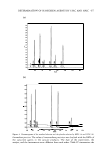
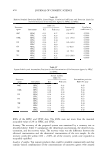
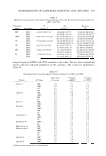
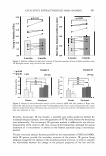
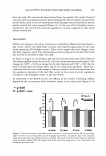
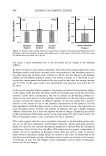
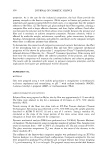
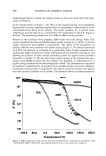
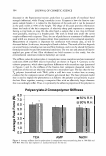
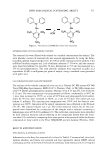
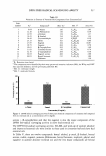
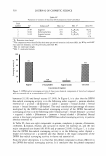
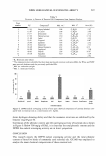
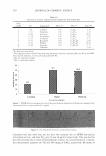
520 JOURNAL OF COSMETIC SCIENCE Table VI Variation in Content of Essential Oil Components from Thyme Red Peak number 1 2 3 4 5 6 7 8 * R/ 8.8 9.37 12.04 12.18 13.24 14.77 21.66 21.86 a R/ Retention time (min). Compound6 Mol. wt.c Mol. f.d a-Pinene 136 C10H16 Camphene 136 C,oH,6 p-Cymene 134 CIOHl4 d-Limonene 136 CIOHl6 Crithmene 136 C,0H 1 6 �-Linalool 154 CIOH18O Thymol 150 C 10 H 1 4O Carvacrol 150 C10H14O Unknown Area(%) 1.26 1.32 23.8 2.82 0.77 2.66 63.65 2.27 1.45 6 The components were identified by their mass spectra and retention indicators (Rls), the Wiley and NIST mass spectral databases, and the previously published Rls. c Mol. wt: molecular weight. J Mol. f.: molecular formula. 60 50 0 20.9 p-Cyrnene 50.7 48.02 Th)'1110l Thyme red Concentration (lmg/mL) Figure 7. DPPH radical scavenging activity of two pure chemical components of thyme red compared with its essential oils at a concentration of 1 mg/ml. Figure 8. The delocalized structures of the phenol radical. Cinnamon leaf and clove bud are the best two essential oils in DPPH free-radical scavenging activity, and their EC 50 are 5 3 and 36 µg/ml, respectively. They are also the best two essential oils in terms of total phenolic content. In a concentration of 1 mg/ml, the total phenolic amounts are 420 and 480 (mg/g of GAE), respectively. By means of

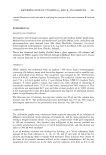
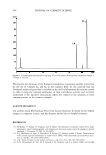
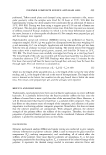
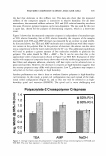
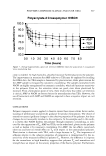
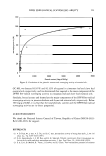
DPPH FREE-RADICAL SCAVENGING ABILITY 521 120 100 ♦ • - 80 � . 60 ·oo 40 20 0 0 1000 2000 3000 4000 5000 Phenolic content (10mg ofGAE'g) Figure 9. Correlation of the phenolic content and scavenging activity of essential oils. GC-MS, we detected 82.87% and 82.32% of eugenol in cinnamon leaf and clove bud essential oils, respectively, and we determined that eugenol is the main component of the DPPH free-radical scavenging activity in cinnamon leaf and clove bud essential oils. Similarly, benzyl acetate and thymol are the major components of the DPPH free-radical scavenging activity in jasmine absolute and thyme red essential oils, respectively. Below 500 mg/g of GAE, it is clear that the total phenolic content and the DPPH free-radical scavenging activity are in direct proportion. ACKNOWLEDGMENT We thank the National Science Council of Taiwan, Republic of China (NSC96-2622- B241-001-CC3) for support. REFERENCES (1) P. D. Duh, W. J. Yen, P. C. Du, and G. C. Yen, Antioxidant activity of mung bean hulls,]. Am. Oil Chem. Soc., 74, 1059-1063 (1997). (2) G. K. Jayaprakasha, L. J. M. Rao, and K. K. Sakariah, Volatile constituents from Cinnamomum zey lanicum fruit stalks and their antioxidant activities,]. Agr. Food Chem., 51, 4344--4348 (2003). (3) E. A. Lissi, B. Modak, R. Torres, J. Escobar, and A. Urzua, Total antioxidant potential of resinous
Purchased for the exclusive use of nofirst nolast (unknown)
From: SCC Media Library & Resource Center (library.scconline.org)