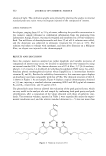
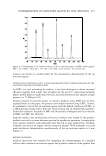
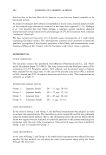
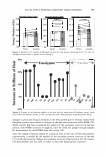
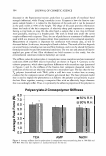
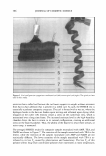
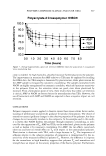
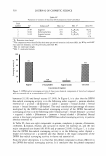
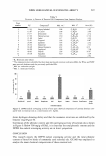
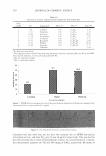
504 JOURNAL OF COSMETIC SCIENCE discussed in the Experimental section, peak force is a good probe of interfacial bond strength (adhesion), while Young's modulus is not. Crispness is how the fixative com posite sample breaks it is related to the sharpness of the peak and it can be measured as the peak width at 95% of the height. The shape of the peak provides information about the break of the hair composite. A relatively sharp peak represents a composite having a crisp break, or snap. On the other hand, a sample that is not crisp will break more gradually, resulting in a broader peak. The work to break (area under the curve) couples stiffness with crispness. Thus, the use of peak force as a measure of stiffness and peak width as a measure of crispness allows these parameters to be evaluated separately. Measurement of crispness is important for correlation with sensory data, as will be discussed below. In this test, the sample is flexed to failure. The mode of failure depends on several factors, including test rate and film thickness, and it can be altered by fixative formulation additives and environmental conditions. The test rate and amount of fixative applied per gram of hair (film thickness) are held constant in this study, but the environmental conditions (relative humidity) are varied. The stiffness values for polyacrylate-2 crosspolymer versus neutralizer and environmental conditions (50% and 90% relative humidity) are shown in Figure 4. Contrary to the cohesive properties, which show significant differences with neutralizer type (presented in Figures 1 and 2), the stiffness of the fixative-hair composite measured under the conditions of this test are relatively insensitive to neutralizer type. The fact that the low T 8 polymer (neutralized with TEA) yields a stiff hair tress is taken here as strong evidence for the composite nature of fixative gel-treated hair. The basic physical model that is used to explain the phenomena is as follows: the polymer acts primarily to glue the hair fibers together, creating a composite fiber with an effectively larger diameter that is accordingly stiffer. Thus, it is primarily the adhesive properties of the polymer to .--- 8.0 z ;- 7.0 � 6.0 0 u. 5.0 � ! 4.0 a, 3.0 en 2.0 cu 1.0 CC 0.0 Polyacrylate-2 Crosspolymer Stiffness TEA AMP ■ 50% R.H. lIIl 90% R.H. NaOH Figure 4. Average stiffness data for polyacrylate-2 crosspolymer versus neutralizing base at 50% RH and 90% RH. The error bars represent ± 1 standard deviation for the test.

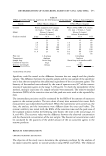
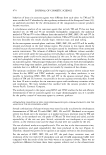
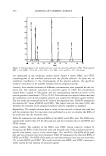
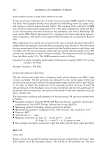
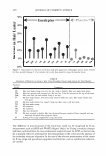
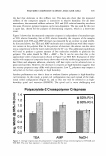
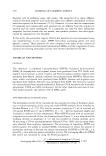
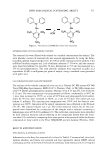
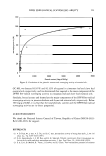
POLYMER COMPOSITE SCIENCE AND HAIR GELS 505 the hair that dominate in this stiffness test. The data also show that the measured stiffness of the composite samples is insensitive to relative humidity. For all three neutralizers, the measured stiffness values at 50% and 90% relative humidity are about the same. However, polymer response can be rate-dependent. The rate used for this test is quite fast, chosen for the purpose of determining crispness, which is a short-time event. Figure 5 shows that the measured composite crispness is independent of neutralizer type at 50% relative humidity, but at 90% relative humidity the crispness of the samples neutralized with TEA and AMP decreases (as measured by an increase in peak width). As discussed above, the TEA and AMP molecules are in equilibrium with their respec tive cations in the polymer film. In the presence of moisture, the amines can also enter into a competition with the water molecules for the H + ion. This additional equilibrium will tend to produce a greater amount of free molecules available to plasticize the polymer. The order should be TEA AMP Na. It can be seen that this is the approximate order of plasticization shown in Figure 5 at 90% RH. Evaluation of these results with respect to composite theory shows that with the reinforcing properties of the hair fibers and adequate adhesion, relatively stiff hair styles can be achieved even in plasticized systems. However, the decrease in crispness at high humidity suggests that the sensory properties may differ with plasticization. Low T g polymers may impart a tacky feel on the hair, especially at high humidity. Another performance test that is done to evaluate fixative polymers is high-humidity curl retention. In this study, a spiral curl configuration was used instead of the tradi tional rolled configuration (Figure 6), and so this test will be referred to as high humidity spiral curl retention (HHSCR). The spiral curl is more challenging and .-.. 1.4 E E 1.2 .,_,, .... 1.0 � Cl u, 0.8 (§) 0.6 .c .... "C 0.4 ti . 0.2 CJ 0.0 Polyacrylate-2 Crosspolymer Crispness ! I •. f H :u l II iii LI! n , 111 ij I I TEA AMP 50% R.H. [TI] 90% R.H . NaOH Figure 5. Average crispness data for polyacrylate-2 crosspolymer versus neutralizing base at 50% RH and 90% RH. The error bars represent ± 1 standard deviation for the test.
Purchased for the exclusive use of nofirst nolast (unknown)
From: SCC Media Library & Resource Center (library.scconline.org)