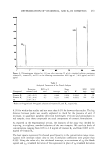
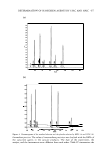
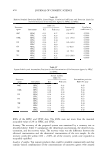
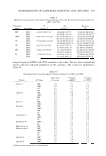
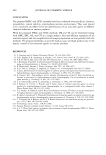
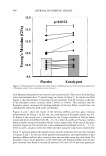
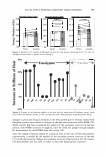
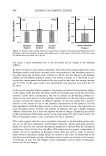
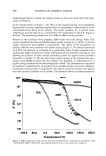
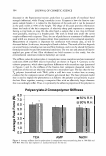
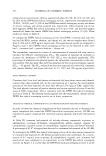
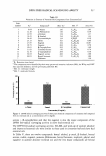
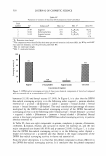
494 JOURNAL OF COSMETIC SCIENCE I.OS ---------- - - - --� 1.05 Q,I .. � 1.025 Q,I � """ Q Q 0.975 (a) Maximum Diameter Minimum Diameter N=67 Averaged Diameter � ... '9 1.025 Q,l � � """ Q Q 0.975 · 0.95 (b) N=67 Ratio of Min/Miax Diameter Figure 12. Relative values of hair diameters (a) and the hair diameter index (minimum/maximum) (b) for all panelists after three months of usage of Eucalyptus extract scalp lotions. The baseline is for those using the placebo lotion or before use of the EL. this result, a more remarkable fact 1s the individual rate of change m the bending stiffness. As shown in Figure 5, the number of panelists whose data show improvement after using Eucalyptus extract scalp lotion increases as the concentration of the Eucalyptus extract in the scalp lotion also increases, from 1.0wt% to 3.0wt%, but the change in the bending stiffness for the affected panelists seems to be almost constant. It is described in par ticular that improvement was observed for four panelists and that the average increase was 9. 7% for 1 % EL users, while it was observed for nine panelists to be 9.8% for 3% EL users. In the case of using hair-fixative products, the polymer contained in the products adheres to the surface of the hair fiber and forms a film the bending stress of the hair fiber then increases. Under these circumstances, the rate of increase in the bending stiffness in creases as the used amount or the polymer concentration of the hair-fixative product increases, because the amount of adhesive polymer on the hair surface has a positive relation to the amount of use or the polymer concentration of the products. For the dose-dependence of the Eucalyptus extract in the scalp lotion, however, the application of more Eucalyptus extract increases the number of panelists who get a higher bending stiffness of hair fiber, but it does not improve the rate of change. Comparing the results of the concentration of Eucalyptus extract in the scalp lotion of 0. 5wt% and 1.0wt%, the effect of Eucalyptus extract is not continuous but has a threshold. This study suggests that the active ingredient contained in the Eucalyptus extract does not act on the hair components (intermediate filaments, keratin-associated proteins, lipids, etc.) directly, but controls the physical properties of the hair fiber by a biological mechanism. From the fact that the effect of Eucalyptus extract appears independent of gender, the active ingredient of Eucalyptus extract does not seem to relate to sex hor mone-related compounds, though details are unclear at this time. As mentioned in the Introduction and Results sections, Eucalyptus extract induces an increase in the amount of ceramides in skin, but the changes in hair components, such as lipids, by Eucalyptus extract are not yet known.

EUCALYPTUS EXTRACT-INDUCED HAIR CHANGES 495 In order to carry out the area-selective Young's modulus measurement and analysis of the hair structure, we selected the nano-indentation mode of AFM. Previously, nano indentation has been used to compare differences between different components of keratin fibers, such as the cortex and cuticle, or between subcomponents, such as the exo and endocuticle (25). Until now, measurement of physical properties, such as the bend ing elasticity of the cortex, has been achieved after removing cuticle layers from the hair shaft by various preprocessing methods (20). As the presence of the medulla in Japanese hair and its influence on mechanical properties could not be disregarded, the interpre tation of the analytical result was difficult. By use of the nano-indentation method, evaluation of the physical properties of each component in the hair, such as medulla, cortex, and cuticle, becomes possible in the intact condition without undergoing re duced pressure, as is the case in observation by TEM. For this reason, the nano indentation method seems to be a powerful method for not only comparison of me chanical properties, such as before- and after-perm processing, but also for the compara tive study of the physical properties of hair between different ethnic groups. According to any interpretation of the analytical results of the secondary structure of the protein by IR microscopy, changes in the physical properties of hair with Eucalyptus extract are caused by an increase in the beta structure in the cortex, since the molar fraction of the beta structure in the cortex increases in the new-growth part of the hair treated with Eucalyptus extract scalp lotion. Until recently, it has been thought that an increase or a change in the alpha structure of the proteins that compose IFs plays a major and essential role in the improvement of mechanical properties, such as the improvement in Young's modulus. In recent years, however, it has become clear that the physical and mechanical character (stiffness and flexibility) of a globular protein is affected more by the beta structure than the alpha structure. Analysis by supersonic wave spectroscopy makes clear that the beta structure is a stronger structure in comparison to the alpha structure (28-32). In other words, an increase in the alpha structure, which shows a strong mechanical molecular configuration, generates "distortion for the entire molecule" the deterioration of physi cal and mechanical properties will be caused by this distortion. From this viewpoint, it can be considered that the increase in the Young's modulus of the hair fibers in this study originates through an increase in the beta structure. More over, in the case of the protein that composes the hair, it is thought that the beta structure exists in/around KAP. It can be said that a new aspect has opened from this study, in that we suggest that the matrix proteins play an essential role in the mechanical and physical properties of hair. Further investigations are necessary to confirm or deny our interpretations of the changes in hair proteins, such as conformations and configu rations, since proteins are the main components of hair and have a large influence on hair properties. REFERENCES (1) Biotechnology in Agriculture and Forestry, Y.P.S. Bajaj, Ed. (Springer-Verlag, Berlin), Vol. 4, Medicinal and Aromatic Plants I (1988) Vol. 7, Medicinal and Aromatic Plants II (1989) Vol. 15, Medicinal and Aromatic Plants Ill (1991). (2) E. Wakisaka, et al., 32nd Annual ESDR Meeting, September 19-21, 2002. (3) G. Imokawa, et al.,]. Invest. Dermatol., 96, 523-526 (1991).
Purchased for the exclusive use of nofirst nolast (unknown)
From: SCC Media Library & Resource Center (library.scconline.org)