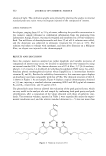
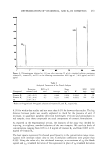
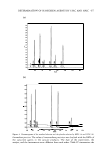
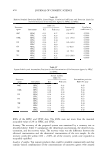
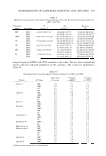
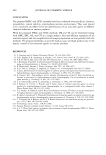
474 JOURNAL OF COSMETIC SCIENCE behaviors of these six sunscreen agents were different from each other. As TM and TS were certified as UV absorbers by the regulatory authorities of the European Union (15), an analytical procedure for the determination of the compounds in suncare products became necessary. A simultaneous analysis of six sunscreen agents that include TM and TS has not been reported yet. As TM and TS are extremely hydrophobic compounds, the analytical method of TM and TS is also different from the method of OMC, IMC, OS, and OT. In the case of the non-aqueous reversed-phase condition, TM and TS could be analyzed with the most favorable test results of peak shape, retention type, and peak tailing. In the non-aqueous reversed-phase condition, OMC, IMC, OS, and OT will be weakly retained and eluted in the void volume region. The elution in this region should be avoided because of poor resolution in the region caused by interference from unretained matrix constituents. The columns of different lengths and different column manufac turers were tested under the non-aqueous reversed-phase condition. The separation of all component peaks could not be exactly obtained in this case. In the case of the column with less hydrophobic sorbent, the retention and the separation were satisfactory for the six sunscreen agents. The principal weak points of the column test with less hydrophobic sorbent were long-time analysis, peak broadness, and peak tailing. From the test, we can conclude that it is difficult to improve test results by variation of the column. The optimum conditions of the gradient and the organic-aqueous solvent mixture were chosen for the HPLC and UPLC methods, respectively. In these conditions, it was possible to determine OMC, IMC, OS, and OT in the aqueous reversed phase. The analysis of TM and TS, however, was possible in the non-aqueous reversed phase. It took less than 10 min to analyze the six sunscreen agents with satisfactory retention values and resolutions. We have validated this method with the suncare products of the Amore-Pacific Cosmetic Company. The method proposed in this paper using HPLC and UPLC enables the fast and efficient determination of the six sunscreen agents in a single chromatographic run. It is suitable for the quality control of sunscreen agents in cosmetic products. OPTIMIZATION CONDITION OF HPLC (HIGH-PERFORMANCE LIQUID CHROMATOGRAPHY) FOR THE ANALYSIS OF THE SIX SUNSCREEN AGENTS Several combinations of eluent mixtures were tested in order to achieve the simultaneous determination of TM and TS with OMC, IMC, OS, and OT. Methanol as an organic solvent was found out to be improper, as it needed too long a retention time for TM and TS. Also, in the methanol test, the peaks of TM and TS were broad and tailed, and the repeatability of the test was poor. Second, acetonitrile was inadequate as an organic solvent, as the retention time and the shape of peak were not suitable for the test. The test of ethanol made an acceptable result. This was due to the short retention time, high resolution, and good repeatability that were produced in the test (Figure 2). Therefore, ethanol was proven to be superior as an organic solvent in the determination. For the analysis of OMC, IMC, OS, and OT, the peak shape, retention time, and resolution of the test with 0.1 % phosphoric acid and 20 mM ammonium buffer were compared with the result of the test with water as an aqueous solvent. There was no significant difference between these three aqueous solvents and so the ethanol-water

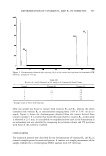
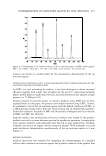
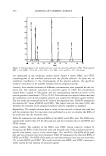
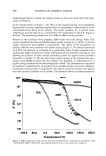
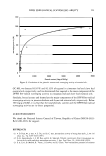
DETERMINATION OF SUNSCREEN AGENTS BY UPLC AND HPLC 475 0 0 u � � � � � � � � � u � � .. Figure 2. Chromatogram of the standard solution of the six sunscreen agents by HPLC. Peaks (µg/ml): IMC = 26.3, OMC = 48.8, OS = 35.5, OT = 20.5, TM = 19.8, and TS = 41.0 (310.0 nm). mixture was chosen as a mobile phase for the simultaneous determination of the six sunscreen agents. OPTIMIZATION CONDITION OF UPLC (ULTRA-PERFORMANCE LIQUID CHROMATOGRAPHY) IN THE ANALYSIS OF THE SIX SUNSCREEN AGENTS As UPLC is a new technology for analysis, it has been developed to obtain increased efficiency together with a short time of analysis by the use of 1. 7 -um porous stationary phases, mobile phases at high linear velocities, and instrumentation that operates at high pressure (ca. 15.000 psi) (16). Analysis research of sunscreen agents in cosmetic products using UPLC has not been reported before. In this paper, we present a new analysis method using UPLC. At first, we performed a test of the six sunscreen agents with the default condition of UPLC in a 100-mm-long column with a flow rate of 0.4 ml/min and an ethanol-water gradient. Under this condition, the peaks of IMC and OS partially overlapped and the co-elution of OMC and IMC was observed. From the results, some modifications of the test condition were needed. In the gradient method, we tried to increase the water portion for satisfactory separation. Increasing the water portion, however, took additional time that led to poor productivity. Secondly, methanol was used as an organic solvent instead of ethanol. With methanol, we could make satisfactory determination simultaneously of the six sunscreen agents in 8 min (Figure 3). METHOD VALIDATION Specificity. Specificity was evaluated by comparing the chromatograms of a standard solution that contained six sunscreen agents and a placebo solution of the product that
Purchased for the exclusive use of nofirst nolast (unknown)
From: SCC Media Library & Resource Center (library.scconline.org)