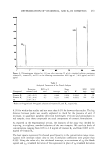
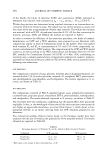
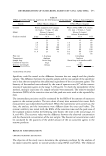
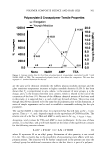
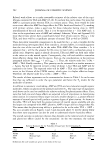
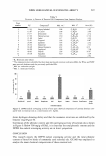
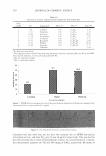
502 JOURNAL OF COSMETIC SCIENCE Related work allows us to make reasonable estimates of the relative sizes of the equi librium constants for TEA and AMP (15,16). To see how this can be done, first note that AMP is a primary amine whereas TEA is a tertiary amine. Thus, there would be little or no steric effects for AMP but large effects for TEA. Smith and Goulet (15), working with primary amines, make a good case for these molecules having close to 100% neutralization of the acid species. Thus it is to be expected that q - 1 for AMP and c is close to the equivalence ratio of AMP and carboxyl. Likewise, Weiss and Agarwal (16) show that tertiary amines have a significantly lower level of ionic species. Thus q 1 for TEA, and there will be a significant amount of neutral TEA as well as COOH. These data allow reasonable comparisons to be made for the c! q! and a variables for the molecules being investigated here. First consider a. As noted above, it is readily apparent that the size of the ion will be in the order TEA AMP Na. Next consider c. It is apparent that c will be the greatest for Na since its bond with a carboxylate group is purely ionic. However, again as already discussed, TEA and AMP can both exist either as the cation or as the neutral species. Consequently, they will each exhibit a somewhat lower effective charge than the Na species. Even so, the considerations in the previous paragraph indicate that c AMP - 1 and cTEA 1. Thus, the relative order for c is Na - AMP TEA. Finally consider q. This quantity can be estimated in a similar manner to c. Again, Na will be expected to have a value of about 1, but TEA and AMP will be expected to be lower. The expected order will be AMP TEA since AMP has greater access to the H atom of the COOH moiety, which gives it a higher effective charge. Therefore, the relative order for q is Na AMP TEA. The results of these arguments can be summarized as shown in Table I. It can be seen that they are sufficient to order the cqla parameter and hence the T g results for the molecules of interest. In addition to ionomeric crosslinking, AMP and TEA are low-molecular-weight organic molecules, which can plasticize the polymer and lower T g· The same type of arguments used above can be used to establish the relative ordering for plasticization effects. First, note that both size and charge effects are expected to be of importance in determining plasticization. It is expected that a larger size and a smaller charge (i.e., a greater effective amount of neutral species) will produce a greater degree of plasticization. As shown in the table, TEA will have both the greatest amount of neutral species available and also the largest size compared with AMP. Likewise, AMP is larger and less charged than Na. This means that the plasticizing ability is predicted to be in the order TEA AMP Na, as is actually seen in Figures 1 and 2 and discussed above. It will be shown below that these same arguments can also be used to understand relative humidity effects. The overall outcome on polymer cohesion thus depends on the relative levels of ionomer and plasticizer effects caused by the neutralizer. At the two extremes, the sodium Table I Relative Estimates for the Variables of Importance for Determining T g Base q a cqla NaOH High High Low High AMP Medium-high Medium Medium Medium TEA Low Low High Low Definitions for each variable are given in the body of the text.

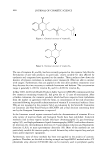
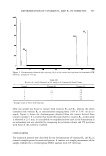
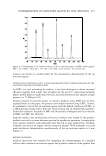
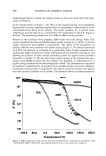
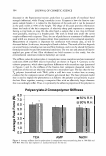
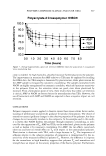
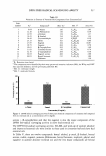
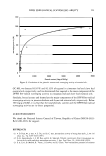
POLYMER COMPOSITE SCIENCE AND HAIR GELS 503 8 7 -- Peak Force 6 i Peak Width at - 5 z 95% Peak Height ._. m 4 � 0 3 LL 2 1 a Distance (mm) or Time (s) Figure 3. Sample data for the three-point bend stiffness test. Force versus time is measured stiffness is calculated as the peak force, and crispness is calculated as the width of the peak at 95% of the height. counterion has the strongest ionomer effect without plasticization, and the TEA coun terion has the weakest ionomer effect and causes considerable plasticization. The iono meric crosslinking and plasticization effects appear to cancel each other out for AMP, and the T g is nearly unchanged from that of the acid form. Therefore, with respect to fixative applications involving acrylic copolymers with acid functional groups, NaOH may be used to make the polymer harder, AMP may be used to maintain the hardness of the acid form of the polymer,1 and TEA may be used to soften a polymer that has a tendency to crack and flake but may cause an increase in tack (if the T g is lowered to below room temperature). PERFORMANCE PROPERTIES If the composite theory presented here holds, then fixative performance tests should be able to probe the adhesive as well as the cohesive properties of the polymer. Two of the most important fixative performance tests are stiffness and crispness. A three-point bend method developed from a standard test for composite materials (17) was used to measure the stiffness and crispness of fixative composite samples. The data from this test can be plotted as force versus time, as shown in Figure 3. The stiffness of the fixative composite is defined as the force needed to bend or break the hair composite for this method, stiffness is measured as the peak force of flexure instead of Young's modulus or work. As 1 The AMP polymer has the same T g as the acid form of the polymer under dry nitrogen conditions. At higher humidity conditions, the T g may be lower since neutralization of the acid groups increases the hydrophilicity of the polymer.
Purchased for the exclusive use of nofirst nolast (unknown)
From: SCC Media Library & Resource Center (library.scconline.org)