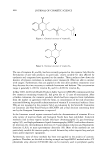
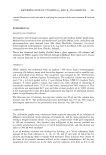
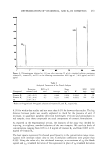
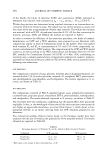
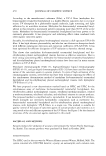
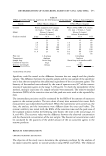
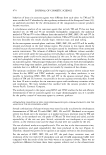
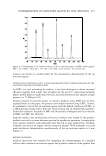
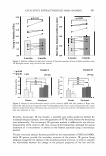
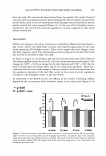
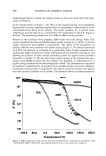
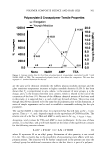
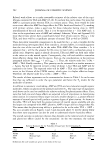
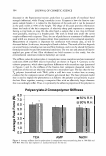
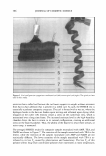
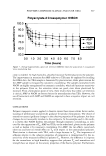
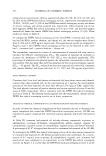
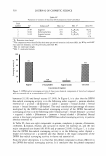
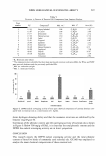
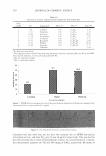
500 JOURNAL OF COSMETIC SCIENCE morphological factors to allow the polymer chains to move past each other with long range coordination. In the example shown in Figure 1, the effect of the neutralizing base on an amorphous (meth)acrylic acid-ester copolymer (polyacrylate-2 crosspolymer) is shown relative to the unneutralized (acid form) of the polymer. The elastic modulus, E', is plotted versus temperature, and the onset of T g is indicated by the temperature at which E' begins to decrease. The neutralizing bases have very different effects on the polymer. Relative to the acid form of the polymer, AMP causes very little change, while TEA causes a significant decrease and NaOH causes a major increase in T g· In fact, T g for the sample neutralized with NaOH is indiscernible. The effects of the neutralizers on polymer cohesion were confirmed with tensile testing (Figure 2). The sample neutralized with TEA was softened, as evidenced by a significantly lower Young's modulus and a significantly higher elongation to break. TEA plasticizes the polymer, lowering Tg and allowing the polymer to relax instead of breaking under the applied stress (increased elongation to break) (7). On the other hand, tensile testing of the polymer film neu tralized with NaOH revealed that the polymer was hardened, as demonstrated by a higher Young's modulus and a lower elongation to break. This phenomenon is explained by ionomeric crosslinking (8). In polymers with ionizable groups, such as the carboxylic acid groups in polyacrylate-2 crosspolymer, electrostatic attraction between ionic species can create physical crosslinks in the polymer. The potential effects on polymer properties 1010 NaOH 109 TEA 108 AMP •□ - •□ □ -None ca � □ D.. 107 -\_□ - � #,fn LL.I � 106 � 105 104 -100.0 -50.0 0.0 50.0 100.0 150.0 200.0 Temperature (°C) Figure 1. DMA temperature sweep data for thin films of polyacrylate-2 crosspolymer, neutralized to pH 7 with NaOH, AMP, or TEA. The unneutralized polymer (none) is also shown for comparison.

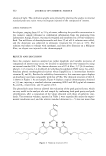
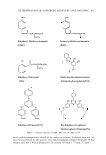
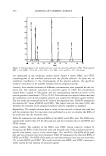
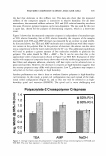
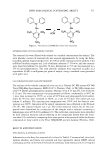
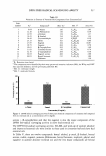
C 0 ca en C 0 � 0 POLYMER COMPOSITE SCIENCE AND HAIR GELS 501 Polyacrylate-2 Crosspolymer Tensile Properties ---.- Elongation 1200.0 ---- Young's Modulus 1000.0 800.0 600.0 400.0 200.0 4.2 4.3 0.0 None NaOH AMP TEA 20.0 18.0 ___ - 16.0 Ica 14.0 ';' ::I - -- 12.0 :i "Cl 10.0 j 8.0 en ·en - 6.0 C ::I , 4.0 � 2.0 0.0 Figure 2. Average tensile data for thin films of polyacrylate-2 crosspolymer, neutralized to pH 7 with NaOH, AMP, or TEA. The unneutralized polymer (none) is also shown for comparison. The error bars represent ± 1 standard deviation for the test. are the same as for chemical crosslinks: the rubbery plateau modulus increases and the glass transition temperature increases at higher crosslink densities (9,10). It has been shown that T g is proportional to cqla, where c is the amount of ionic groups, q is the charge, and a is the distance between ionic centers, which is related to the size of the counterion of the base (11). Because of the different chemical natures of the bases used in this study, it is expected that c) q, and a will vary for each of them. This is true even though the pH was ad justed to be the same for all polymers prior to film formation. A series of simple arguments can be used to establish a reasonable ordering for the cqla parameter. The case for NaOH is relatively clear. It is expected that Na will exist as the + 1 ionic species. Thus q = + 1, and c depends simply on the equivalents of COOH and Na. The relative size of a for Na vs TEA and AMP is easily seen to be: aNa a AMP aTEA· Assigning c and q values for TEA and AMP is more problematic. In the case of these amines, it is clear that c and q will both depend on the value of the equilibrium constant for the following reaction scheme: (2) where R represents H or an alkyl group. Estimation of this quantity is not trivial (12-14). This is mainly due to the possibility of encountering steric effects with non primary amines. The situation will be further complicated in the present case since the carboxyl group has additional constraints due to the fact that it is part of a polymer.
Purchased for the exclusive use of nofirst nolast (unknown)
From: SCC Media Library & Resource Center (library.scconline.org)