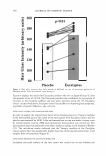
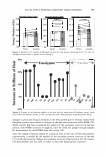
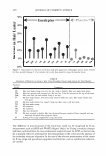
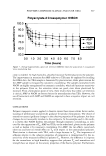
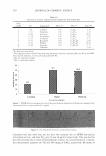
482 JOURNAL OF COSMETIC SCIENCE skin but also in the hair fiber (4-6) however no one has ever found ceramides to be functional in hair. As analysis techniques have advanced remarkably in recent years, detailed analysis results on the ceramide-type substances contained in hair have been reported (7-11). Hallegot et al. (12) reported that hair fibers develop a tolerance against oxidative chemical treatments such as hair bleach or the photodamage of UV after treatment with ceramide "analogous" chemicals. We have carried out long-term (2.5-3-month) usage investigations of a scalp lotion containing Eucalyptus extract. The investigations consisted of an interview to assess the panelists' perceptions of the physical properties of hair fibers, and measurements of the bending stiffness of hair treated with the Eucalyptus scalp lotion versus a placebo. EXPERIMENT AL LOTION COMPOSITION The Eucalyptus extract was purchased from Maruzen Pharmaceuticals Co., Ltd. (Ono michi, Hiroshima Japan 722-0062). The scalp lotions with the Eucalyptus extract (EL), containing 0.5-3% Eucalyptus extract, 50% ethanol, and de-ionized water to balance were prepared for the usage tests. In the case of the placebo scalp lotion (PL), a mixture of 50% ethanol and 50% de-ionized water was used twice a day. The compositions are indicated as weight % . INVESTIGATED PANELIST GROUPS Group 1: Group 2: Group 3: Group 4: Japanese female Japanese female Japanese male Caucasian female USAGE TEST METHOD A (N = 11, age: 26-41) (N = 17, age: 37-53) (N = 30, age: 32-41) (N = 9, age: 22-31) In the cases of Group 1 and Group 3, the half-head examination was adopted in order to exclude the seasonal factor. The distribution of the lotions EL and PL was performed using the double-blind method, that is, the information about the area on which the EL lotion was applied was not disclosed to either the panelists or the persons analyzing hair properties until the end of the investigation. The period of usage was three months for Group 1 and 2.5 months for Group 3. USAGE TEST METHOD B In the cases of Group 2 and Group 4, the whole-head examination was adopted for three months. By this method, we can assess the total consciousness about using the lotion through the interviews.

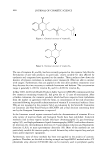
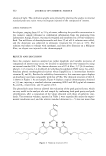
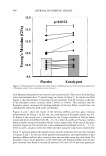
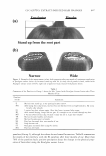
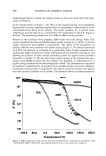
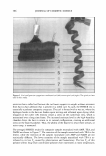
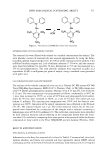
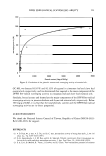
EUCALYPTUS EXTRACT-INDUCED HAIR CHANGES 483 SAMPLING OF HAIR FIBERS AND INTERVIEW WITH PANELISTS AFTER APPLICATION OF THE SCALP LOTION The samples of hair fibers were taken from a part as near to the scalp as possible, just before and after the scalp lotion usage survey. After application of the scalp lotion, interviews with the panelists were carried out. HAIR GLOSS INTENSITY MEASUREMENT For the measurement of hair gloss, hair gloss intensity equipment of our own making (13,14) was used. Its principle and directions for use are as indicated in references 13-16. HAIR DIAMETER MEASUREMENT The hair diameter was measured at 20°C and 65% RH using a SLB DIA measuring system (Kato Tee Ltd.) (17). Each hair was measured at five positions at intervals of 5 mm along the hair axis. At each position, the hair was rotated and measured every 30° . The averaged values of the maximum and minimum values for five positions were set to be the major (a) and the minor axes (b), respectively. The cross-sectional area of the hair fiber was calculated using the major axis and the minor axis, assuming the hair cross section to be ellipsoid. BENDING STRESS MEASUREMENTS (18,19) Two pieces of graph paper (length: 51 mm, width: 15 mm), with double-sided adhesive tape, were placed 10 mm apart from each other and in parallel. Fifty hair fibers were fixed on these graph papers at intervals of 1 mm. This sample was installed in a pure bending testing machine (KES-FB2-S, Kato Tee Ltd.) and the bending stress was measured. The measurement condition was 20°C, 65% RH, and the maximum curva ture of the device was 2. 5 cm - 1 . CALCULATION OF YOUNG'S MODULUS (19-21) The measured bending stress, M, is expressed in equation 1 with lip, curvature E, Young's modulus and I, geometrical moment of inertia: M/(1/p) = E X I (1) Assuming that the bending direction of hair fibers is around the minor axis in the hair cross section, I is obtained from equation 2: (2) In this experiment, as the measuring sample consists of 50 hair fibers, the average of I, I av ' was calculated from the averaged hair diameters a and b of 50 hair fibers. From the measurement, the relationship between M and lip was obtained. Since the linear rela tionship between M and lip was approved in the range around 1-2.5 cm- 1 of lip, the averaged Young's modulus was calculated from the slope and I av (equation 3): E = M/(llp)/50 Iav (3)
Purchased for the exclusive use of nofirst nolast (unknown)
From: SCC Media Library & Resource Center (library.scconline.org)