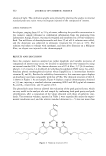
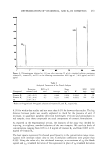
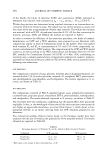
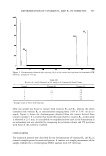
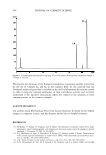
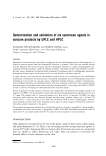
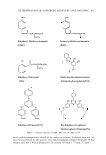
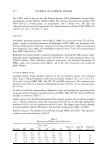
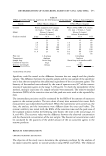
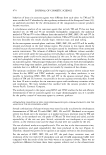
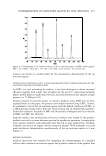
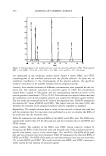
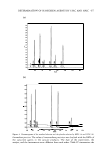
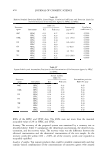
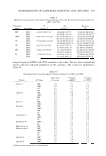
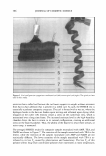
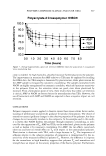
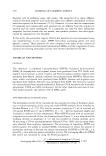
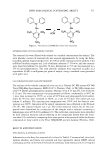
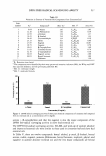
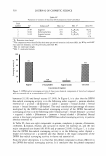
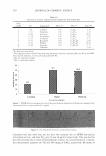
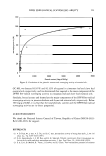
DETERMINATION OF VITAMINS K1 AND K3 IN COSMETICS 465 mAU K1 1H 5 15 mm Figure 5. Chromatogram obtained after injecting 20 µl of the extract deriving from the homemade 0/W emulsion, recorded at 3 3 3 nm. Table III Results (%, w/w/ Obtained in the Analysis of Commercial Facial Creams Sample 2 3 4 5 a Average values of three determinations Vitamin K3 0.5 Vitamin K1 2.0 3.6 4.3 5.5 4.0 Only one sample was found to contain both vitamins K 1 and K3, whereas the others contained only vitamin K 1 at concentrations ranging from 2.0% to 5.5%. As an ex ample, Figure 6 shows the chromatogram obtained from the extract derived from cosmetic sample 5. It is evident that beside the peak related to vitamin K 1 , another peak is observed at 25.3 min. It is ascribable to tocopherol acetate used in the formulation as an antioxidant and was identified by comparing the retention volume and UV spectrum with those of the authentic standard. CONCLUSIONS The analytical method here described for the determination of vitamins K 1 and K3 in cosmetic samples proved accurate and precise. It consists in a simple pretreatment of the sample, followed by a reversed-phase HPLC analysis with UV detection.

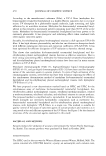
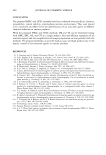
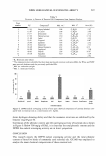
466 JOURNAL OF COSMETIC SCIENCE mAU 350 I.S. 160 100 0 H '15 min Figure 6. Chromatogram obtained after injecting 20 µl of an extract deriving from commercial sample 5, recorded at 333 nm. Waiting for the decisions of the European Committee concerning possible restrictions for the use of vitamins K 1 and K3 in the cosmetic field, we can conclude that the developed analytical procedure is suitable to be used by laboratories for routine control in order to help the national authorities in their surveillance activity and to better understand if the reported sensitization effects are related to the amounts of these vitamins present in the cosmetic samples. ACKNOWLEDGMENTS The authors thank Mr Gianluigi Pinci from Istituto Superiore di Sanita for his helpful support in computer science, and Mr Antonio Parlato for his helpful assistance. REFERENCES (1) M. Kamao, Y. Suhara, N. Tsugawa, and T. Okano, Determination of plasma vitamin K by high performance liquid chromatography with fluorescence detection using vitamin K analogs as internal standards,]. Chromatogr. B, 816, 41--48 (2005). (2) D. J. Harrington, R. Soper, C. Edwards, G. F. Savidge, S. J. Hodges, and M. J. Shearer, Determination of the urinary aglycone metabolites of vitamin K by HPLC with redox-mode electrochemical detec tion,] Lipid Res., 46, 1053-1060 (2005). (3) J. W. Suttie, Vitamin K and human nutrition,]. Am. Diet. Assoc., 92, 585-590 (1992). (4) G. G. Dolnikowski, Z. Sun, M.A. Grusak, J. W. Peterson, and S. L. Booth, HPLC and GC/MS
Purchased for the exclusive use of nofirst nolast (unknown)
From: SCC Media Library & Resource Center (library.scconline.org)