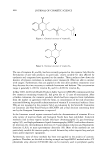
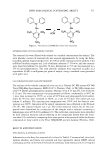
EUCALYPTUS EXTRACT-INDUCED HAIR CHANGES 483 SAMPLING OF HAIR FIBERS AND INTERVIEW WITH PANELISTS AFTER APPLICATION OF THE SCALP LOTION The samples of hair fibers were taken from a part as near to the scalp as possible, just before and after the scalp lotion usage survey. After application of the scalp lotion, interviews with the panelists were carried out. HAIR GLOSS INTENSITY MEASUREMENT For the measurement of hair gloss, hair gloss intensity equipment of our own making (13,14) was used. Its principle and directions for use are as indicated in references 13-16. HAIR DIAMETER MEASUREMENT The hair diameter was measured at 20°C and 65% RH using a SLB DIA measuring system (Kato Tee Ltd.) (17). Each hair was measured at five positions at intervals of 5 mm along the hair axis. At each position, the hair was rotated and measured every 30° . The averaged values of the maximum and minimum values for five positions were set to be the major (a) and the minor axes (b), respectively. The cross-sectional area of the hair fiber was calculated using the major axis and the minor axis, assuming the hair cross section to be ellipsoid. BENDING STRESS MEASUREMENTS (18,19) Two pieces of graph paper (length: 51 mm, width: 15 mm), with double-sided adhesive tape, were placed 10 mm apart from each other and in parallel. Fifty hair fibers were fixed on these graph papers at intervals of 1 mm. This sample was installed in a pure bending testing machine (KES-FB2-S, Kato Tee Ltd.) and the bending stress was measured. The measurement condition was 20°C, 65% RH, and the maximum curva ture of the device was 2. 5 cm - 1 . CALCULATION OF YOUNG'S MODULUS (19-21) The measured bending stress, M, is expressed in equation 1 with lip, curvature E, Young's modulus and I, geometrical moment of inertia: M/(1/p) = E X I (1) Assuming that the bending direction of hair fibers is around the minor axis in the hair cross section, I is obtained from equation 2: (2) In this experiment, as the measuring sample consists of 50 hair fibers, the average of I, I av ' was calculated from the averaged hair diameters a and b of 50 hair fibers. From the measurement, the relationship between M and lip was obtained. Since the linear rela tionship between M and lip was approved in the range around 1-2.5 cm- 1 of lip, the averaged Young's modulus was calculated from the slope and I av (equation 3): E = M/(llp)/50 Iav (3)

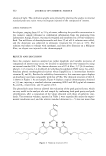
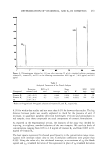
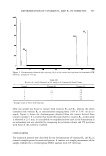
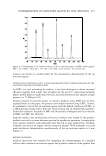
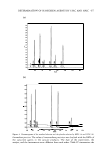
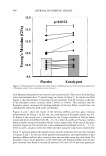
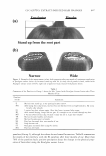
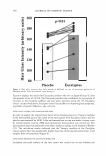
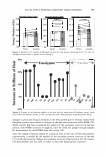
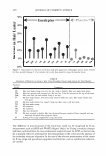
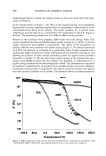
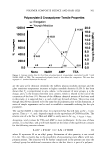
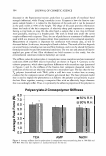
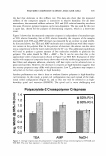
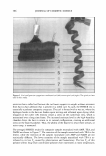
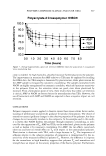
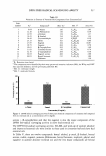
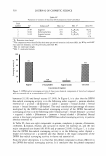
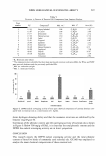
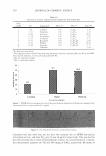
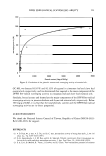
484 JOURNAL OF COSMETIC SCIENCE NANO-INDENTATION BY ATOMIC FORCE MICROSCOPE (AFM) In the case of nano-indentation by an atomic force microscope (AFM), samples of human hair fibers from Japanese females were prepared by embedding them into epoxy resin, and cutting to reveal a mirror-finished surface. The scanning of the cantilever of AFM was carried out under room temperature (25 ° C). The physical properties of the hair fiber in the cross-sectional area were obtained at the nanometer scale with a NanoScope Illa multi-mode AFM (Digital Instruments Co.), equipped with nano-indentation measure ment components. The details of the experimental technique are as reported by Ruetsch (22). Nano-indentation was carried out 25 times on the cross-sectional area of each hair fiber, sampled from two panelists. Four hair fibers per panelist were measured. Two fibers were the new-growth part of hair that was treated with the Eucalyptus extract scalp lotion, and two fibers were the new-growth part of hair that was treated with the placebo lotion. We carried out a simulation to obtain Young's modulus. The simulation model was adapted from the Hertz model (23). The AFM parameters were as follows: Cantilever: Si single crystalline probe (made by N anosensor company, NCH-1 OV, spring constant: 40 Nim) Resonant frequency: 300 kHz MICROSCOPIC METHOD IR SPECTRUM The hair section was made with a trimming knife, placed between two NaCl single crystals, and fixed. The IR spectrum was measured in the cortex region of the hair section by the microscopic method the measurement range assumed to be 6 µm2 (Figure 1). In order to obtain the proportion of the secondary protein structure of both the new-growth part of the Eucalyptus extract lotion-treated hair and the new-growth part of the placebo lotion-treated hair, the spectra of the amide I band were analyzed using the Sarver method (24). The observation condition and parameters of the microscopic IR spectrum method were as follows: • Equipped machines: Herschel FT/IR-480 Plus-type Fourier transform infrared spec- trophotometer, Irtron IRT-30-type infrared microscope QASCO) • Measuring method: Revealing, minute penetration method • Measurement parameter: Integrated times 100 times per step, resolution: 4cm - l • Detector: MCT • Aperture size: 4 x 4 µm • Mapping conditions: (a) Step: X = 10 µm and Y = 10 µm. (b) Point: X = 6 and Y = 6, 36 points in total • Hair samples: Eucalyptus-treated hair: eight hair fibers placebo hairs: eight hair fibers RESULTS USAGE TEST Figure 2 shows the results for bending measurements for sampled hairs of Group 1 after three months use of EL (Eucalyptus extract, 3%) and PL by the half-head test. The ratio
Purchased for the exclusive use of nofirst nolast (unknown)
From: SCC Media Library & Resource Center (library.scconline.org)