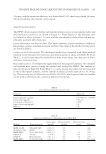
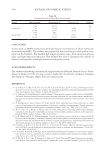
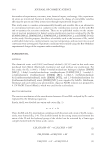
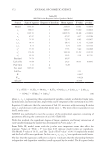
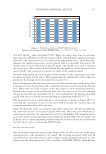
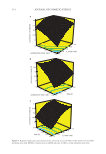
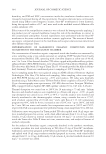
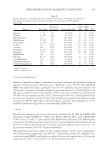
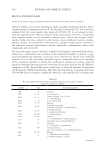
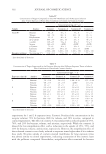
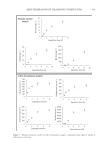
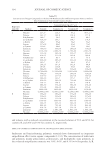
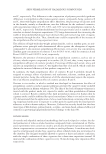
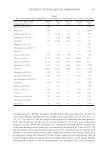
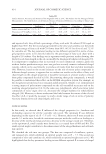
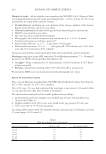
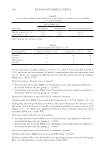
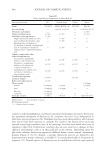
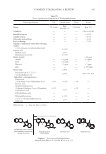
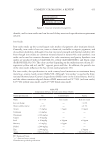
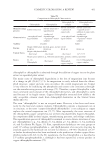
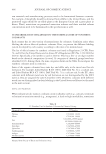
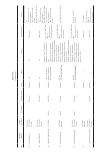
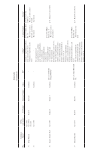
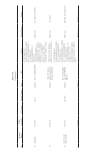
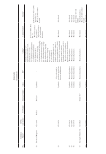
414 JOURNAL OF COSMETIC SCIENCE and rapeseed oils, they all had a percentage of fatty acid with 18 carbons (C18) equal or higher than 90%. For the second group formed by the olive and camelina oil, they both had a percentage of fatty acid with C18 lower than 90%: 86.5% for olive oil and 72.5% for camelina oil. The key parameter leading to two different optimal R in terms of oleo- gel properties seems to be directly linked to the percentage of fatty acid chain with a length of 18 carbons. Our findings are in agreement with previous results showing that the fatty acid chain length in the oil can modify the rheological behavior of oleogels (39). It is important to emphasize that in our study we used commercial cosmetic grade oils without further purification steps, since our goal was to study cosmetic industrial oleogel systems, which can be used directly to produce oil foams from hair and skin treatments (40). However, based on the recent literature on the role of minor polar compounds in different oleogel systems, it appears that to confirm our results on the effect of fatty acid chain length on the oleogel properties it would be necessary in a future study to remove these polar compounds for each oil (34). By removing these polar compounds, it would be possible to understand their effect on the BO/BA oleogelator system. For example, in the oleogelator system based on γ-oryzanol and β-sitosterol, Scharfe et al. demonstrated a strong impact of polar minor compounds on the self-assembled structures and on the resulting oleogel properties (34). In the same way, polyphenols, which are minor polar compounds of extra virgin olive oil, decreased the oleogel hardness for ethylcellulose oleogels (38). Moreover, to better understand the links between the nature of the oils and the effect of R, it would be necessary to study a wider range of oils in terms of polarity, viscosity, density, fatty acid chain length, and so on. CONCLUSIONS In this study, we showed that R influenced the oleogel properties (i.e., hardness and oil-binding capacity) for all the vegetable oils tested. The optimum R was different depending on the type of oil: R =7:3 or R = 8:2. However, these two R were around the specific 3:1 molar ratio, for which a minimum area per molecule could occur leading to a decrease of the interfacial energy and into a decrease in the average crystal size. Therefore, at the optimum R, small crystals were formed as a co-crystal form of BO and BA. The small crystals might contribute to the enhancement of the oleogel hardness and oil-bind- ing capacity. We classified the oils into two groups. The first one composed of sunflower, apricot, and rapeseed oils, which exhibited an optimal weight ratio at R = 7:3. The second one composed of olive and camelina oils, which exhibited an optimal weight ratio at 8:2. We highlighted that the key parameter leading to two different optimal R in terms of oleogel Table III Surface Tension, Viscosity, and Density of the Vegetable Oils at 25°C. The Values Are the Average of Three Measurements. The Small Letters a to d Indicate Groups of Statistical Differences According to Tukey’s test (p 0.1) Sunflower Olive Apricot Camelina Rapeseed Surface tension (mN·m−1) 32.5 ± 0.7a 33.7 ± 0.3a 33.5 ± 0.5a 33.1 ± 0.6a 35.4 ± 0.2b Viscosity at 25°C (mPa.s) 70.2 ± 0.2a 62.5 ± 0.7b 60.8 ± 0.8b 52.7 ± 0.5c 56.1 ± 0.3d Density 25°C (g.cm3) 0.92 ± 0.01a 0.91 ± 0.01a 0.91± 0.01a 0.92± 0.01a 0.90 ± 0.01a

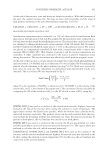
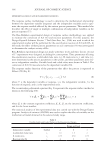
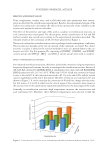
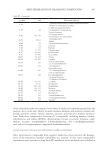
415 THE EFFECT OF VEGETABLE OIL COMPOSITION properties was the fatty acid chain length composition of the oil, more precisely the per- centage of fatty acid chain with a length of 18 carbons. Above 90% of fatty acid chain with a length of 18 carbons in the oil, the optimal ratio was 7:3, below 90% the optimal ratio was 8:2. In the literature, the fatty acid chain length in the oil is described as possi- ble parameter modifying the orientation of the platelet crystals inside the liquid oil giv- ing rise to different rheological properties (39). The different orientation of the platelet crystals formed by the oleogelator system could lead to a modification of the distribution of the crystalline material inside the oil, resulting in different rheological properties as a function of the oil. To verify this hypothesis, complementary measurements would be necessary in order to use the model developed by Miyazaki and Marangoni based on the cellular solid approach of Gibson and Ashby (47,48). This model was successfully applied to different oleogels to explain the relationship between the mechanical properties of oleogels and their microstructure (20,48). As perspective also to continue this work, it would be interesting to study the effect of minor polar compounds of each oil by removing them as described recently by Scharfe et al. (37). By removing these polar compounds, it would be possible to understand their effect on the BO/BA oleogelator system in terms of oleogel structures and properties (38). Our results obtained with cosmetic grade raw materials have practical applications for the cosmetic industry since it shows how to obtain the best oleogels in terms of texture and stability, and then to use them to produce oil foams (11,40). As a function of the fatty acid chain length composition of the oil, the ratio between BO and BA can be adjusted in order to tune the oleogel properties. ACKNOWLEDGMENTS This research was supported by L’OREAL R&I. REFERENCES (1) E. D. Co and A. G. Marangoni, Organogels: an alternative edible oil-structuring method, J. Am. Oil. Chem. Soc., 89, 749–780 (2012). (2) A.G. Marangoni and N. Garti, Edible Oleogels: Structure and Health Implications (AOC Press, San Diego, CA, 2018). (3) M. Suzuki and K. Hanabusa, Polymer organogelators that make supramolecular organogels through physical cross-linking and self-assembly, Chem. Soc. Rev., 39, 455–463 (2010). (4) T. Dürrschmidt and H. Hoffmann, Organogels from ABA triblock copolymers, Colloid. Polym. Sci., 279, 1005–1012 (2001). (5) M. Davidovich-Pinhas, S. Barbut, and A. G. Marangoni, The gelation of oil using ethyl cellulose, Car- bohydr. Polym., 117, 869–878 (2015). (6) M. Hermansson, The fluidity of hydrocarbon regions in organo-gels, studied by NMR: basic trans- lational and rotational diffusion measurements, Colloids Surfaces A Physicochem, Eng. Asp., 154, 303–309 (1999). (7) M. A. Rogers and R. G. Weiss, Systematic modifications of alkane-based molecular gelators and the consequences to the structures and properties of their gels, New. J. Chem., 39, 785–799 (2015). (8) R.G. Weiss and P. Terech, Molecular Gels, Kluwer Aca (Kluwer Academic Publishers, Dordrecht, the Netherlands, 2006). (9) M. Zhang and R.G. Weiss, Self-assembled networks and molecular gels derived from long-chain, naturally-occurring fatty acids, J. Braz. Chem. Soc., 27, 239–255 (2016). (10) A.-L. Fameau and M.A. Rogers, The curious case of 12-hydroxystearic acid–the Dr. Jekyll & Mr. Hyde of molecular gelators, Curr. Opin. Colloid Interface Sci., 45, 68–82 (2020).
Purchased for the exclusive use of nofirst nolast (unknown)
From: SCC Media Library & Resource Center (library.scconline.org)