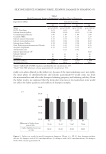
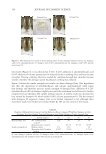
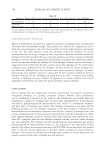
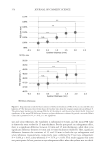
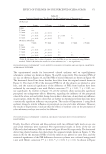
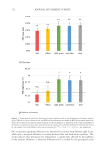
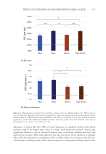
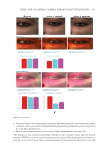
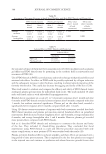
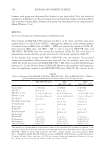
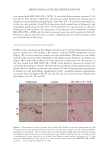
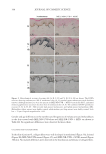
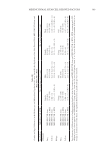
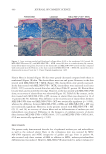
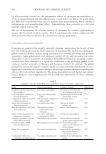
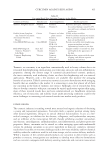
360 JOURNAL OF COSMETIC SCIENCE HAIR SWATCH SENSORY TEST RESULTS Shown in Table III are the panel test results for greasiness of damaged hair swatches after 28 washes with each shampoo sample. The panelists were asked to do a simple panel test to check the greasy/nongreasy feel of the hair swatches. In total, eight panelists participated in the test. All eight panelists noted hair swatches washed by shampoo S2 (0.21% amodimethicone) as having a nongreasy feel, six panelists noted hair swatches washed by shampoo S3 (0.42% amodimethicone), and seven panelists noted hair swatches washed by shampoo S4 (0.18% silicone quaternium-18) as having a nongreasy feel. Only four panelists noted hair swatches washed by shampoo S1 (base shampoo without silicone) as having a nongreasy feel. It verified that the hair swatches treated by shampoos S2, S3, and S4 have a nongreasy feel compared to the base shampoo. In other words, no silicone buildup effect was observed, although these hair swatches were repeat-treated by shampoo 28 times. Interestingly, four panelists observed a greasy feel for hair swatches washed by the base shampoo without silicone. Although our panel was very small, it indicated that adding silicones in shampoo can give a balance of deposition of cationic polymer and silicone ingredient and therefore can reduce the greasy feel from cationic polymers. CONCLUSION Due to natural and clean megatrends in beauty and personal care markets, nonsilicone transparent shampoos are gaining consumers’ interest however, their performance can be insufficient if silicones are not added to the formulation, particularly when the formulation is applied to damaged hair. In this study, amodimethicone microemulsion and silicone polyquaternium-18 microemulsion were added to a transparent shampoo, and their effect in shampoo was studied. The shampoo transparency was kept, and the lathering property was not changed compared to the base shampoo without silicone. Amodimethicone microemulsion improved wet and dry combing of damaged hair, and silicone polyquaternium-18 microemulsion improved dry combing of damage hair, while both improved flyaway control for damaged hair. Hair breakage was improved by more than 80% compared with the base shampoo without silicone, and hair tensile strength was also improved. The addition of both amodimethicone microemulsion and silicone polyquaternium-18 microemulsion resulted in the reduction of the appearance of hair damage. The digital microscope observation and ICP-OES silicone deposition test showed there is effective silicone deposition on the hair, which correlated to above benefit in shampoo. Our sensory test showed that although there is effective silicone deposition, any negative sensorial effect due to buildup was not observed. Table III Number of Panelists Who Checked Greasy or Nongreasy Feel of Hair Swatches After 28 Washes No. of Panelists S1 S2 S3 S4 Greasy feel 4 0 2 1 Nongreasy feel 4 8 6 7 S1: base shampoo without silicone S2: shampoo with 0.21% amodimethicone S3: shampoo with 0.42% amodimethicone S4: shampoo with 0.18% silicone quaternium-18.

361 Silicone Reduce Combing Force, Flyaway, Damage in Shampoo ACKNOWLEDGMENTS Here we present our sincere appreciation to Carol Luo, Momentive Performance Materials, personal care north Asia segment leader, for giving the support and budget approval of this joint project. We also present our sincere appreciation to Dr. Jianzhong Yang, CEO of Beauty Hi-tech Innovation Co., Ltd., for help conducting the experiments and providing the test results data and explanation to us. We also present our sincere appreciation to Dr. Benjamin Falk, Momentive Performance Materials, segment technology leader in personal care and home care, for a professional review of the paper manuscript. REFERENCES (1) K. Higuchi, M. Kamei, M. Kudo, and S. Aoki, Silicones for cosmetics, in Silicone Encyclopedia, 1st Ed., M. Yamaya, Ed. (Nikkan, Tokyo, 2016), pp. 201–209. (2) M. Kropfgans and J. Tully, A silicone approach to shine, volume and smoothness, Pharm. Cosmet. Rev., 35(11), 32 (2008). (3) K. Suenage and M. Suzuki, Hair cosmetic composition, JP 5079318 B2, September 7, 2012. (4) K. Suenage and M. Suzuki, Hair cosmetic composition, US 8440175 B2, May 14, 2013. (5) A. D. Dussaud, P. C. Breen, and K. Koczo, Characterization of the deposition of silicone copolymers on keratin fibers by streaming potential measurements, Colloids Surf. A Physicochem. Eng. Asp., 434, 102–109 (2013). (6) R. Suzuki, Hair cosmetic composition, WO 2020/022488 A1, January 30, 2020. (7) T. Kurashima, M. Kojiri, and R. Yoshiba, Hair treatment method, WO 2020/090951 A1, May 7, 2020. (8) J. Yang, Shampoos, in Cosmetic Science and Technology: Theoretical Principles and Applications, 1st Ed., K. Sakamoto, H. Lochhead, H. Maibach, and Y. Yamashita, Eds. (Elsevier, Amsterdam, 2017), pp. 602–606. (9) K. Klein, Evaluating shampoo foam, Cosmet. Toiletries, 119(10), 32–35 (2004). (10) T. Koyagi and R. Hirohata, Scalp care focusing on lipid peroxide, Fragrance J., 40(10), 16–22 (2012). (11) X. Lin, M. Nakamura, and J. Yang, Stroke of genius: Successive combing force yields realistic conditioning results, Cosmet. Toiletries, 133(6), 40–47 (2018). (12) S. Breugnot, M. Vedel, R. George, K. Nowbuth, and P. Sterle, Volumizing, fly-away/frizz control and straightening claims substantiation using 3D volume measurement system, NutraCos Cosmet., May/ August, 9–14 (2017). (13) H. M. Haake, H. Lagrene, A. Brands, W. Eisfeld, and D. Melchior, Determination of the substantivity of emollients to human hair, J. Cosmet Sci., 58(4), 443–450 (2007). (14) P. A. Cornwell, A review of shampoo surfactant technology: Consumer benefits, raw materials and recent developments, Int. J. Cosmet. Sci., 40, 16–30 (2018). (15) W. Li, J. Amos, S. Jordan, A. Theis, and C. Davis, Selecting the optimum silicone particle size/cationic polymer structure to maximize shampoo conditioning performance, J. Cosmet Sci., 57(2), 178–180 (2006).
Purchased for the exclusive use of nofirst nolast (unknown)
From: SCC Media Library & Resource Center (library.scconline.org)