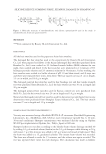
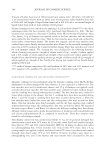
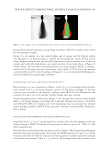
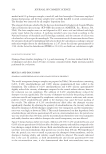
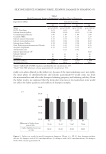
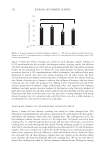
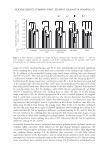
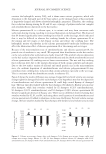
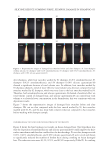
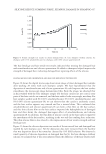
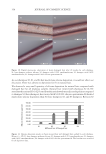
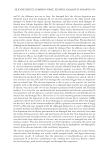
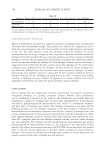
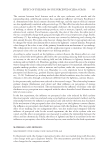
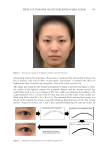
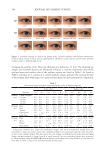
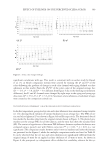
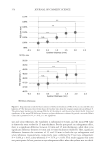
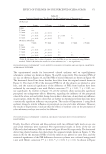
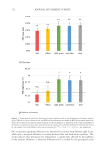
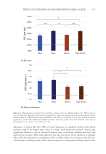
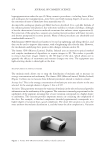
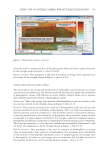
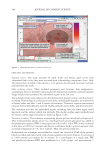
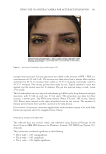
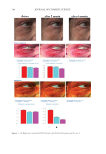
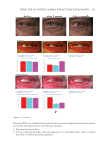
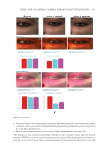
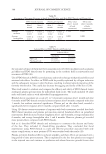
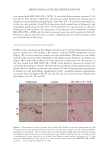
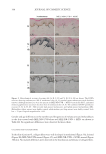
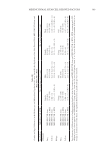
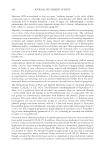
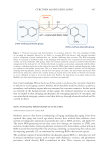
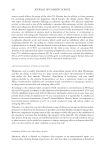
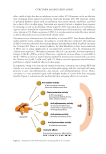
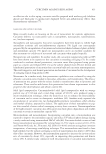
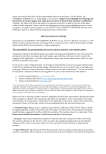
369 EFFECT OF EYELINER ON THE PERCEIVED SCLERA COLOR significant correlations with age. This result is consistent with an earlier study by Russel et al. (7), in which comparison stimuli were created by varying the L* and b* of the sclera following the gradient of change in each color channel with aging (defined as sclera whiteness in this study). From the L*a*b* of the sclera color of the original average face (L* =47.4, a* =3.8, and b* =8.7, different from Figure 5 due to the shooting environment difference), the L* and b* channels were changed by eight steps in the aging and young age directions (L* =37.6–57.2, b* =5.5–11.9). Seventeen sclera-whiteness–modulated images were created as the comparison stimuli set. PSYCHOPHYSICAL EXPERIMENT 1: BLACK EYELINER WITH THICKNESS VARIATION In the first experiment, perceptual eye size and sclera whiteness were examined using stimulus set 1 by drawing black eyeliners of various thicknesses on an average face. The PSEs of eye size and sclera lightness L* are shown in Figure 6A and B, respectively. The horizontal dotted line marks the baseline (data from the original stimuli shown in Figure 3). The plotted grey markers are the average PSEs for all the subjects, and the error bars show the standard error (SE). The statistical significance of the mean PSE difference between eyeliner thicknesses was evaluated using a paired t-test with Holm’s correction (**:p 0.01, *:p 0.05, n.s.: not significant). The comparison results between only 0 mm (no eyeliner) and other thicknesses are presented in the Figure 6, while the multiple comparison results are listed in Table II. It can be observed that the eye size and sclera whiteness are significantly different from the original image (0 mm) for an applied eyeliner thickness of 1.0 mm or more. As shown in Figure 6, the perceptual eye enlargement effect exhibits less variability, whereas for the eye Figure 5. Sclera color change with age.

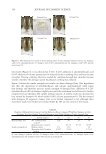
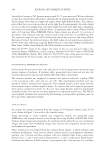
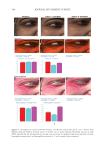
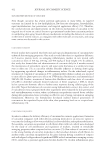
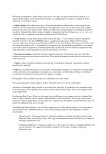
370 JOURNAL OF COSMETIC SCIENCE size and sclera whiteness, the variability is substantial (2.0 mm), and the mean PSE value is almost the same as that for 1.5 mm thickness. For the perceptual eye enlargement effect, there is a significant difference between 1.0 mm and 1.5 mm thicknesses, while there is no significant difference between 1.0 mm and 2.0 mm thicknesses (Table II). Here, significant differences between the variations of 1.5 and 2.0 mm in both the eye enlargement and sclera whiteness measurements, respectively, were confirmed by F-test (eye enlargement: F =3.839, p 0.05 sclera whiteness: F =3.174, p 0.05). This result suggests that some test participants did not perceive an eye enlargement effect when the eyeliner was too thick. Figure 6. Experimental results for black eyeliners of different thicknesses: PSEs of (A) eye size and (B) sclera lightness L*. The horizontal dotted line shows the baseline (data from the original stimuli shown in Figure 3). The plotted grey markers are the average PSEs for all the subjects, and the error bars show the SE. Statistical significance of the mean PSE difference between eyeliner thicknesses evaluated by paired t-test with Holm’s correction is presented as **:p 0.01 n.s.: not significant.
Purchased for the exclusive use of nofirst nolast (unknown)
From: SCC Media Library & Resource Center (library.scconline.org)