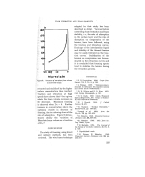
JOURNAL OF THE SOCIETY OF COSMETIC CHEMISTS receiver at 80 ø F. is the viscosity value that is used. The rotating spindle type of viscosimeter such as the Brook field instrument is not satisfactory for viscous liquids that tend to be thixottopic. As the spindle rotates, the liquid in contact with the rotating spindle thins out and a constant reading is unobtain- able. ß A very important test for all dear liquid shampoos, whether of the soap, detergent or oil types, is the cold test. Not only is the cloud point determined but also the temperature at which the liquid becomes clear. These two values are not always the same, especially where the shampoo contains sodium lauryl alcohol sulphate. This par- ticular detergent,' which is exten- sively used in shampoos, is not too soluble and tends to crystallise out of solution in the temperature range of 45-55 ø F., but, what is still worse, is that it might not redissolve until the solution is warmed to 70 or 75 ø F. These temperature values will vary with the concentration and composition of the shampoo' and must be-carefully checked. Milky or pearly liquid shampoos may settle or separate, and 'oven tests at 100 ø and 120 ø F., centrifuga- tion,-and exposing the shampoo to prolonged vibration, are all useful accelerated stabilit•r tests. One of the 'basic qualifications of.'a "good cream shampoo is that it should always have good texture and con- sistency, irrespective of the tempera- ture to which it has been exposed. Freezing, chilling to 350-45 ø F., 186 prolonged heating at 100 ø to 120 ø, are among the accelerated tests frequently used. ßAfter these tests the shampoo is permitted to reach room temperature and then carefully examined for any change. A very valuable tool in the examination of cream shampoos is the microscope. Shampoos of this type usually are a complex suspension and emulsion, •and changes in crystal structure and particle size after subjecting' the shampoo to accelerated stability tests is often an indication of impend- ing difficulty. Prolonged vibration is also a useful test. Egg shampoos, still enjoying con- siderable popularity in the United • States, contain either whole, frozen or dried eggs and should be tested for heat stability at 100 ø and 120 ø The protein is very-easily denatured .i7 by heat and may coagulate in the •.:( shampoo. White milky or cream shampoos ::iii have a tendency to become yellowish }• ß upon standing for several weeks months, especially if they containiiii unsaturated fatty acids or alkanol-:"?! amines. Discoloration should be!?! watched for in all the samples thati! i have been put through acceleratedl .:111 stability tests. It is good practice test unperfumed samples Of shampoo along with the perfumed!i !! samples,• If discoloration results, it?.i may be due to the perfume, •vhich.::•! can adversely affect the shampoo other ways as well. Many shampoos are subject t o ' bacterial contamination unless ade• quately preserved. Shelf-testing th':• ': product and waiting for micr6

STABILITY TESTING OF :i.•... '¾organisms to appear just won't .'i?!i' do, and the only way to reach a quick !•}i!i •:" and decisive answer is to use bacterio- [!i'•' logical methods of evaluation. This ?. is, done by inoculating' the shampoo }?::::'•ith moulds, bacteria and sewage ??:organisms which have been found to ?!i•i!': contaminate shampoos, and examin- !}!:i?ing the shampoo for colony growth •}?or gas formation. !•(i!" The packaging of shampoos does ( i::}not pose any serious stability pro- {::':::i: blems, with the exception of cream ii}i(' shampoos in collapsible tubes. The ::i! i:':quickest .way to determine whether :½i: :..: or not the product will corrode the ':?Container is to oven-test it for 30 ?30 days at 130 ø F. :..) i TESTING HAIR FIXATIVES :}':•? Preparations to hold the hair in i{:(:::: place, especially some of the newer .!i::,, : types, have grown in popularity and ' i:? include,. in addition to the brillian- :4 : ?:i tines, oil emulsions and pomades-- ?.:a variety of hair setting preparations .. {:i•i: based upon gums, resins and pro- ?:.}.] teins. The aqueous preparations are ?:?: generally clear, dilute solutions of }i :/ gums or proteins and may be thin fluid preparations or viscous, stringy ß ': : solutions such as those based on gum karaya. Accelerated tests are usef• here, especially those which might induce precipitation or turbidity. ': These products readily support the growth of micro-organisms if not adequately preserved. Concentrated wave set prepara- tions are' manufactured for beauty shop use and consist essentially of an alcoholic suspension of a water- soluble •m, plus other additives. HAIR PREPARATIONS This concentrate is added to water to make a product ready for use. The problem or difficulty that must be looked for here is the caking of the suspended gum so that the con- centrate cannot be poui-ed out of the bottle. Two useful stability tests are prolonged vibration and oven- testing at 90 ø F. Non-aqueous hair sets are formu- lated to be sprayed on the hair and are either packaged in a polythene squeeze bottle or as a low-pressure aerosol. These products must remain clear without the formation 'of any sediment, precipitate or crystals which may clog the spray head or valve. The aerosol preparations are best oven-tested at 130 ø F. for a period of 30 days, the can being then examined for corrosion. These hair set preparations shoul•l always be checked for functional stability by using the product on live models. The film deposited on the hair must dry quickly, must not flake off, must not be sticky or rough. A simple routine test is to spray the liquid on a flexible sheet of clear plastic and examine the film for tackiness, flexibility, clarity, etc. Successful cosmetics are the result of' (1) (2) (3) (4) (5) Rigid control of raw materials. Careful formulation. Meticulous care in manufac- ture. Maintenance of close toler- ances in the finished product. An exhaushve testing pro- gramme, both in the labora- tory and in the field. 187
Purchased for the exclusive use of nofirst nolast (unknown)
From: SCC Media Library & Resource Center (library.scconline.org)