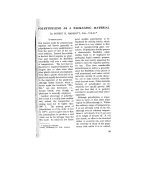
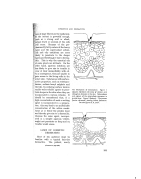
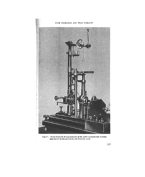
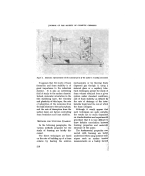
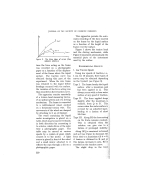
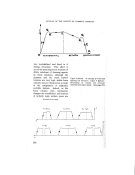
JOURNAL OF THE SOCIETY OF COSMETIC CHEMISTS .. "' . . :•½•-, :-•:-•i: ..•:,.,.. ...-•,•',.•..:: ,•i:. ........ •-:'•::,•,, :•:'•.• .. •-•i .,.: ............. •':•-,..--, Figure 2. Schematic representation of the essential parts of the author's recording instrument It appears that the study of foam formation and foam stability is 'of great importance to the industrial chemist. It is also an interesting field of study to khe surface chemist. Indeed, molecular orientation in the film stabilising layer, the viscosity and plasticity of this layer, the rate of adsorption of the molecttles from the bulk solution to the surface phase, and the rate of desorption from the surface layer, are factors controlling foam formation and foam stability. I'V[ETHODS FOR STUDYING •'OAMING In the following paragraphs, the various methods proposed for the study of foaming are briefly dis- cussed. The direct techniques are based on the rate of building up of a foam column. by beating the solution 218 mechanically or by blowing finely ... dispersed gas through it, using a sintered glass or a capillary tube.' Such techniques permit the study of• foam volume obtained from a given -, system under standard conditions," and of foam stability as defined by the rate of drainage of the inter-'.,_ lameliar liquid and the rate at which the foam collapses. Although it would appear that-• such techniques .are quite suitable: j the results are. so much dependent'• on standardisatiori and experimental}{ procedure that it is very difficult to i! draw definite correlations betweem? foaming properties and molecularx .. structure of the solute. The fundamental properties con-..t nected with foaming are better., understood when using indirect techJ•! niques such as surface tension' measurements on a freshly formed': . :/•

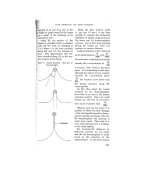
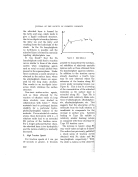
•?S?u'rface, and on an aged surface, of ':•[{the system under investigation. • •iSuch measurements lead to the [•ild•namic and the static surface ?•nsion respectively. The time taken •}iby a .{reshl• formed surface to reach :•{• ...... uilibrium is related to the rate of of the solute from the bulk to the surface layer. The mechanical properties of the Surface layer may be investigated the two-dimensional pendulum cometer. Plateau," Wilson and • and later on Clark', have used •his instrument for determining the !i:i•i:i•Sscosity, elasticity and plasticity }• i!øf the surface layer.. Interesting iii:i. results were obtained on aqueous iii?Sølutions' of saponins, Na oleate, Na ?Stearate, proteins, and proteins ?tanned with polyvalent metal'ions. ?'Xlthough this technique would :iSappear quite simple, the results are }i?'erratic and the method is not sensi- •i: tive enough to detect a change in the }11. mechanical properties following the ?.iadsorption of surface-active agents !:i which are known' to ca. use extensive .':.)•foaming. For example, Burcik • was :unable to detect any change in the :: pendulum viscometer behaviour, ,. using Na laurate, Na laurylsulphate aqueous solutions, from a clean :::: water surface. A NEW TECHNIQUE DEVELO1 ED A new technique has been devel- oped by the author' which enables us to follow a significant change in the pr.operties of such system. This technique has been applied to a wide range of amphipatic compounds, AND FOAM STABILITY anionic, cationic and non-ionic series. Saponins and proteins were also investigated. This technique originates from the work of Lenard • in 1924, who meas- ured the surface tension of liquids by means of a rectangular wire frame. When the frame is with- drawn from the bulk of the liquid and raised above the surface, a pull is being applied. This pull increases gradually and, after reaching a maximum, drops slightly. The value then obtained is a measure of the surface tension of the liquid. An interesting feature inherent. to the rectangular wire frame, as opposed to the ring, is the appearance for some systems of a region over which the frame is raised under a constant pull. When this is observed, a thin lamina forms in the plane of the wire frame. Using an aqueous solution of Na oleate, for example, this lamina is seen to display interference colours and drainage of the inter- lameIlar liquid similar to those observed in the foam columns. Before the rectangular wire frame technique could be applied for the study of foaming, several factors had to be controlled. It was found, for example, that the rate of withdrawal of the frame had a marked effect on the extension of the lamina. Moreover, the surface tension of the lamina was also found to vary with this rate. For this purpose an automatic recording apparatus was designed by the authorJ ensuring the with- drawal of the platinum wire frame under a constant rate. At the same 219
Purchased for the exclusive use of nofirst nolast (unknown)
From: SCC Media Library & Resource Center (library.scconline.org)