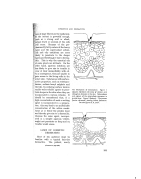
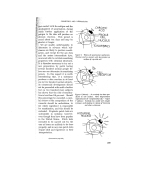
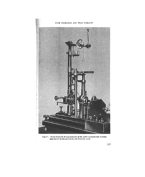
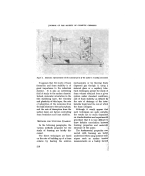
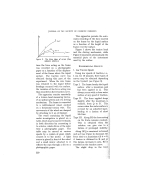
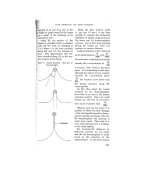
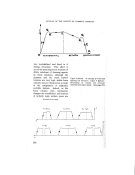
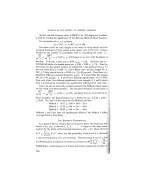
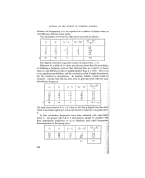
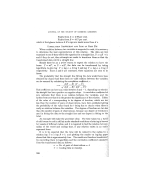
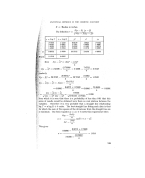
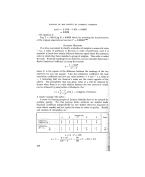
JOURNAL OF THE SOCIETY OF COSMETIC CHEMISTS •, T,f ?,. tit Y Figure 3. The three tyDes of curves (See adjacent column.) This apparatus permits the auio- matic recording of the force exerted on the frame by the liquid surface as a function of the height of the frame over the surface. Figure 1 shows the torsion head and the driving mechanism, while Figure 2 represents schematically the essential parts of the instrument used by the author. time the force acting on the frame was recorded on a photographic paper as a function of the displace- ment of the frame above the liquid surface. The traction curve was obtained during this part of the experiment. When the wire frame was returned to the liquid before breakage occurred with the surface, the variation of the force acting was then recorded on the retraction curve. The apparatus consists essentially of a torsion head measuring device, of an optical system and of a driving mechanism. The frame is connected to a well-balanced wheel, centred on a horizontal torsion wire. The movements of the wheel are damped by attaching to it an oil damper. The vessel containing the liquid under investigation is placed on a table, which may be moved vertically in both directions by connecting it to a motor, which drives at the same time a photographic paper. The table may'be moved at various speeds by a system of gears which connect it to the motor. A light source is placed in front of the wheel and a small mirror attached to it reflects the rays through a slit on a photographic paper. EXPERIMENTAL t•ESULTS I. Low Traction Speeds Using low speeds of traction, i.e., 1 cm. for 10 minutes, three types of curves may be obtained depending on the System • (see Figure 3). Type I. The frame breaks the liquid surface after a maximi•m pull has been applied in Q. This always,occurs with a clean water surface at any speed of traction. :' Type II. The force 'applied drops.:: ii slightly after the maximum ism: reached, from Q to Ri This'!11!•i ' occurs when the water surface covered by an adsorbed layer, :' :i:' leading to a lamina of short ? life-time. Type III. Along RS the force acting I on the frame remains constanL!.: This is obtained when the/i((. solution can give rise to lamina of prolonged stability !:,' Along OPQ a meniscus' is and as O (see Figure 4) decreases force rises to a maximum till 0 -- A lamina is obtained in R and this lamina increases in area,' RS is.'fi! recorded on the traction curve. The slight drop in the 220

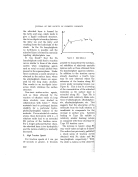
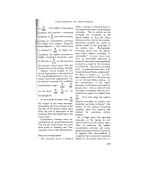
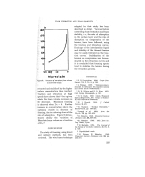
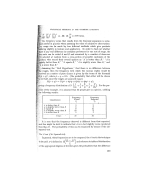
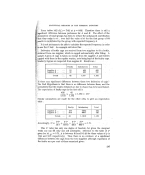
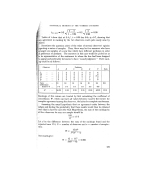
FOAM FORMATION AND FOAM STABILITY in Q and R is due to the of .liquid raised by the frame as a result of the thickness of its horizontal wire.' Along RS the surface of the is extended under a constant i}•i!Pull and the work of extending is ?/:•-S where ¾ is the force recorded •'•i•?'along RS and •-S the increase in (area. This demonstrates that the •.•?'force recorded along RS is the sur- ii!'iace tension of the liquid. ' ii!ii•Figure 4. Lamina formationß (See foot of i•:•?::!:: .: previous page.) •i. ." :., Using the slow traction speed (1 cm. per 10 min.) it has been possible to compare the mechanical stabilities of lamina• originated from Na oleate and Na dodecylsulphate systems. Curves have been prepared giving the results for these two systems at various dilutions. Lamina formation is first observed inNaoleatebetween M and M -- ß 5000 2000 The extension of the lamina increases M steadily till a concentration of 200 is reached, after which it decreases again. It is interesting to note that, although the surface tension remains constant for concentration above M the traction curve shows that 800, the lamina extension along RS varies greatly. On the other hand, the results obtained for Na dodecylsulphate show that in no case is the lamina extension marked. Only very small lamina• are observed at concentra- tions equal or greater than 00. Whereas with the Na oleate it,is possible to follow the slow drainage of the interlamellar liquid by observ- ing the interference bands, with the Na laurylsulphate the draining is much more rapid. This leads to a .very rapid thinning and a breakage of the small laminas. The fundamental difference in behaviour between the Na oleate and the Na laurylsulphate is easily found in the structure of the adsorbed layer. In the oleate system 221
Purchased for the exclusive use of nofirst nolast (unknown)
From: SCC Media Library & Resource Center (library.scconline.org)