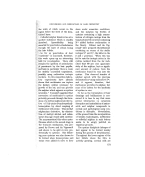
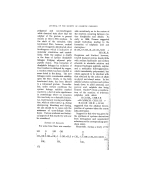
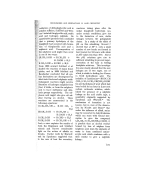
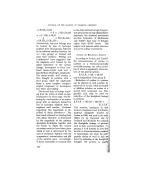
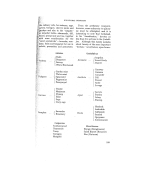
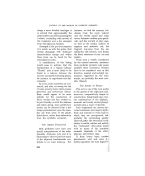
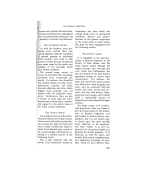
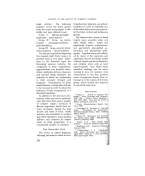
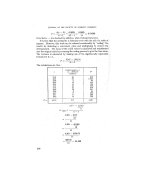
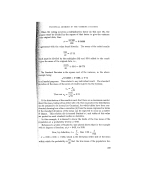
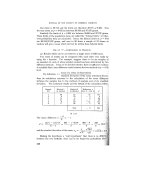
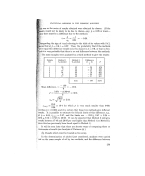
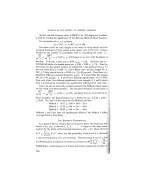
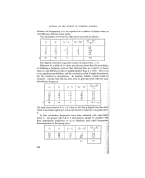
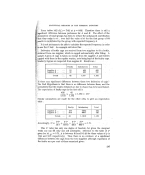
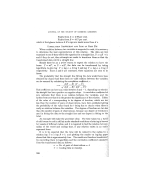
STATISTICAL METHODS IN THE COSMETIC INDUSTRY' AN INTRODUCTION By A. W. MIDDLETON, B.Sc., Ph.D., F.R.I.C.*' Tins ARTICLE is an attemp• to give cosmetic workers an outline of a very few of the possible applications of statistical methods to their work. Space does not allow of any very fundamental approach to the subject, but it hoped that readers will be able to apply the technique of the examples given to similar problems of their own and that they will be encouraged to make! • : use of the bibliography for further study. * * Statistical methods have very wide application .and are the by which the maximum amount of information can be obtained from a given?::i set of experimental results consistent with any desired degree of probability. i] The general principle of statistical analysis for.the judgment of the signifi2i! !? cance of any difference between two or more sets of observations is adoption of the "Null Hypoth½sis"--that there is no difference between the?• sets of observations--and the subsequent calculation of the probability thaC• in any particular case the variations found between the sets observations could have been obtained by chance. If this chance':)i'i• is small, the conclusion is dra/wn that the sets of observations differ and that the different. treatments given the sets have a significah•'•):i effect. It can be considered that a significant difference between sets observations exists when it is probable that only once in twenty times woulCi•{ the particular data have been obtained by chance (p= 0.05). Oth•"•}•! commonly used "levels of significance" are probabilities that the would be obtained by chance once in a hundred times (p -- 0.01) and in a thousand times (p = 0.001), the level being chosen by the ex[ to meet the particular degree of accuracy that he requires. For cosmetic work the writer has found p -- 0.05 satisfactory. •,• For easy reference, the symbols used and the tabular data required the proper understanding of the techniques to be described are collecte ß together and shown on the opposite page. * Chesebrough Manufacturing Co. Ltd., London.

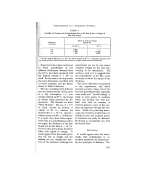
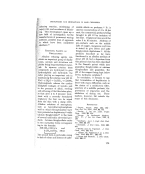
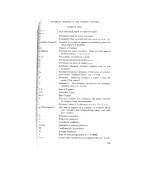
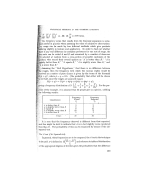
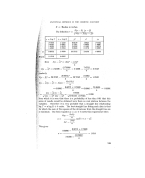
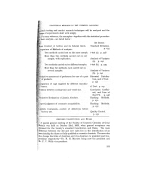
(Sigma Squared) .(Sigma) S.S. ?,::X •- (Chi Squared) ': ?•?{) O (rho) -, STATISTICAL METHODS IN THE COSMETIC INDUSTRY SYMBOLS USED Any individual result or series of results. Probability that an event will occur. Probability that an event will not occur (q = p -- 1). Variance (,'= sum of squares of deviations from the mean/degrees of freedom). Degrees of freedom. The sum of a series of results. Thus 27x is the sum of all the results x• + x• q- x• q- .... The number of results in a series. The mean of a series of results x•,•,• ..... The mean of a series of results y •,•_, 3, ß ß ß ß Estimated standard deviation (square root of the variance). Estimated standard deviation of the mean of a series, often called "Standard Error" (a,, = a/x/n). Deviation. Difference between a result x and the mean of the series •. Student's t. The deviation divided by its estimated standard error (t = dx/n/rr). Sum of Squares Correction Term. Mean Square. The ratio between two variances, the larger estimate of variance being the numerator. Factorial (thus 4! is factorial 4 = 4 X 3 x 2 x 1). The sum of squares of a number of variables which vary normally and independently about zero with unit variance. Frequency expected. Frequency observed. Correlation coefficient. Spearman's ranking coefficient. Coefficient of Concordance. Average frequency. Base of natural logarithms (e = 2.71828). Greater than , smaller than (A is greater than B: A B). 233
Purchased for the exclusive use of nofirst nolast (unknown)
From: SCC Media Library & Resource Center (library.scconline.org)