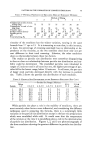
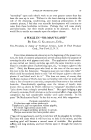
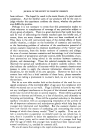
NEWER CONCEPTS OF LANOLIN COMPOSITION 13 of free hydroxyls has evidently not been considered very important in the past and was rarely determined. The importance of the hydroxyl number will become evident in the latter part of this paper. Even careful study of the analytical data does not shed much light on the composition of lanolin. For instance, the iodine number indicates that some unsaturation is present, but doesn't tell in what part of the ester the double bonds are located. The hydroxyl number is indicative of free hy- droxyl groups but doesn't tell us whether these are present on free alcohols or on hydroxyesters, and the sapor•ification number indicates the presence of esters but tells us nothing of their structure. The elucidation of the chemical structure of the various components which form lanolin has been attempted by many investigators whose find- ings are quite contradictory. It may truthfully be said, in this instance, that disagreement is the rule rather than the exception. The logical first step in a study of lanolin composition is the splitting of the esters by means of saponification into component alcohols and soaps of the fatty acids. The saponification procedure has been carried out by many methods, the end products varying considerably depending on the nature and concentration of the alkali or alkaline earth, and other factors such as media, temperature, time, pressure, agitation, and presence of inert gas. L^•o•.m A•.coHo•.s Let us now examine the lanolin alcohols which constitute approximately 50% of lanolin. In the analytical data for lanolin alcohols, on Table II, TASLE II--AI•ALYTICAL DATA FOR LAI•OLII• ALCOHOLS SOURCE OF DATA IOOINE NO.(w) HYDROXYL NO. MEAN MOL. WT. ORUI4MONO & BAKER 6,9.1 - - ER•A, - 145.3 392.3 LOWER •'5.5 •ee E•TERN •O•L •B. - I•.• • 375 U.S. •. A•IGULTU• 0 CHOLESTEROL PRODUCTS •9.•
A•EmCAH 1•.5 •8• the iodine numbers are listed in the first column. Most of the double bonds of lanolin are located in the alcoholic fraction, and some of them, especially in the triterpene alcohols, are quite resistant to iodine, resulting in very er- ratic results when the Wijs method is used. We prefer the more reactive Hanus method which gives us reproducible results. Note there is good

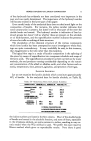
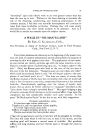
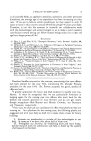
14 JOURNAL OF THE SOCIETY OF COSMETIC CHEMISTS agreement with reference to the hydroxyl number. This determination is used as the basis for the calculations of the mean molecular weight of the total alcohols which, as shown on this table, falls within the comparatively narrow range of 364.3 to 392.3. It must be stated that Warth (6) in his book on waxes published in 1947 listed the contradictory value of 239 as the mean molecular weight of this fraction. In view of the data obtained by us and others as listed on this tab!e, we must disagree with this author. As far back as 1856 investigations were carried out in an effort to isolate and identify the individual components of lanolin. After nearly a century there are many contradictory findings in the literature, and gaps in our knowledge. Table III depicts our present information on the composition of the lanolin alcohols. The major groups are aliphatic alcohols, sterols, and triterpene alcohols. T•srs III--Courosxxxos or L•sorxs A•coi•o•s ALIPHATIC ALCOHOLS NORMAL (½• • C•. BRANCHED CHAIN (,.Ci7 •o C•, •) DIOLS •l•,te C=• FIVE t4Et4•ER$ •LATEO IN 1951 •ROL5 CHOLESTEROL C u H•O DIHYDROCHOLE•EROL •aoLe• Car H• 0 CEREBROSTEROL TRITERPENE ALCOHOLS 18% 4t•5% 25% 5% SHALL AMOUNT The incompleteness of data on the alcohols is evidenced by the fact that approximately 20% of'this fraction remains unknown and unclassifiable. The literature on the aliphatic alcohol group has been in an unsettled state for many years due to the reported presence in lanolin of various familiar alcohols without positive isolation and identification. We now have reason to suspect that many of the compounds reported were mixtures of the un- usual alcohols very recently identified. In 1951 Horn and Hougen (7) isolated and identified five long-chain aliphatic alcohols having two hy- droxyl groups each. These are commonly referred to as diols. Dr. Louis Fieser (8) of Harvard University in a personal communication last month reported that he had isolated 3.7% of a related diol from a fraction of lan- olin alcohols. Tie& and Truter (9) in 1951 isolated and identified five normal alcohols. In 1952 Murray and Schoenfeld (10) working in Australia isolated and identified ten branched chain alcohols which have a close structural relationship to the lanolin fatty acids.
Purchased for the exclusive use of nofirst nolast (unknown)
From: SCC Media Library & Resource Center (library.scconline.org)