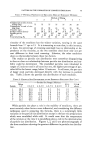
NEWER CONCEPTS OF LANOLIN COMPOSITION 15 The sterol group is composed mainly of cholesterol which is unquestion- ably the major single component of lanolin alcohols. It is accompanied here, as is usual in animal tissue, by its dihydro derivative, cholestanol. It is likely that many other related sterols are present in small amounts, but ill-defined products such as oxycholesterol, although reported in the literature, are not included in this table. Cerebrosterol, a cyclic diol, was isolated and identified by Dr. Fieser (8) just a few months ago, and is re- ported here for the first time. An interesting point about this sterol is that it had previously been found only in brain tissue hence its name. It seems that although lanolin gets into everything these days, the reverse is also possible. The third group listed as triterpene alcohols, has been commonly known by the misnomer, "isocholesterol." These are more unsaturated than cholesterol and have three additional carbon atoms. The lanosterols are the Fredominant members of this group. The presence of small amounts of hydrocarbons was established in 1945 by Daniel, Lederer, and ¾elluz (11), in France. These have been separated from lanolin alcohols by chromatography in our laboratory, and we find them to be a viscous, oily liquid mixture. LANOLIN FATTY ACIDS We now turn to the study of the other major component of lanolin es- ters-the fatty acids which constitute approximately 50% of lanolin. An- alytical data on the lanolin fatty acids are presented in Table IV. Natural variations which go back to the original lanolin account for some, but not all, of the apparent discrepancies. Our concept of lanolin composition is based in part on findings that marked changes occur in the fatty acids dur- ing the decomposition procedure required to free them from their soaps. It is unfortunate that there are so many blank spaces in this table. Many TABLE IV--ANALYTICAL DATA FOP. LANOLIN FATTY ACIDS SOURCE OF D•TA ACID NO. S•NG ESTER NO. t4• •L.•T. OH NO. %0# ACJDSlZ NO. DRUHHOIil) s BAKER 185.., • - - 297 - - - WEITKAMP 1865 e - - .M)O - 4.'2 - MERICAN I70 e - -- 329 167.6 9•.5 BERTI•LAUST•^, I71 e - 327 102.6 60.0 - LOWER 1•28 a 15:3 25 e 437 e 46.5 a• ?e,e 18 f 126.? I?&q- •.7 •35 a.2.•i. 33.0 9.2 CHOLESTEROL PRODUCTS 15a.5
AH•mCAI• 178 2•.5 •62 65.8 ql.$ 6.5 =CALCULATED FROM DATA G, IYEN BY THE SOURCE •tlt= CALCULATED FROM THE ACETYL NUH6ER •'=PRESENCE OF 15% U#SAPO#IFIASLE PREVENTS CALCULATION

16 JOURNAL OF THE SOCIETY OF COSMETIC CHEMISTS of the sources listed did not determine saponification number, hence the ester number cannot be calculated. Had the hydroxyl number been deter- mined by Weitkamp (2) it probably would have given him a different con- ception of his original fatty acids and had iodine determinations on these fatty acids been carried out our knowledge of lanolin would probably be further advanced. .Although the data of Lower (12) is presented and discussed in this paper it is well to point out that the fatty acids, according to his 1947 publication contained 15ø-/o of unsaponifiable matter which we must assume to be al- cohols. From the manner in which the acids reported on by the other in- vestigators were treated, we feel safe in assuming that these contained no alcohols. In our own experiments th• fatty acids were tested and gave negative Liebermann Burchard reactions the absence of steroIs being taken as indicative of the absence of alcohols. It will be noted that various authors, particularly Bertram, report a sizable hydroxyl number indicating that their fatty acids contained con- siderable amounts of hydroxyacids. These are acids which contain a free hydroxyl group in the molecule in addition to the carboxyl group which is characteristic of acids. • The alpha hydroxyacids, to date the only type identified in lanolin, when under the influence of heat or of an acidic catalyst, convert by esterification into cyclic esters, or, by condensation into polyesters. The result of these reactions is to decrease the hydroxyl and acid numbers with a proportionate increase in the ester number. Although beta hydroxyacids have not been isolated, it is possible that these are present in the original lanolin. These are saturated acids which undergo dehydration to form unsaturated acids. Since we are dealing here with fatty acids which were treated with heat and acid, we now have to take the possible effects of this treatment into con- sideration in visualizing the original structure of the fatty acids. From the iodine number as shown in the last column of Table IV, it is evident that unsaturated acids are present. Truter (13) in 1951 estimated that these represent about 15ø-/o of the total fatty acids. We question whether unsaturated acids are present in the original fatty acids to the ex- tent of 15%. Our doubt on this point is due to our findings that the degree of unsaturation is readily affected by the treatment of the fatty acids. Fatty acid samples were prepared by us from the same fatty acid soap but under different conditions. The data on these acids are to be seen on the bottom two rows of Table IV. Separation of the first sample was carried out under the usual drastic conditions that is, acid treatment for an ex- tended period of time and a fairly high temperature. The preparation of the second sample on the bottom row differed only in that milder conditions were observed. In each case the reaction was carried to completion. Note
Purchased for the exclusive use of nofirst nolast (unknown)
From: SCC Media Library & Resource Center (library.scconline.org)