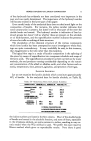
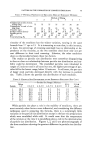
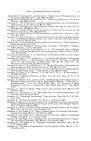
NEWER CONCEPTS OF LANOLIN COMPOSITION 19 TABLE VI--FKEg ALcoaors ov LANOLIN FREE TOTkLFREE OHNo, OFLANOLIN O#tlO. DUE TO FREE ALC CliOLESTEIIOL ALCOHOLS DUE TO FREE ALC. o# #o.oF• X I00 (CAte.) PERSONAL COMMUNICATION - 195• Recently reported direct determinations of the percentage of free choles- terol in lanolin yield the data presented on Table VI. It must be remem- bered that this determination is carried out by the digitonin gravimetric method, which is not specific for cholesterol since lanosterol, cholestanol, and related products will form insoluble digitonides (16). It is apparent from the table that the hydroxyl number which can be attributed to the free alcohols in lanolin is quite low. In the last column we have calculated the percentage of the total hydroxyl number of lanolin which is due to the hydroxyl number of the free alcohols. It will be noticed that even the high- est percentage listed taken from data of the Eastern Regional Research Laboratory (17) indicates that a minor percentage of the,hydroxyl number is due to free alcohols, and the greater part must be attributed to another type of compound, namely hydroxyesters. Hydroxyesters are those esters of acids and alcohols which have a free hydroxyl group in the molecule.. That they may be formed by various com- binations is obvious because of the established presence in lanolin of hy- droxyacids and of diols. In any event, all hydroxyesters have free hydroxyl groups which in these samples are responsible for 83% or more of the hy- droxyl number of lanolin. In terms of per cent composition of the last sample (in Table VI) this represents a maximum of 4% free alcohols, the balance, or 96%, being esters. It would now be proper to look further into the possible structure of the lanolin esters as found in nature. Based on the known variety of alcohols and acids, we can expect a great many combinations ranging from simple monoesters to diesters, cyclic esters, and possibly higher polymeric deriva- 'tires. However, the indications are that the lanolin esters are not random combinations or'the alcohols and acids. There is evidence in the data pre- sented here and in the work of Truter (13) and of Bertram (1) that a sub- stantial part of the lanolin esters are diesters of hydroxyacids. Indirect evidence for the presence of diesters in lanolin can be deduced from the 'relationship between the hydroxyl number of lanolin esters and the hydroxyl

20 JOURNAL OF THE SOCIETY OF COSMETIC CHEMISTS number of lanolin acids. Acids constitute approximately 50% of the esters whose hydroxyl number is in the range of 24 to 29. Therefore the fatty acids liberated from lanolin monoesters should have a hydroxyl number twice that of the esters, or a range of 48 to 58. The corrected range of hydroxyl number for our acids is 62 to 88 indicating that a considerable amount of diesters is present in lanolin. Further evidence that the combinations are not random is given by Truter (13) who could not isolate straight chain esters by means of urea in anything but negligible quantities. If random combinations were the rule, at least 12% of such esters should be present. Bertram (1) calculated that diesters constituted 91.5% of the esters of the American, and 31.7% of the esters of the Australian wool fat. The actual separation and identification of individual lanolin esters is an immense task, but great impetus has been given to this type of investiga- tion by new methods and modern equipment. Urea may be used as a com- plexing agent to separate lanolin into straight, branched chain, and cyclic ester groups. In 1952 Tiedt and Truter (18) subjected a fraction oflanolin to an 85-stage systematic fractional crystallization, resulting in the isolation and identification of three cholesterol monoesters of branched chain acids. They also isolated a diester of a hydroxyacid and another hydroxyacid of unknown structure whose molecular weight, 489, is considerably higher than for any hydroxyacid isolated hitherto from lanolin. These findings are consistent with the idea that lanolin esters as formed in nature may be simple or exceedingly complex, and confirms the suspicion that degradation during separation and analysis has added greatly to the difficulties in elucidation of the chemical structure of the unaltered lanolin. COMPOSITION P$. EMULSIFYING PROPERTIES In studying the emulsifying properties of lanolin an interesting applica- tion can be made of the data which has been presented. The ability to form water-in-oil emulsions is the outstanding character- istic oflanolin but a study of the literature for the past 30 years reveals only disagreement as to which fraction endows lanolin with this property. In the recent literature, Maimstrom (19) in 1949 found "no indication that the free, combined or total cholesterol had any effect on the water absorp- tion power of lanolin," and concluded that the water absorption properties were "due to the composition of the mixture." Bertram (1), whose data have been presented here in detail, attributed the emulsifying properties to the high molecular weight diesters of hydroxy- acids. Tie& and Truter (20) carried out an extensive investigation in 1952 and concluded that the esters of lanolin were incapable of forming emulsions by themselves. They attributed the emulsifying power to the free alcohol content and to a minor extent to the free acids. The stability of these
Purchased for the exclusive use of nofirst nolast (unknown)
From: SCC Media Library & Resource Center (library.scconline.org)