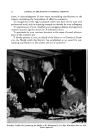
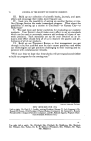
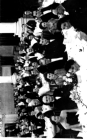
66 JOURNAL OF THE SOCIETY OF COSMETIC CHEMISTS honor, I want to assure all of you that I consider myself quite unworthy of it. However, since one cannot very well take issue with a fait accompli let me say, in all sincerity, that in accepting the medal I want it to be understood that I am sharing this honor with my former co-workers at the Lehn and Fink laboratories. Most of those with whom I have been associated during the greater part of my connection with the Company's research and development activities are still there. It is my sincere hope and wish that this moment may reawaken their awareness of a long period of fruitful accomplishment accruing to the benefit c•f their Company and to the prestige of the cosmetic industry. With your very kind permission I would like to mention these friends and co-workers here by name: in the chemical division, Lou Gates, Phil Cox, Jon Wolters, Fred Taylor, Jerry Compeau, Ed Tilly and Leo Forim in the bacteriological labora- tory, Mrs. Eleanor Wright and Dr. Shternov. On the administrative level I have been aided and abetted most effectively by Lillian Sippach and there is a very special niche in my heart for Moritz Dirtmar. I salute them here one and all. A cosmetic chemist cannot expect to operate successfully in the splendid isolation of the laboratory. He needs and he benefits by the guidance of those in the sales, advertising and publicity fields who are in the logical position of feeling the pulse of the market, its demands and its trends. In turn the experts in these latter fields frequently seek the chemist's help in laying down ideas from which develop eventually the all-important sales appeals designed to draw the ultimate consumer's attention to the product. It would be impossible for me to name all those in the fields named with whom I have had the good fortune to collaborate both within the Company and outside of it, over a period of years. However, I assure you that I remember gratefully all these men and women whose intelligent and con- structive approach to problems of mutual interest has been to me a source of constant and deep satisfaction. And last but not least, I want to pay my sincere tribute to the captain of the team, Lehn and Fink's president Dr. Edward Plaut whose foresight, wisdom and determination I never ceased to admire over the years of my association with the Company. To the extent that all these good people have inspired me to do the things for which you are honoring me tonight, I want them to feel that the honor is theirs, too. • The rules of the Medal Award require the Medalist to present a paper upon a subject relevant to the interests of this Society so I am compelled to ask your kind indulgence while I am discharging this obligation. I have always been intrigued in the borderline contacts between cosmetics and other specialties such as dermatology, endocrinology, bacteriology, and others. This is why in the following paper I propose to illustrate some of these contacts, thereby hoping to persuade the respective specialists to

A WALK IN "NO-MAN'S LAND" 67 "eavesdrop" upon each other's work to an even greater extent than has been the case up to now. Without in the least desiring to minimize the role of the cleansing, conditioning, and make-up preparations in the cosmetic picture, I feel that true scientific developments will continue to come from these borderline territories. Perhaps they will come slowly and laboriously but their results promise to be dramatic. And so I would like to entitle my remarks upon the subject chosen: A WALK IN "NO-MAN'S LAND" By EMiL G. KL^UM^NN, D.Sc., ?ice-President, in charge of Technical Services, Lehn & Fink Products Corp., New York 22, N.Y. FRoM times immemorial, almost up to the beginning of the present cen- tury, the bulk of cosmetic preparations served substantially the purpose of covering the skin with pigment and color. The application of such make- up was carried out twenty centuries ago with the same intention as pro- fessed in a modern piece of advertising copy, viz., "to impart a glow to the skin." Ovid, the Roman poet who lived at the turn of the era says it this way in his Ars Amatoria: "Sanguine quae veto non tuber, arte tuber" which could be translated freely to read "Art will impart a glow to the com- plexion if real blood won't do it." This does not mean, of course, that the Roman woman of Ovid's days was not familiar with what we would call today a line of treatrr ent cosrr etics, compounded from more or less rational formulas. Parenthetically speaking, even the virtues of lanolin were known then as shown by Ovid's reference to "oesypum" described as the "juice drawn from a sheep's unwashed fleece." But again bridging a gap of twenty centuries, Ovid's dictum as to the eventual effect of age upon the complexion has had considerable validity until quite recently. In his poem "De Medicamine Faciei" he has this to say, with lofty resignation: ................ Formam populabitur aetas, Et placitus rugis vultus aratus erit. Tempus erit, quo vos speculum vidisse pigebit, Et yenlet rugis altera causa dolor. Sufficit, et Iongum probitas perdurat in aevum. Perque suos annos hinc bene pendet amor. ("Age will ravage beauty, and the lovely face will be ploughed by wrinkles. The time will come when it will hurt you to look in the mirror, and the resulting grief will become a second cause of wrinkles. But goodness suffices and long endures, and love thrives upon it through the years to come.")
Purchased for the exclusive use of nofirst nolast (unknown)
From: SCC Media Library & Resource Center (library.scconline.org)