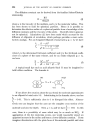
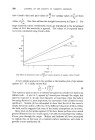
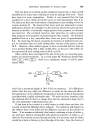
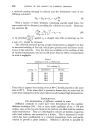
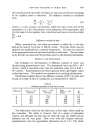
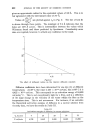
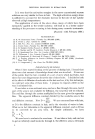
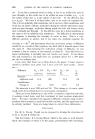
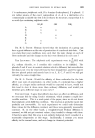
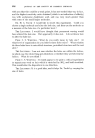
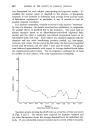
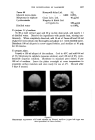
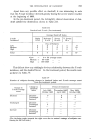
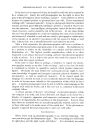
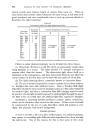
DIFFUSION PROCESSES IN HUMAN HAIR C is azobenzene psulphonic acid, D is 4-amino-2-nitrophenol, E is phenol. I am rather unsure of the exact composition of A--it is a derivative of a commercially available dye but I do not know its structure, except that it is an acid dye containing sulphonic acids. A B C D E F G SO3H OH x x x x NH2 DR. H. G. TROTU: Herman showed that the ionization of a group can have a great influence on the rate of penetration of a molecule into hair. Can you state that your conditions were such that the ionic charge on each of these molecules and the charge on the hair were identical in each case ? N THE LECTURER' The sulphonic acid experiments were in ]-• HC1 with 2% sodium chloride, so I consider this condition to be fulfilled. The phenols D and E were in neutral solution which is different, but nevertheless the data is not very far removed from the best straight line, and if we ignore the two phenol points and merely base it on .4, B, C, F and G we still get virtually the same straight line. DR. H. G. TROTH: Would the affinity of these molecules for the hair affect your rates of penetration in other words, if a molecule has a higher affinity, as a larger radius molecule would be expected to have, would not this tend to slow it down more than ordinary diffusion, and would you therefore get a different slope on your curve ? THE LECTURER: I agree that affinity does have an effect on diffusion, and we overcame this by using Crank's treatment, which assumes a rapid irre- versible reaction. This is a weak point of the paper, since we do not know that sulphonic acids fulfil this condition. The reaction is probably rapid, but probably not irreversible. In each experiment we could only determine three values for the diffusion constant, and these were generally reasonably constant. If, on the other hand, a straightforward Fickian diffusion is assumed, we did not get constant values they tended to change with time. I therefore agree that this area is not entirely foolproof, but I consider it a reasonable compromise at this stage. Incidentally, I assume you mean affinity in the normal sense, and not change in chemical potential.

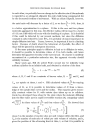
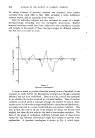
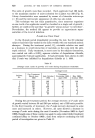
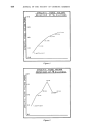
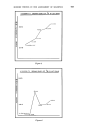
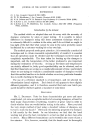
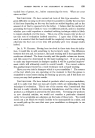
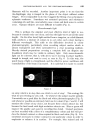
606 JOURNAL OF THE SOCIETY OF COSMETIC CHEMISTS DR. H. G. TROTH: Yes, you are right. You referred to a paper by Her- man where the fibres are stained with iodine, and where the penetration of reducing agents, in particular thioglycollic acid, is observed. I was very interested in this and had a look at it. By observing the ends of cut fibres, I found that they penetrate much faster along the length of the fibre than from the surface of the fibre through the fibre. Does this not indicate that there was a diffusion barrier, which had been removed by cutting it off at the end ? THE LECTURER: It might also indicate that the fibre is anisotropic, and since we know it is anisotropic, this is hardly surprising. A membrane is not the only explanation for this phenomenon. DR. J. BLAKE: I take it there is no direct experimental evidence, for example by low angle X-ray scattering, for the pore sizes postulated for dry and swollen hair ? THE LECTURER: Correct. DR. J. BLAKE: For what dye species were the data in Fig. 1 obtained ? Were they the same for Fig. 2 ? THE LECTURER: Fig. 1 was Crank's, who did not obtain any data at all-- he just worked it out mathematically. DR. J. BLAKE: Then you do not know if that equation is generally applicable for describing diffusion processes in hair and in wool. He did this for cellulose, did he not? THE LECTURER: No, he did not do it for anything. He just took a cylinder and said "this molecule is going to diffuse in, it is going to undergo rapid irreversible reaction, but otherwise it would undergo Fickian diffusion." What mathematical formulae fit this situation ? The one which I have quoted in the paper. Then he computed values for DT of varying reactivity ratios. a2 DR. J. BLAKE: I think your paper indicates that there is no effect of temperature on swelling and dyeing rates for hair and wool, and it is all activation energy. Is that right ? THE LECTURER: NO. I suggest that swelling is unimportant up to 60 ø, mainly because swelling does not occur. In fact it decreases at first and then increases slightly. This cannot therefore be the explanation of increased dyeing at 60 ø, as compared with 20 ø. There must be some other ,explanation, and I suggest that the activation energy of diffusion is such that it could provide some explanation of increased dyeing. MR. R. L. DAVIES: Have you been able to show any correlation between the size of holes found, and what I would call the condition of hair. Does
Purchased for the exclusive use of nofirst nolast (unknown)
From: SCC Media Library & Resource Center (library.scconline.org)