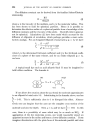
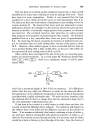
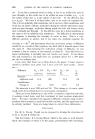
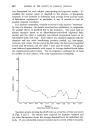
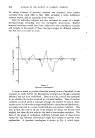
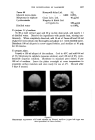
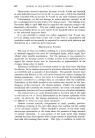
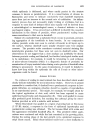
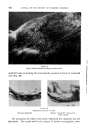
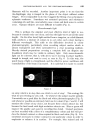
DIFFUSION PROCESSES IN HUMAN HAIR 599 Very few data are available on dye uptake by human hair, so that we find ourselves in the usual state of having to work by analogy with wool. There have been two main assumptions. Firstly, it was assumed that the hair consisted of a sieve which prevented access of molecules greater than 6 A. The idea arose from the observations of Speakman on the swelling of wool in various alcohols (7). He observed that when wool was immersed in water, methanol or ethanol, the strength was decreased by almost the same amount, whereas in alcohols of molecular weight greater than propanol, no decrease was observed. He concluded, therefore, that molecules of a radius greater than propanol were incapable of penetrating the fibre rapidly. He therefore predicted that in a dry, unswollen fibre, there are pores of approximately 6 A. By observing the elastic properties in mixtures of methanol and octa- nol, he calculated that in a fully swollen fibre, the size of the pores is about 35 A. However, other authors appear to have overlooked the fact that we are in general dealing with a fully swollen fibre, so the pore with which we are concerned (if such a thing exists) is 35 A, not 6 A. Other authors have investigated the size of the pore by observing pene- tration of coloured molecules. In a recent paper (8), Wilsmann showed that H•N••fiNHx/--•, which has a maximum length of 12.5 A, pene- trated, while CI- H,C • Ctta /JCHa • NH 2 which has a maximum length of 13.0 A did not penetrate. It is difficult to believe that the very slight size difference accounts for the observed effects. The appearance of the published photographs is typical of that of ring dyeing associated with a highly substantive dye. We may conclude, therefore, that the observed effect is due to a change from the less substantive basic dye to the very substantive triphenylmethane dye. If hair does in fact consist of a solid barrier in which there are holes, the amount of material diffusing will be reduced. The reduction will depend on the relative sizes of the holes and the diffusant, and also on the number of holes. If we assume an infinitely thin barrier containing n holes of radius r h per unit area, which is bombarded with spherical molecules of radius r d, in order for the molecule to pass through the hole, it is necessary that its centre should be at least a distance r d from the edge of the hole thus, the chance of

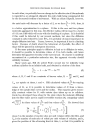
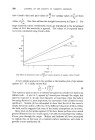
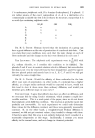
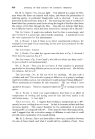
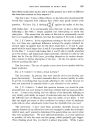
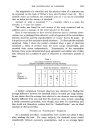
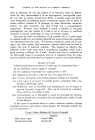
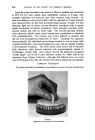
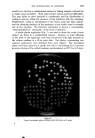
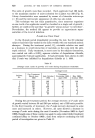
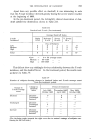
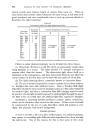
600 JOURNAL OF THE SOCIETY OF COSMETIC CHEMISTS a molecule passing through is reduced and the determined value of the diffusion constant is D H: D w n = (r h -- rd) 2 •w With a barrier of finite thickness containing parallel sided holes, the same result will be obtained, providing the collisions are elastic. Rearrang- ing equation (9), (DH _•H_ • • • •w n =2 = rh-- rd (10) so by plotting (D•)i against rs, a straight line with an intercept on the x axis of r h should be obtained. The observed increased dyeing at high temperatures is alleged to be due to increased swelling of the hair, which gives greater pores and hence easier access of the molecule. Very few data are available on the swelling of hair at various temperatures, but one set (9) shows that the effect of temperature in wool is negligible. Table I Swelling of wool at 100% R.H. Temp. o C 20 30 4O 5O 6O Vol. swelling % Southdown 35'7 33'1 32'5 33 '6 34 '8 Merinos 36.0 34.5 34.3 34-7 35.4 From this it appears that dyeing wool at 60 ø C should proceed at the same rate as 20 ø C. If the same effect is present in human hair, we must look for some other explanation of the observed increased dyeing at high temperatures. EXPERIMENTAL The determination of diffusion constant in water Diffusion constants in water have been determined by the capillary diffusion technique (10). One or more small capillaries (3 cm x 0.5 mm radius), open at the top and closed at the bottom, are filled with the solution under examination. They are centrifuged to remove air bubbles, topped up with fresh solution, and mounted in a holder. This is immersed in water which has been equihbriated in a constant-temperature bath, and gently rotated to provide a plane interface. Diffusion is allowed to proceed for
Purchased for the exclusive use of nofirst nolast (unknown)
From: SCC Media Library & Resource Center (library.scconline.org)