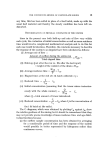
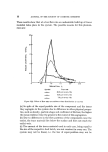
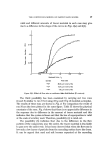
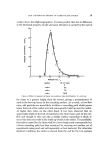
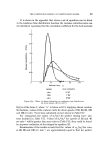
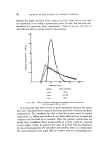
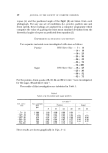
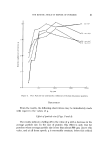
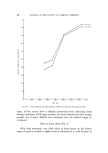
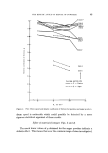
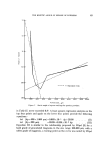
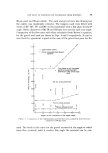
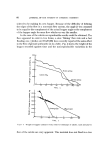
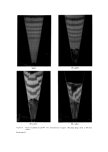
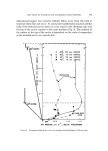
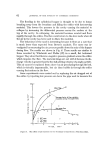
THE CONTINUOUS MIXING OF PARTICULATE SOLIDS 13 any time, this has been added in place of a feed batch, made up with the usual feed material and thereby the steady condition has been left un- disturbed. DETERMINATION OF PHYSICAL CONSTANTS OF THE SYSTEM Since in the present case both hold-up and rate of flow vary within each cycle, the evaluation of initial concentration as well as mean residence time would involve complicated mathematical analysis and to do this for each case would be laborious. Therefore, the constants necessary to describe the response of the system to an impulse have been calculated as follows: (i) Average rate of flow: Amount of outflow during the entire run = Vgs-1 Total elapsed time (ii) Hold-up (just after the run i.e. 10s after the last input) =weight of the content of the drum=H 10 H10 (iii) Average residence time -- _ --• 10 V (iv) Elapsed time at the end of i th batch collected=t i s (v) Reduced time -- tl -- t R }10 (vi) Initial concentration (assuming that the tracer mixes instantan- eously with the •vhole content) -- Q _ Co H10 where Q=total amount of tracer introduced. Ci (vii) Reduced concentration = C-- 7 =CR, where C i is the concentration of the i th batch at the outlet. The C-diagrams, which were obtained by plotting C• against t•, show the relative goodness of the mixing but it should be remembered that they may not provide precise knowledge of mean residence time and age distri- bution functions because {a) the outflow sample concentration has been obtained by averaging for a considerable period of time and the response of the system would possibly be better represented by histograms rather than continuous curves

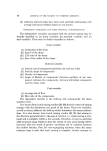
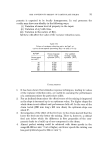
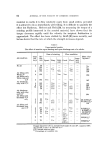
14 JOURNAL OF THE SOCIETY OF COSMETIC CHEMISTS lb) arbitrary reduced scales have been used and their relationship with average and mean residence times are not known. OPERATING VARIABLES AND SOME PHYSICAL CONSIDERATIONS The independent variables associated with the present system may be broadly classified as: (a) drum variables, (b) material variables and (c) feed variables. These may be further classified as [ollows: Drum variables (i) Inclination of the drum (ii) Speed of the drum (iii) L/D ratio of the drum (iv) Size of the outlet of the drum. Material variables (i) Particle size of components (absolute size and size ratio) (ii} Particle shape of components (iii) Density of components (iv) Angle of friction of components {between particles of one com- ponent, between the components, between individual components and the drum wall). Feed variables (i) Average rate of flow. (ii) Mix ratio of the components. The dependent variable is the hold-up and consequently the mean residence time. It is known from batch mixing studies (29, :30) that the extent of mixing changes with the inclination and speed of the drum. These two variables, as well as others, influence the hold-up which determines the mean residence time. It is also known from batch mixing studies (1t3, :31) that mixing in the direction perpendicular to the axis of rotation, i.e. radial mixing is very rapid and is complete within a few seconds. Therefore, it may be said that with increased mean residence time the extent of only axial mixing will be increased with the result of greater smoothing out of variation between the outflow batches. Now, for non-segregating mixtures, when the mean residence time is such that axial mixing is complete, further increase in
Purchased for the exclusive use of nofirst nolast (unknown)
From: SCC Media Library & Resource Center (library.scconline.org)