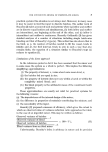
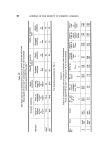
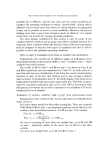
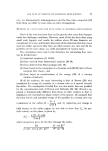
THE CONTINUOUS MIXING OF PARTICULATE SOLIDS 5 practical systems this situation is not always met. Moreover, in many cases it may be easier to feed the input in discrete batches. The earlier work of Beaudry (2) takes account of such real systems where (a) inflow and outflow are in discrete equal batches and simultaneous, (b) both inflow and outflow are intermittent, one beginning at the end of the other, and (c) inflow is intermittent and outflow is continuous. Recently Goldsmith (3) has given detailed analyses of a number of situations including simple batch-wise blending and that of Beaudry's type (a). This author has also shown that in the limit, as p, the number of batches needed to fill the vessel, tends to infinity and At, the feed interval, tends to zero in such a way that At p remains finite, the equation of a situation similar to Beaudry's type (a) reduces to equation {I). Limitations of the direct approach In the references quoted so far it has been assumed that the mixer and in some cases the system as a whole is perfect. This implies the following simplifying approximations: (i) The property of interest, x, varies about some mean level, u (ii) the batches fed are equal in size (iii) the property of interest does not vary within a batch or within the completely mixed blend and (iv) the blend property is the arithmetic mean of the constituent batch properties. These approximations are usually not valid for practical systems for the following reasons: (a) The imperfectness of the internal design of the mixer (b) the difference in properties of materials constituting the mixture and (c) the non-ideality of the input. Beaudry (2) proposed a measure of efficiency, which gives the extent to which an observed value of variance reduction ratio approaches the ideal, in the case of an imperfect mixer. This may be written as follows: Observed variance of batches 1 Observed variance of blend x 100-¾% (II) Observed variance of batches --1 Blend variance from an ideal mixer Unfortunately, Beaudry's index is arbitrary in nature and its precision

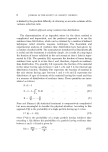
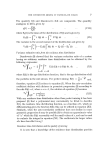
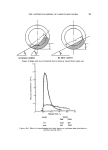
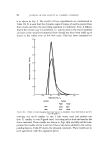
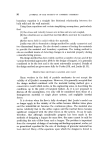
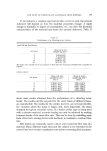
JOURNAL OF THE SOCIETY OF COSMETIC CHEMISTS is limited by the practical difficulty of obtaining an accurate estimate of the variance reduction ratio. Indirect approach using residence time distributions The characterization of an imperfect mixer by the direct method is complicated and impractical, and the preferred approach is to use the residence time distribution, which can be obtained by a number of indirect techniques called stimulus response techniques. The theoretical and experimental analyses of residence time distribution have been given by a number of authors (4-6). The nomenclature introduced by Danckwerts (5) is useful and the treatment is relatively simple. As a result of a step input the fraction of tracer exhibited in the exit stream at time t later is repre- sented by F(t). The quantity F(t) represents the fraction of tracer having residence time equal to or less than t and, therefore, depends on residence time distribution. The quantity Idt represents the fraction of the material in the mixer having ages between t and tq-dt, and I is the internal age distribution function. Similarly Edt represents the fraction of material in the exit stream having ages between t and tq-dt and E represents the distribution of ages of elements of the material leaving the vessel and thus is a measure of distribution of residence times. These quantities are inter- related as follows: F+I=I (III) E dt ...... (IV) E- dF__ dl dt -- d--[' ...... (V) Naor and Shinnar's (6) statistical treatment is comparatively complicated but more meaningful to describe the physical situation. According to this approach F(t) is the probability of a single particle having age t or less. F* (t): 1--F(t) ...... (VI) where F*(t) is the probability of a single particle having residence time exceeding t. f(t) defines the probability of a particle having residence time between t and t q-dt and is given by f(t) = .dF(t) _ dF*(t) (VII) dt dt
Purchased for the exclusive use of nofirst nolast (unknown)
From: SCC Media Library & Resource Center (library.scconline.org)