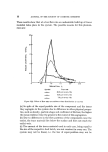
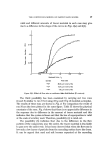
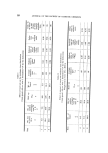
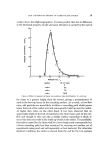
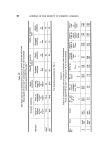
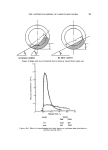
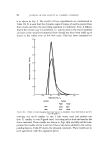
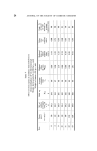
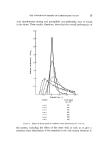
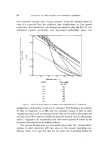
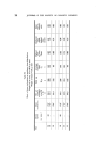
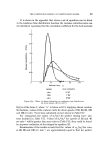
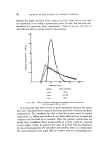
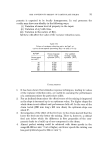
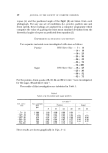
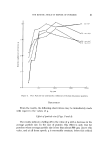
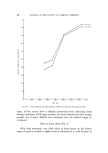
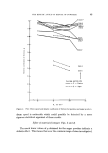
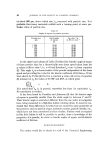
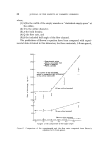
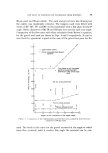
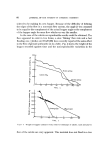
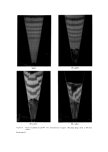
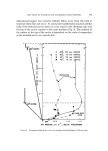
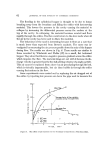
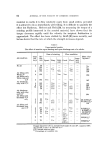
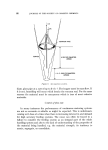
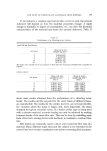
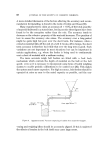
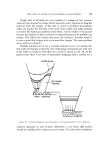
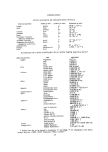
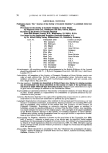
THE CONTINUOUS 3{IXING OF PARTICULATE SOLIDS 23 However, there is no reason to suppose that this segregation occurs only near the outlet rather it is likely that similar segregation extends to the entire length of the drum and the final extent of build up is greater the higher the mean residence time. Therefore, possibility (b) superimposed upon possibility (a) could account for the discrepancy shown by the curves in Figs. $(a) and 3(b). In any case, these experiments lead to the conclusion that the lowest flow rate used should not be so low that it prevents outflow from an ap- preciable depth of the material bed in the drum. Effect of speed of rotation of the drum on the residence time distribution (components having equal particle size) In this set of experiments the speed of rotation of the drum was varied and other variables were held constant. The results are shown in Fig. 7 and the physical constants are sum- marized in Table V. It is seen, in general, that there are definite time delays in the response to the impulse and that mixing in the axial direction is limited. But with increasing speeds the time delay decreases and the extent of axial mixing increases. For low speeds the high concentration of the tracer at its initial position is shown by the high peak in the C-diagrams (Fig. 7) but as speed increases the peak reduces and the material is distributed both in the forward and backward directions. At speeds over 60 rev min-l it is seen that though the time delay decreases with further increase of speed there is a slight tendency in the peak to increase. These results are in agreement with the findings and explanations of Roseman and Donald (30) that at high drum speeds the extent of mixing decreases. The cumulative residence time distributions, F(z) for results corres- ponding to Fig. 7 have been calculated and 1--F(z) has been plotted against z in Fig. 8. It is seen that while results at speeds 50, 80 and 100 rev min-1 give straight lines on semi-logarithmic scales lower speeds do not. A noticeable departure from the straight line relationship is also seen at a speed of 120 rev min- 1. These results show that at speeds 80-100 rev min- 1 the mixing is as if ideal with a lag in response and the F function can be given by the following relationship: t-L F(t) -• 1--e •0 ...... (XIV) However, from the physical point of view it is not reasonable to imagine that in these cases the contents of the drum at any moment are perfectly mixed it is more likely that the system at any speed is subject to plug flow

24 JOURNAL OF THE SOCIETY OF COSMETIC CHEMISTS
Purchased for the exclusive use of nofirst nolast (unknown)
From: SCC Media Library & Resource Center (library.scconline.org)