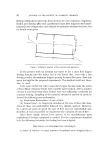
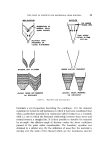
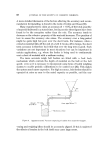
THE FLOW OF PARTICULATE MATERIALS FROM HOPPERS 71 (31) Colijn, H. and Chase, P. x,V. Paper presented at 17th Annual Iron and Steel Conference, Pittsburgh, (15 March 1967). (32) Lowe, E. I. Trans. Inst. Chem. Engrs., 411 T.206 (1965). (33) Richards, ]. C. Ed. The storage and recovery of particulate solids (1966) (Inst. Chem. Engineers, London). DISCUSSION MR. L. B^T•s: This paper clearly shows the effect of pressure variation in inter- stitial air and the impact of hopper design on feeder performance. It is not common practice to utilise open orifices as finely calibrated feed rate controllers because, although superficially attractive, there are various objectsions. 1. The feed rate is difficult to predict with accuracy, as confirmed by the choice of answers from available formulae. 2. The rate is rarely dependably stable. 3. The rate is highly sensitive to fine changes in orifice size or material character- istics. 4. Orifices of sufficient size to ensure that flow blockages do not occur due to bridging or structural arching effects usually pass far greater quantities of material in free discharge conditions than are generally required at fine rates of control. 5. Core flow hoppers due to the flow patterns and segregational characteristics do not favour uniform discharge conditions. Mass flow hoppers, which are still com- paratively rare, are not easily varied in orifice size without jeopardizing the mass flow characteristics. •Vhere feeders of the volumetric type are fitted it is still important to secure consistent conditions of flow as variations in pressure at the entrainment point have been shown {26) to influence the state of compaction and hence the output rate. The air feed technique described is most interesting and appears to be very effective in certain cases. To some extent this may indicate the basic difficulty of searching for a simple relationship of discharge rate to a few material and hopper parameters. Could we not expect that all factors which influence the powder con- dition and stress variations through the bulk solid in the container, when filling static and flowing, will have some bearing on the eventual floxv rate at discharge? •Vill this not lead to such a state of complexity that a general solution will not only be difficult to find but meaningless as a particular rate will be related to a unique set of conditions ? Regarding the accuracy of feeding devices, it is my experience that economic circumstances often preclude adequate technical consideration of the study and testing of individual feeding problems. Although it is so often the core of a process operation or major production expense, there is frequently a reluctance to face the existence of a difficult problem because the task can be so simply defined and often deals with trivial rates which can be the most difficult to accommodate. T• L•ca'umm: I fully agree with you. MR. M. A. R•x•': In Fig. I the material in the hopper is shown with a flat surface. In practice this is difficult to attain.

7•2 JOURNAL OF THE SOCIETY OF COSMETIC CHEMISTS 'I'HE LECTURER: In a practical hopper with a single pour point, the material forms in a heap and segregation occurs, the larger material tending to concentrate at the walls of the hopper. In a mass riow hopper, however, the material shears at the walls and moves down as a plug, the effect being to offset the effect of segregation, since material is removed uniformly from all parts of the cross-section of the hopper orifice. The effectiveness of a mass flow hopper in preventing segregation is very clearly demonstrated by a film called 'The Million Dollar Rat Hole', by U.S. Steel. The effect of segregation and heaping on filling a hopper can be overcome by using a rotating pour point. The material surface will not be as flat as shown in Fig. 1, which was drawn purely to show the differences between mass flo•v and non-mass flow. MR. A. H. BIRKS: I think that Mr. Rahman was concerned about the definition of mass flow. People who are not falnilar with mass flow could be misled if you have a criterion--this level surface--for characterising mass flow. This surface only remains level in the vertical section of a mass flow hopper and as it moves into the convergent section you get a velocity profile and a dipping of the surface in the centre. People who are not used to mass flow might confuse this with the coring type of flow associated with non-mass flow. T•v. LECTURER: It is difficult for me to agree precisely where the surface shows this dipping characteristic you mention, since it is my experience that it depends on the size of the equipment and material being examined. Free flowing materials tend to dip higher up in the cone than the more cohesive ones. It is possible to get a velocity profile even in the vertical section of a small hopper, especially with free flowing materials due to the effects of wall friction. In a larger hopper, say 1.Sm diameter, the effect is not noticeable and with cohesive materials you do not get a dipping of the surface until it has moved down •-•- of the conical section. MR. A. H. Bin}cs: There is a lot of experience that shows that the level surface breaks up at entry to the conical section The exact position may depend on the hopper and the type of materials, but people who use much smaller hoppers and probably hoppers with no vertical section, may find the point about this level surface misleading. DR. M. AltSIAD: The flow of fine material has been shown to be improved by passing air into it. The change in flow rate may not be entirely due to balancing out the negative pressure gradients but also due to the enormously decreased inter- particulate forces. Would you like to comment? T}tE L•:c'rURER: I think in the case of materials which are free flowing, cohesion- less materials, the effect of air is solely to overcome the negative pressure gradient at the orifice. The effect of air in cohesive materials is somewhat different. It appears that the main effect is to separate the particles, thereby lowering the forces between them making the powder compact weaker. The effect of pressure gradients on the macro- scale in such materials is difficult to assess as the materials are relatively impermeable and it is difficult, at the present time, to see how fluid pressure can be transmitted.
Purchased for the exclusive use of nofirst nolast (unknown)
From: SCC Media Library & Resource Center (library.scconline.org)