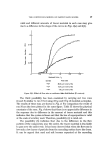
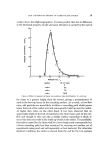
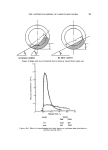
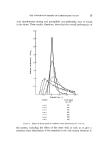
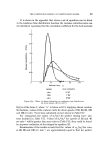
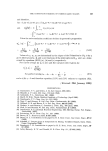
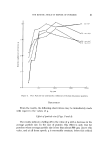
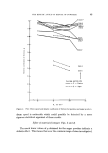
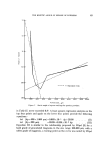
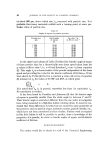
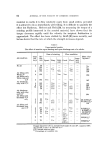
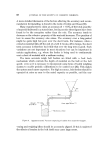
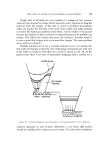
THE KINETIC ANGLE OF REPOSE OF POWDERS 49 to particle-particle forces. However, thc range of angles covered in Fig. 7 is quite small, just over 3 ø . It would therefore be interesting to concentrate on the size range below 180 gm, to establish how this curve progresses. DR. T. M. JONES: Have you any data on the effect of interparticulate forces on the angles outlined in this paper? T}•: L•,CTVRER: No. DR. T. M. JoNEs: If the value for the 180 gm fraction is ignored in Fig. 7 it can be seen that the variation in angie of repose is about 1 o. Was the shape of the par- ticles in each fraction identical? If not, could this not explain this variation? In addition, it can be shown that a loss of one particle from the apex of a cone of particles with a size 1 000 tun may produce an error in measured angle of several degrees. You do not state which method of Trains you have used. 'rue LEC•rURER: It is a poured angle of repose and exactly as described by Pilpel (3). Four readings were taken of each angle of repose and the repeatability was excellent, the mean average deviation never exceeding 0.$ ø. For the mean angles of repose the same sample was used each time for each of the four readings in each size range I have no doubts about this curve. DR. T. M. ]o•s: I was wondering about the differences excluding that 180 gm point, all your differences are of the order of •--1 ø. This is very small when you consider a 2 000 gm particle. I am wondering whether that shape is possibly an important variable in Fig. 77 Tu• L•CTURER: It may be, but 1 do not think so. We separated the pumice by a normal sieve analysis taking samples out of each sieve we did not analyse the particle shape. MR. J. E. B•,•C•URN: Could we establish the size of the problem'caused by the difference between taking into account the static angle of repose and the kinetic angle of repose, i.e. what is the error by assuming a static angle in the whole of the drier? T• L•CtURER: The formula for the drum holdup is given elsewhere {2). It is directly related to the flight holdup, and it makes allowance for the variations in the kinetic angle of repose. The kinetic angle of repose of, say, pumice, is of the order of 48 ø or higher, at the commencement of cascade. The static angle of repose is much lower. The relevant area for this difference calculation would be that bounded by these two angles in the flight. The static angles are of the order of $0ø•so it is quite a sizeable area. To take 30 ø instead of the current 45 ø would mean something near a $$«% error in the design holdup calculation. A MEMBER OF •'mZ AUmENCE: I would like to question the wall effects of your apparatus the ratio of the flight to particle size seems quite high. T}•E LEC•U•: In fact, it is not very large, about 20:1. In packed distillation columns, etc. 8:1 or 12:1 are accepted to miniraise wall effects. TUE s• M•BER OF T• AUDieNCE: You can not really compare packed distillation columns with moving particles in flights.

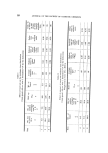
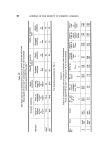
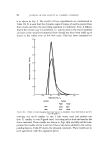
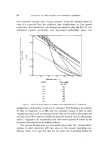
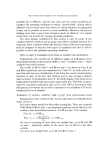
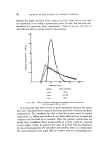
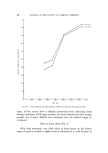
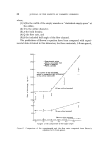
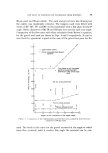
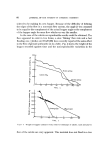
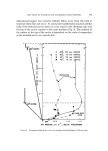
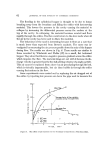
50 JOURNAL OF THE SOCIETY OF COSMETIC CHEMISTS THE LECZURER: Agreed, of course, but it is important to realise that the particles are not moving in the flight until they reach the top surface, i.e. until the granules staffc to roll. THE SaME MEMBER or THE AUDIENCE: I disagree very profoundly. The movement of the particles will go down a large number of layers. THE LECTURER: It may go down a little of course, but the bulk of the particles will be stationary. We have a film somewhere to support me on this point. Equation I is based on this assumption and whilst there is a certain movement in the particles below the top rolling layers to a depth of perhaps one or two particles, the bulk of the particles do not move until they reach the top. THE SaME MEMBER OF ZHE AUDIENCE: This is precisely my point because the wall affects the particles in the same way that they would on a much larger scale. ANOTHER MEMBER OF THE AUDIENCE: I would like to comment on Dr. Jones's contribution. I think it is very dangerous to compare results with two different kinds of material, especially when one is magnesium. What is this magnesium? Our labor- atory found that magnesium can differ considerably from manufacturer to manu- facturer, although having the same particle size. It depends on the previous history of the surface, on moisture, etc. What are the interparticulate forces xvhich Dr. Jones talked about? Is this due to moisture capillary attraction? I would suggest that the differences in characteristics between particles of these sizes are remarkably small and the effects are mainly due to moisture and to the fact that the particles hook together. The following written communication was subsequently received from Professor H. E. Rose: This paper is particularly interesting in that it suggests a means by which the dynamical friction characteristics of powders may be investigated a field of work in which but few simple experimental techniques are available. As stated in the synopsis, the investigation relates to the determination of the kinetic angle of repose of materials in the flights of rotary drums and this aim is achieved. In this connection it should be noted that the kinetic angle of repose is a function of the frictional properties of the powder (which properties can probably, at least approximately, be characterised by the static angle of friction) and of the dynamics of the system--such as the size and speed of rotation of the drum. Thus, whether the kinetic angle of friction so obtained is applicable to cases such as the flow from hoppers is questionable, and attempts to use the data in such a way would imply a reckless disregard for the laws of mechanics. With reference to .Fig. 5, would it not be expected that for zero speed of rotation {N=0) the kinetic angle of friction would correspond to the static angle? This does not appear to be the case and it would be interesting if the reason for this difference could be explained..Fig. 7 is as expected. For particle size below about 500 gm the cohesive forces increase rapidly with decreasing particle size and so the static angle of repose increases rapidly with decreasing size. This can be very important because, for example, with Portland
Purchased for the exclusive use of nofirst nolast (unknown)
From: SCC Media Library & Resource Center (library.scconline.org)