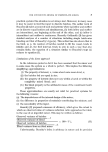
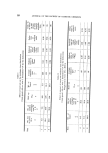
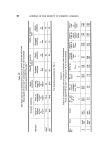
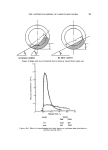
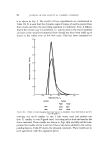
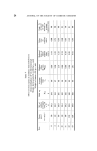
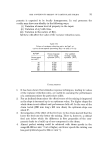
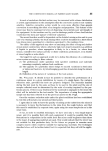
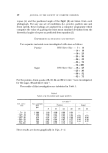
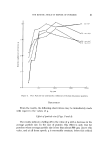
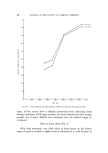
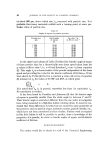
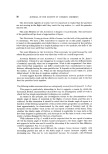
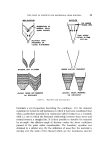
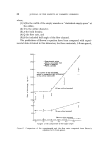
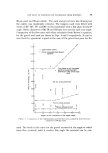
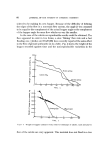
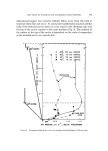
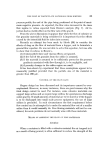
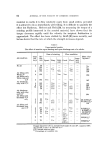
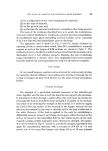
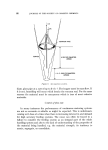
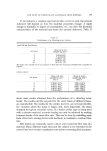
THE CONTINUOUS MIXING OF PARTICULATE SOLIDS ponents is expected to be locally homogeneous. In real processes the results may show non-ideality in the following ways: (i) Variation of mean level of property in the input. (ii) Variation of ,i2 with time. (iii) Variation in the nature of R(r). All these will affect the value of the variance reduction ratio. Table VII Values of variance reduction ratio, Go2/{Ji 2, at various drum speeds (assuming R(r):a r and a=0.11) {•o2/Gi 2 Drum speed rev rain- 1 50 60 80 100 120 From response curve using equation (XIV) 0.140 0,074 0.073 0.077 0,088 For perfect mixing using equation (XII) 0.070 0.072 0.070 0.074 0.075 CONCLUSIONS 1. It has been shown that stimulus response techniques, leading to values of the variance reduction ratio, are useful in assessing the performance of a continuous mixer for particulate solids. 2. For an inclined drum mixer the effectiveness of the mixing is improved as the slope is increased up to an optimum value. For higher slopes the whole drum is not utilised and performance falls off. In the case of the drum tested (200 mm long x 100 mm diam) the optimum slope was about 3 ø . 3. Investigation of the effect of the feed rate to the drum showed that the -lower the feed rate the better the mixing. There is, however a critical feed rate below which the difference in flow properties of the com- ponents leads to a build up of one component in the drum. 4. Almost perfect mixing could be achieved with drum speeds in the range 60-100 rev rain- • but at higher, and lower speeds the mixing was less good (critical speed is 134 rev min- •).

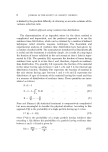
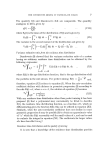
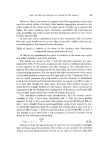
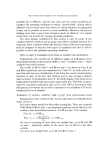
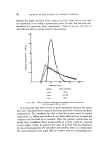
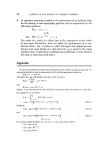
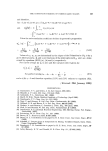
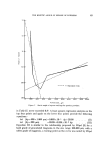
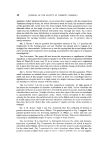
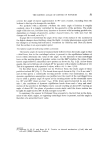
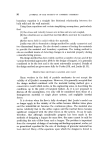
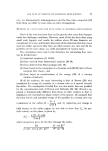
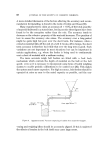
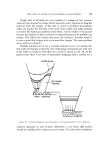
32 JOURNAL OF THE SOCIETY OF COSMETIC CHEMISTS , At optimum operating conditions the performance of an inclined drum for the mixing of non-segregating particles can be represented by the following equations: F(t) =0 t • t--lg and F(t)=l-k l0 t e The value of e, which is a delay time in the appearance in the outlet of any input fluctuation, does not affect the performance of a con- tinuous mixer. For a system in which the input and output are con- tinuous and equal during any time interval, i10 is equal to the mean residence time. Under these conditions the performance of the drum is the same as that of an ideal mixer. Appendix It has been pointed out that the F-function of the results in type (a) and (b) for a given time interval can be represented by the following general equation: F(t) = 1--e--n (t--•) Therefore the age distribution function, E(t), becomes: d F(t) E(t) dt ne--n(t--e) and E (t + r) = ne--n (t + where r is an interval of time less than the total time interval considered. Therefore, the integral I l (r) becomes: II(r) ::•2 E(t)xE(t+r) dt X• •--•nt e-n•r[e-2n•(xfer) --e-2tl•(x2-efi] ...... (XIIIa) Similarly, 12(r) =•n 2e-n2r[e-2n 2(x2-e2) --e-2n2fx3-e2)] .... (XIIIb) and 13(r) =.•n3 e-n3r[e-2n3(x•-e3)--e-2n 3(x4-e• )] .. and so on. By solving equations XIII (a), (b) and (c) with appropriate limits I • (r) ---- •11 • ae-*l • r 12(r) = •n 2 [•e -n 2 r • •(r) = .•n • ¾e-n .• r .. (XIIIc)
Purchased for the exclusive use of nofirst nolast (unknown)
From: SCC Media Library & Resource Center (library.scconline.org)