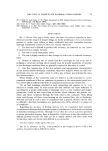
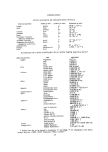
THE KINETIC ANGLE OF REPOSE OF POWDERS 47 Department Workshop of University College Dublin, without whose help this work would not have been possible. {Received: loth January 1969) REFERENCES (1) Schofield, F. R. and Glikin, P. G. Trans. Inst. Chem. Eng., London, 40 183 (1962). (2) Kelly, J. J. and O'Donnell, J. P. Proceedings of the Tripartite Chemical Engineering Conference, Montreal (1968), Session 14 (to be published by the Institution of Chemical Engineers). (3) Pilpel, N. Brit. ½hem. Eng., 11 699 (1966). (4) Porter, S. J. Trans. Inst. Che•n. Eng., London, 41 272 (1963). (5) Franklin, C. and Johanson, L. M. ½hem. Eng. Sci., 4 119 (1955). (6) Train, D, J., Pharm. P/•armacol., 10 127T (1958). SYMBOLS USED dp average particle size in micrometres (gm) g acceleration due to gravity (m s-2) r drum radius (m) N drum speed (rev s-•) Greek 0 angle defining position of particle on drum circumference (degrees) kinetic angle of repose of powder in flight attached to drum circumference (degrees) g kinetic coefficient of friction (dimensionless) u ratio of centrifugal to gravitational forces =re)2 g-• e) speed of rotation (rad s-•) gm micrometres Subscripts st static (angle of repose) k kinetic (angle of repose at 0=90 ø or 270ø). DISCUSSION MR. L. BATES: This work certainly shows the massive change of character of powders over a narrow range of size below this range the forces are cohesive. I think it is generally agreed that the term "angle of repose" ceases to have any real meaning, but nevertheless under dynamic conditions an equilibrium is obtained. In this range there is considerable evidence that the condition of the ambient fluid occupying the voids have some influence on the behaviour, and the effects of different gases and different air temperatures on the dynamic behaviour of granules has been demon- strated. From this, one would think that any study of such fine powders in driers would be strongly affected by the temperature difference and one would have to redress the effects and try and simulate the temperature of the ambient fluid. T•E LECTURER: The point made with references to driers and the effect of tem- perature, etc. in the angles of repose, is a valid and important one. This paper, however,

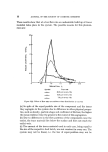
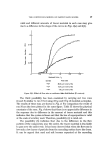
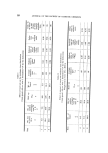
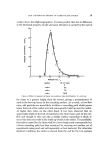
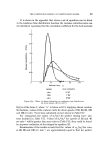
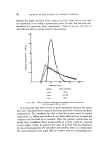
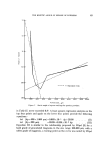
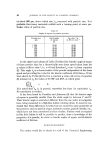
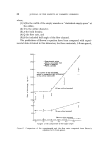
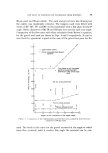
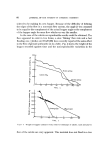
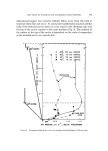
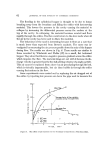
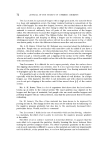
48 JOURNAL OF THE SOCIETY OF COSMETIC CHEMISTS presents a rather idealised situation in an actual drier, together with the temperature variations along the drum, for which allowances must be made, the moisture content of the powders also varies down the drum length. Both these parameters have con- siderable effect on the angle of repose, on the cohesive forces and therefore on the value of g, the coefficient of friction will indeed vary through the drum. In a rotary drum in which the same distribution is required along the whole length of the drum, it is necessary to vary the flight profile in steps or gradually within the drum, making allowances for varying moisture contents, temperatures, etc. In practice, this is rarely necessary. MR. L. BATES: I wish to question the regression analysis of Fig. 7. I question the implication of the turning point and ask whether one should seek to regress to a straight line characteristic. Is there not a case for saying that the actual shape of the curve at that point may have more meaning, and should be the subject of a separate investigation? THE LECTURER: The paper did not stress the importance or significance of these equations. I attempted these analyses simply to see if the derived equations resembled those of Pilpel {•l) in any way. It is, of course, very easy to carry out a regression analysis on scattered data and to get a nice equation which does not mean an awful lot. I agree that this area, where the curve shows a definite change of direction, merits further work to find out what exactly is going on in there. MR. L. BATES: There is also a minor point in connection with the apparatus. Where small containers are rotated about a cylinder two effects result, that of the cylinder itself and that of the sample container. The ratio of these two centrifugal forces is significant as one gets down to a single mixer or a single container where the contents are tending to rotate in contact with the surface. THE L•CTURER: I do not accept this comparison completely. At high speeds of the drum the assumption of dynamic equilibrium is not valid. At low velocities the particles roll down on a static bed below towards the point of cascade, whereas at high velocities this is not true. At high velocities, when the value of the ratio of centrifugal to gravitational forces approaches unity, which would correspond to the critical velocity for the drum, the particles tend to stay in the flights and do not cascade at all. It would appear from the results that this situation commences to occur at values for this ratio above 0.4. Below this value equation I applies and the whole situation is changed. DR. T. M. JONES: Table I and Fig. 8 indicate that the coefficient of friction of pumice decreases for sizes below 500gm. The graph presented as Fig. 7 suggests that particle-particle forces are becoming significant at 180•m, i.e. below this size one might expect an increase in the coefficient of kinetic friction. This can be illustrated by measuring a consolidated angle of repose or angle of static friction. THE LECTURER: It is important to distinguish between the static and dynamic behaviour of powders. Fig. 8 represents the dynamic situation, for which it may be noted that below 500gm, the flow properties of the powder improve quite dramatically. On the other hand, Fig. 7 represents the static situation, where below 500 gm the powders sustain a higher static angle of repose, which is possibly due, as you suggest,
Purchased for the exclusive use of nofirst nolast (unknown)
From: SCC Media Library & Resource Center (library.scconline.org)