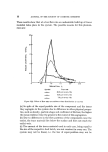
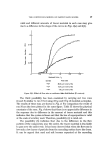
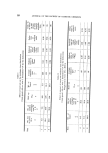
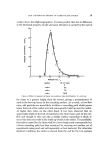
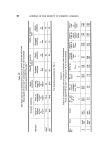
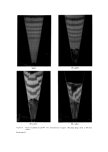
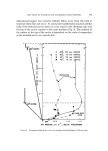
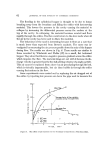
J. Soc. Cosmetic Chemists 9,1 37-51 (1970) ¸ t97o Society of Cosmetic Chemiats of Gre,,t Britain The kinetic angle of repose of powders j. j. KELLY* Presented at the sy•nposimn on "Powders", organised by the Pharmaceutical Society of Ireland and the Society of Cosmetic Chemists of Great Britain, at Dublin, on 17th April 196,9. Synopsis--The factors which contribute to the KINETIC ANGLE OF REPOSE of POWDERS in the flights of ROTARY DRUMS are experimentally investigated. The results, presented graphically, show the effects of PARTICI,E SIZE, DRUM SPEED and the •naterial type on the kinetic angle of repose. MEASUREMENTS of the STATIC ANGLE OF REPOSE are also taken and correlations with the particle size are statistically derived. Comparisons are made between the static and kinetic angles of repose. COOLING-DRYING INTRODUCTION The final stages of the manufacturing processes for many granular chemical products often involve a drying or cooling stage. In the heavy chemical industry, such as fertiliser manufacture or sugar production, these operations are commonly carried out in a rotary drum process, whereby the granules or powders are brought into contact with either cooling 'or drying gases for a fixed period of time. The drum is mounted at a slight angle ( 6 ø normally) to the horizontal and has lifting flights running lengthwise on the inside surface of the drum circumference. The purpose of the flights is to improve the gas/solid contact by lifting the granules into the upper half of the drum and cascading them downwards across the flow- ing gas stream. The granules to be processed are fed continually to the higher end of the drum, whence, due to the angle of the drum, together with the lifting action of the flights, the granules progress through the drum length to the lower end where they exit suitably processed. *University College, Dublin, Ireland. Now at College of Engineering, University of Maryland, College Park 20742, U.S.A. 37

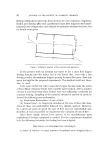
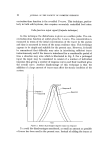
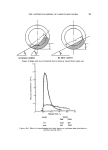
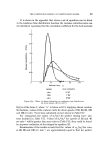
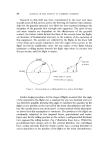
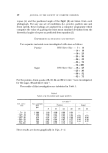
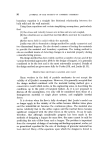
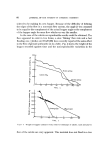
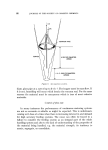
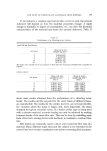
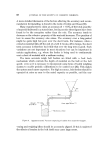
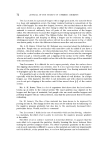
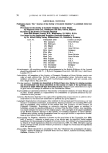
38 JOURNAL OF THE SOCIETY OF COSMETIC CHEMISTS Research in this field has been concentrated in the heat and mass transfer areas of this process and in the deriving of residence time relation- ships for the granular material very little has been reported relating to the dynamics of the granular flow through such apparatus. The rates of heat and mass transfer are dependent on the effectiveness of the gas/solid contact the factors which dictate the form of the cascade from the flights are therefore of fundamental relevance to the analysis of the operation of this equipment. The powders are collected by the flights in the lower half of the drum and cascade commences once the angle of the powder in the flight exceeds its equilibrium value the top surface of the flight holdup maintains a rolling motion towards the flight edge where it cascades into the gas stream, until the flight is empty. 8=180 ø 8=9o o Kinetic angle of repose. Forces acting on a granule. Figure 1. Forces acting on a rolling particle in a rotary drum flight. Earlier design procedures for the shape of flights assumed that the angle of the material in the flight xvas a constant for any one material and so it was therefore possible, knowing this angle, to calculate the quantity in the flight at any position on the top half of the drum circumference and there- fore the cascade rate at any drum speed. A closer analysis of this phenomen- on shows that this assumption is erroneous. The powders in the flight are continually subjected to two imposed forces, gravitational and centri- fugal, and, for the rolling powders on the surface, a self-generated frictional force opposes this rolling motion. Fig. 1 illustrates these forces. Whilst the gravitational force always acts in the vertical direction, the centrifugal force, acting outwards from the drum's centre, has a varying direction of action dependent on the position of the flight on the drum circumference
Purchased for the exclusive use of nofirst nolast (unknown)
From: SCC Media Library & Resource Center (library.scconline.org)